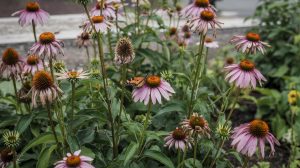
Bare winter gardens are a design choice, not a requirement. Evergreen shrubs hold structure, color, and texture through every season, doing the heavy lifting that flowering perennials simply can't manage in January.
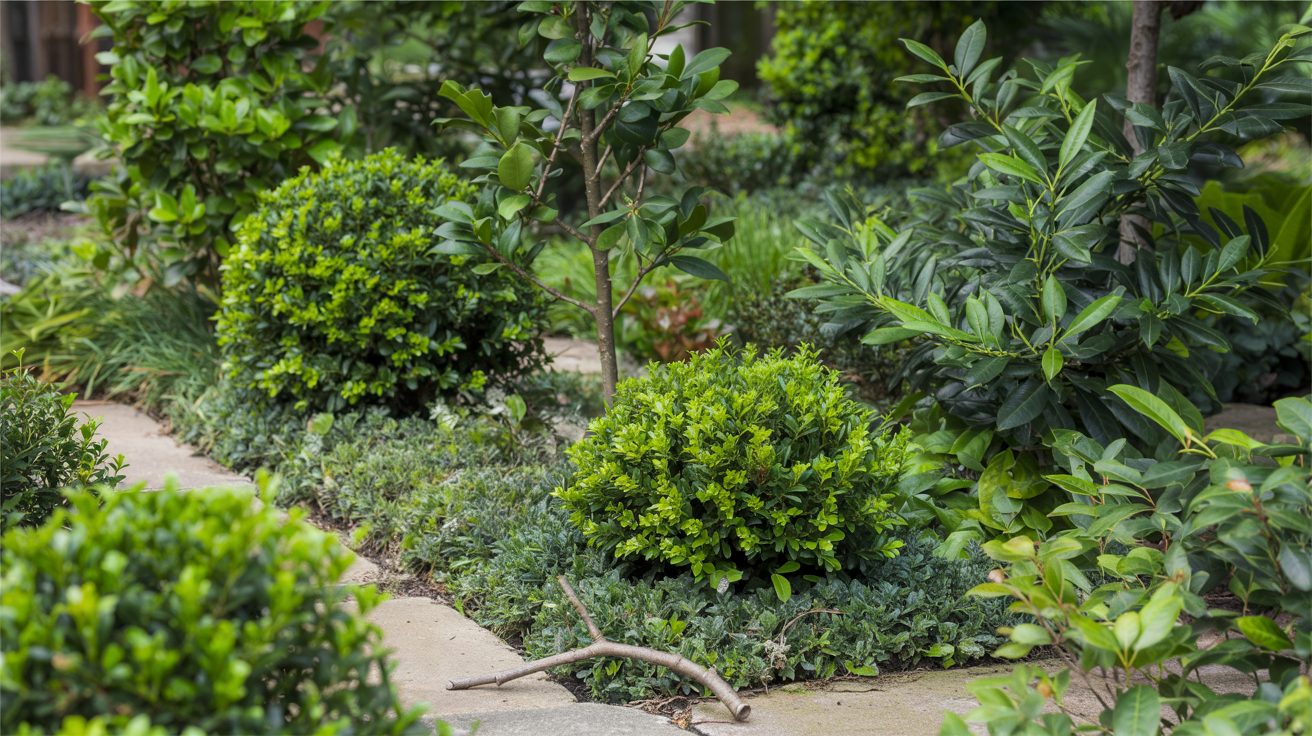
Whether you need a clipped hedge, a foundation anchor, or a low-maintenance groundcover, there's an evergreen that fits the spot.
This guide covers 12 evergreen shrubs sorted by use case — hedges, shade gardens, groundcovers, and flowering specimens. We flag zone ranges, sun needs, and spacing so you can match plant to place before you buy.
Evergreen Shrubs for Hedges and Screens
A good hedge shrub needs dense branching, tolerance for pruning, and reliable foliage in winter. These four deliver all three, with different size and zone trade-offs worth knowing before you dig.
Remember it later
Planning to try this recipe soon? Save it for a quick find later!
English Boxwood
Zone 5–9 Medium
Buxus sempervirens is the classic formal hedge - dense, slow-growing, and responsive to hard shaping. It handles pruning down to 6 inches without complaint, which is why it's been a garden staple for centuries.
Before planting, managing boxwood blight risk starts with good air circulation and avoiding overhead watering in humid summers.
- Growth rate: Slow - expect 3-6 inches per year depending on cultivar and soil fertility.
- Blight risk: Highest in zones 6-8 during wet summers; 'NewGen' series offers better resistance.
- Best use: Formal knot gardens, low edging borders, and tightly clipped foundation rows.
English Laurel
Zone 6–9 Easy
Prunus laurocerasus grows fast enough to build a privacy screen in 3-4 years, which is a major advantage over slower hedging options. The 'Otto Luyken' cultivar stays compact at 3-6 feet with nearly horizontal branching, while 'Schipkaensis' pushes 6-12 feet for taller screens.
For homeowners building a yard screen, laurel is worth considering alongside arborvitae.
- Shade tolerance: Performs in deep shade - one of the few large-leaved shrubs that does.
- Maintenance: Cut back hard in late winter; avoid light trimming that shreds the big leaves.
- Caution: Seeds and leaves are toxic to livestock - avoid near pasture fences.
Holly 'Compacta'
Zone 6–9 Easy
Ilex crenata 'Compacta' passes for boxwood at a glance but skips the blight issues, making it a reliable swap in humid climates. The small, glossy leaves give a tidy texture that clips cleanly into formal shapes.
Plant one male per five females if berry production matters - berries appear on female plants only.
- Berry color: Black, not red - subtle winter interest rather than showy display.
- Soil: Prefers slightly acidic pH 5.5-6.5; alkaline soils cause yellowing leaves.
- Container use: Dwarf forms work well in large pots on patios through zone 7.
Viburnum tinus
Zone 7–9 Easy
Viburnum tinus earns its place by flowering in late winter - white clusters open from pink buds while most shrubs are still dormant. Blue-black fruit follows in spring, giving birds an early food source.
It's one of the few winter-blooming shrubs that also forms a dense, informal screen at 4-8 feet.
- Coastal use: Handles salt spray and sea winds better than most broadleaf evergreens.
- Pruning window: Trim right after flowering ends to avoid cutting next season's buds.
- Cold limit: Most strains fail below 0°F; look for 'Bewley's Variegated' for marginal zone 6 trials.
English laurel and Ilex crenata both resemble boxwood in texture, but they have opposite soil pH preferences. Laurel tolerates neutral to slightly alkaline soils; Japanese holly needs acidic conditions. Test your soil before substituting one for the other.
Evergreen Shrubs for Shade Gardens
Deep shade doesn't mean bare ground. Several evergreen shrubs not only survive but look their best away from direct sun, making them ideal for north-facing beds, woodland edges, and under tree canopies.
Japanese Yew
Zone 4–7 Easy
Taxus cuspidata handles conditions that eliminate most competing shrubs - deep shade, salt spray, and cold down to zone 4. Dwarf forms stay 2-4 feet for 20+ years, making them genuinely low-maintenance once established in well-drained soil.
The only hard requirement is drainage; standing water kills yew faster than shade or cold ever will.
- Deer resistance: Low - deer browse yew heavily in winter when other food is scarce.
- Toxicity: All parts except the red aril are toxic to humans, pets, and livestock.
- Establishment: Slow the first two seasons; don't judge mature habit from young plants.
Mountain Laurel
Zone 4–9 Medium
No native North American shrub puts on a spring flower show like Kalmia latifolia. Buds are geometric and intricate - the plant looks ornamental before a single flower opens.
It's a strong candidate for wildlife-friendly native plantings under oak or pine canopy where the soil stays acidic and lean.
- Soil pH: Needs pH 4.5-5.5 - add sulfur to lower pH in neutral beds before planting.
- Light: Morning sun with afternoon shade is ideal; deep shade reduces flowering significantly.
- Size range: Compact cultivars like 'Minuet' top out at 3 feet; species plants hit 10 feet in 20 years.
Rhododendron
Zone 5–8 Medium
Large-leaved evergreen rhododendrons offer the biggest flower trusses of any shade shrub - clusters 6-8 inches across in late spring, in colors from white through deep purple.
Cultivar selection by zone matters more here than with almost any other shrub on this list. 'PJM' handles zone 4 winters; 'Catawbiense Album' is reliable through zone 5 without special siting.
- Leaf curl: Leaves roll inward in hard freezes - this is a stress response, not damage.
- Root depth: Shallow fibrous roots; mulch 3-4 inches deep and never cultivate beneath the canopy.
- Deadheading: Snap off spent trusses before seed set to push stronger flowering next year.
Oregon Grape
Zone 5–8 Easy
Mahonia aquifolium fills the gap that few shrubs manage: dry shade under mature trees. Spiny, holly-like leaflets turn bronze-red in winter before flushing green again in spring.
Bright yellow flowers appear in February or March, earlier than almost anything else in the garden, feeding early pollinators when little else is open.
- Fruit: Purple berries ripen by June and attract birds; edible but very tart fresh off the plant.
- Spread: Slowly spreads by suckers to form colonies - useful for erosion control on slopes.
- Pruning: Cut the oldest canes to ground level every 3 years to keep plants compact and vigorous.
Mountain laurel and rhododendron both span zones 4–9 in catalogs, but specific cultivars vary by up to two zones in cold hardiness. Always buy from a source that lists the individual cultivar's hardiness, not just the species range.
Flowering Evergreen Shrubs
These shrubs carry real ornamental weight through their blooms - not just structure. They need slightly more specific siting than the hedge types, but the winter-to-spring flower display justifies the extra care.
Camellia
Zone 7–9 Medium
Camellia japonica blooms from November through March depending on cultivar, filling the exact gap in the garden calendar when almost nothing else flowers. Glossy, dark leaves look polished year-round.
Zone 6 gardeners can trial cold-hardy selections like 'Korean Fire' or 'Winter's Star' with east-facing placement that protects buds from early morning freeze-thaw cycles.
- Bloom protection: Late freezes after buds open will brown flowers - plant where morning sun hits slowly.
- Soil: Same acidic, well-drained requirements as rhododendron; pH 5.0-6.5 is the target range.
- Container option: Large containers let zone 6-7 gardeners move plants to shelter during hard freezes.
Pieris japonica
Zone 5–8 Easy
New growth on Pieris japonica flushes bright red or bronze in early spring, a color effect that reads almost like a second bloom. Pendant white flower clusters hang from branch tips from February to April, overlapping with the colored new growth for a two-layered display.
It's a reliable four-season shrub - structure in winter, flowers and foliage color in spring, clean green through summer and fall.
- Pest note: Lace bugs cause stippled, pale leaves in summer - treat with neem oil at first sign.
- Companion planting: Works well next to rhododendron and mountain laurel sharing the same acidic bed.
- Height control: Remove spent flower clusters and any wayward stems immediately after bloom ends.
Camellia and pieris both prefer morning sun with afternoon shade. In zones 7–8, an east-facing wall with good soil drainage creates near-ideal conditions for growing both in the same bed, extending your flowering sequence from February through April without any gaps.
Low-Growing Evergreen Shrubs and Groundcovers
Not every evergreen needs to be waist-high. These low-growers solve real landscape problems - slopes, hot dry strips, and spaces where low-maintenance groundcover outperforms turfgrass or mulch alone.
Juniper 'Blue Rug'
Zone 3–9 Easy
At 6-12 inches tall with a spread of 6-8 feet, Juniperus horizontalis 'Blue Rug' covers ground faster than almost anything else in this list. Blue-gray foliage intensifies to a soft purple in winter, giving genuine cold-season color.
It's fully drought-tolerant after the first season, deer-resistant, and handles poor, sandy, or rocky soils without complaint.
- Slope use: Deep roots stabilize banks and dry slopes where irrigation is impractical.
- Sun requirement: Needs full sun - shaded plants thin out and lose the signature blue color.
- Spacing: Plant 5-6 feet apart; plants fill in completely within 3-4 years.
Dwarf Hinoki Cypress
Zone 4–8 Easy
Chamaecyparis obtusa 'Nana' grows roughly an inch per year, which sounds frustrating until you realize a 15-year-old plant still fits a container or small border without any pruning. The foliage arranges itself in flat, fan-shaped sprays with a deep, almost lacquered green that holds all winter.
Root rot from waterlogged soil is the one reliable way to kill it - raised beds or mounded planting areas solve this in clay soils.
- Mature size: 2-3 feet tall and wide after 10 years; 4-6 feet after 20+ years.
- Texture contrast: Pairs well with ornamental grasses or broad-leaved shrubs for strong foliage contrast.
- Container lifespan: Stays container-happy for 8-10 years before needing to move to ground.
'Blue Rug' juniper and dwarf Hinoki cypress both have low water needs once established, but they have opposite drainage tolerance profiles. Hinoki cypress is extremely sensitive to wet feet; juniper tolerates dry, compacted soils that would stress the cypress significantly.
Evergreen Shrub Quick Comparison
Choosing between similar-looking shrubs is easier with side-by-side data. This table covers the key decision points for all 12 picks at once.
| Shrub | Zone | Sun | Height | Best Use |
|---|---|---|---|---|
| English Boxwood | 5–9 | Full sun–part shade | 2–6 ft | Formal hedge |
| English Laurel | 6–9 | Full sun–deep shade | 3–12 ft | Privacy screen |
| Holly 'Compacta' | 6–9 | Full sun–part shade | 3–6 ft | Boxwood substitute |
| Viburnum tinus | 7–9 | Full sun–part shade | 4–8 ft | Coastal screen |
| Japanese Yew | 4–7 | Deep shade–part sun | 2–8 ft | Shade hedge |
| Mountain Laurel | 4–9 | Part shade | 4–10 ft | Woodland edge |
| Rhododendron | 5–8 | Part–dappled shade | 3–12 ft | Specimen plant |
| Oregon Grape | 5–8 | Part shade–shade | 3–6 ft | Dry shade fill |
| Camellia | 7–9 | Part shade | 6–12 ft | Winter bloomer |
| Pieris japonica | 5–8 | Part shade | 4–8 ft | Spring color |
| Juniper 'Blue Rug' | 3–9 | Full sun | 6–12 in | Slope cover |
| Dwarf Hinoki Cypress | 4–8 | Full sun–part shade | 2–6 ft | Container/border |
Winter Performance: What These Shrubs Actually Do in Cold Months
Calling a shrub "evergreen" tells you about leaf retention - it says nothing about how interesting the plant looks in February. This is worth thinking through before you plant a bed that needs to carry visual weight through winter.
Some shrubs hold flat, unchanging color all season. Others shift dramatically.
Knowing which category each falls into helps you plan a planting that earns its space year-round, not just in May.
- Color shifters: 'Blue Rug' juniper turns blue-purple in cold; Oregon grape goes bronze-red; both recover to green by spring without any damage.
- Active bloomers: Viburnum tinus opens white flower clusters in January-February; camellia blooms November through March depending on cultivar.
- Structural standbys: Boxwood, yew, holly 'Compacta', and dwarf Hinoki cypress hold static form and color all winter - reliable backdrops, not focal points.
- Leaf response to cold: Rhododendron leaves roll tightly in hard freezes and unfurl when temperatures rise - unsettling if you haven't seen it before, but not harmful.
For a bed that reads well in January, pair at least one active bloomer with one color-shifting groundcover and two or three structural evergreens. That combination gives foreground movement, mid-ground color, and background structure simultaneously.
Pairing garden plants by winter behavior rather than just bloom season produces beds that look intentional twelve months a year.
Which Evergreen Shrub Fits Your Situation?
Most planting mistakes come from choosing a shrub by appearance at the nursery rather than matching it to actual site conditions. Use these scenarios to narrow down fast.
- Cold climate, deep shade: Japanese yew in zones 4-7 is the most reliable option; tolerates root competition under large trees better than broadleaf shrubs.
- Humid South, no blight risk: Holly 'Compacta' replaces boxwood in zones 6-9 with similar texture and none of the fungal vulnerability.
- Dry, sunny slope: 'Blue Rug' juniper covers ground in zones 3-9 with zero supplemental irrigation after year one.
- Winter flower display: Camellia in zones 7-9 or viburnum tinus in zones 7-9 - both bloom when the garden calendar is otherwise empty.
- Acidic woodland garden: Mountain laurel, rhododendron, and pieris share the same soil pH range and look cohesive planted together in dappled light.
- Fast privacy screen: English laurel 'Schipkaensis' grows 12-18 inches per year and tolerates heavy pruning once at the target height.
- Small space or container: Dwarf Hinoki cypress grows roughly an inch per year - genuinely low-maintenance in a container for a decade before needing to move to ground.
If you're working with a site that gets fewer than 4 hours of sun and you need a screen taller than 6 feet, English laurel is the only shrub on this list that meets both conditions reliably.
For everything else, matching soil pH to plant requirements matters more than any other single factor in long-term success.
Frequently Asked Questions
Japanese yew (Taxus cuspidata) handles deep shade in zones 4–7 better than almost any other evergreen shrub, while Oregon grape manages dry shade in zones 5–8 where even yew struggles with competition from tree roots.
Holly 'Compacta' holds black berries through winter in zones 6–9, but requires one male plant per five females to produce fruit reliably; viburnum tinus produces blue-black berries in spring rather than winter.
Spacing depends on the shrub: plant English boxwood 18–24 inches apart for a dense formal hedge, English laurel 3–4 feet apart for a screen, and 'Blue Rug' juniper 5–6 feet apart for full groundcover within 3–4 years.
Dwarf Hinoki cypress stays container-viable for 8–10 years given excellent drainage; boxwood and holly 'Compacta' both work well in large pots but need one zone more protection than their listed in-ground hardiness suggests.
Pin it for your next evergreen shrubs: best varieties and growing tips project.