Most gardens hit peak color in June and fade by August - but a well-planned fall border can outshine summer entirely. The right mix of late-season bloomers keeps pollinators fed, fills gaps left by spent perennials, and carries real color right up to hard frost.
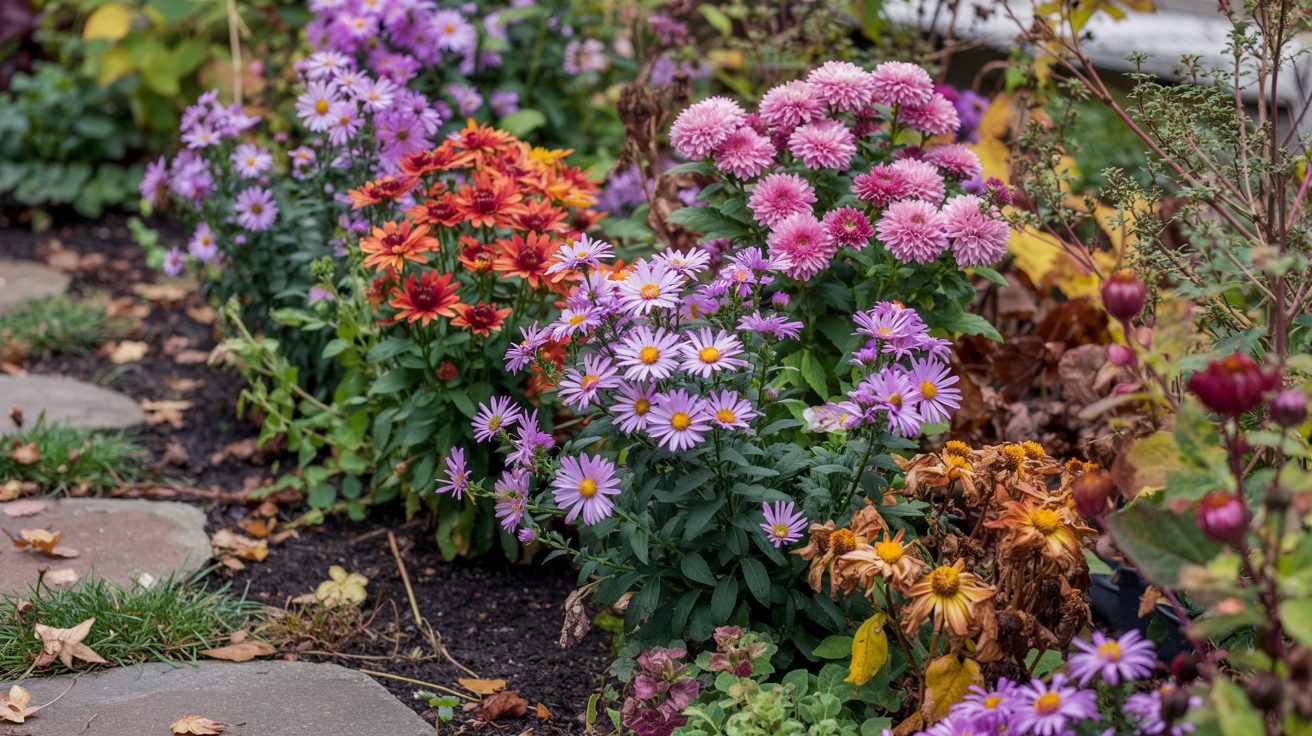
Twelve fall-blooming flowers — from hardy perennials like asters and sedum to frost-tender dahlias and tithonia — can fill your garden with color from late August through October. Match plants to your USDA zone, first frost date, and sun exposure for best results.
Perennials for Fall Color
Perennial fall bloomers cost more upfront but return every year with minimal effort. Planting them 6-8 weeks before your first frost date gives roots time to establish before the ground freezes.
Remember it later
Planning to try this recipe soon? Save it for a quick find later!
New England Aster
Zone 4-8 Easy
Symphyotrichum novae-angliae 'Purple Dome' is the workhorse of the fall perennial border. Dense, 2-3 inch purple daisy flowers peak mid-September through October, and the compact mounded habit rarely exceeds 24 inches without pinching.
- Pinching: Cut stems back by one-third in late June to prevent legginess and encourage branching before bloom.
- Frost tolerance: Handles light frost well - blooms persist after temperatures dip to 28°F overnight.
- Pollinators: One of the top late-season nectar sources for migrating monarchs and native bees.
Gardeners looking to add purple-toned blooms late in the season will find 'Purple Dome' hard to beat for sheer coverage.
New York Aster
Zone 4-8 Easy
Symphyotrichum novi-belgii 'Fellowship' produces pink-lavender sprays with a later, longer bloom window than New England types. It handles heavier clay soils that would waterlog other asters.
- Deadheading: Removing spent flowers every 10 days extends bloom into late October.
- Height: Stays 18-30 inches - useful as a mid-border filler without staking.
- Soil: More tolerant of poorly drained sites than most asters.
Sedum 'Autumn Joy'
Zone 3-9 Easy
Hylotelephium telephium 'Herbstfreude' earns its place through four full seasons of interest. Flat flower clusters open dusty pink in September and slowly dry to a rich rust that holds through winter.
- Drought tolerance: Established plants need water only during prolonged dry spells - once every 2 weeks in summer suffices.
- Structure: Leave dried seed heads standing through winter for architectural interest and bird feed.
- Spread: Clumps expand slowly; divide every 3-4 years to keep them vigorous.
Cut sedum stems back to 6 inches in early May if you want a shorter, more compact plant by fall. Skip that cut and you'll get taller, slightly looser flower heads by September.
Helenium 'Moerheim Beauty'
Zone 4-9 Medium
Copper-gold daisy flowers with swept-back petals and rich brown centers - Helenium 'Moerheim Beauty' looks like summer stubbornly refusing to leave. Blooms run from late August through September and into October in cooler regions.
- Flopping: Plant in full sun with lean soil; too much nitrogen causes stems to flop by September.
- Deadheading: Removing spent blooms every week prolongs the display by 3-4 weeks.
- Companions: Pairs naturally with ornamental grasses and cooler blue-toned flowers for contrast.
Rudbeckia 'Goldsturm'
Zone 3-9 Easy
'Goldsturm' carries one of the longest bloom windows on this list - from late July all the way through October in most zones. Yellow petals around coarse black centers are virtually indestructible in heat and drought.
- Maintenance: Light deadheading keeps foliage tidy, but leaving seed heads standing feeds goldfinches through November.
- Spread: Self-seeds moderately; thin seedlings in spring if clumps expand past 24 inches.
- Drought: Once established, survives 3-4 weeks without rain in zones 5-7.
Japanese Anemone 'Honorine Jobert'
Zone 4-8 Medium
Few fall perennials offer the airy elegance of Anemone hupehensis var. japonica 'Honorine Jobert.' Tall, wiry stems carry single pure white flowers above bronze-green foliage from late August through October.
- Shade tolerance: Performs well in partial shade - ideal under deciduous trees where little else blooms in fall.
- Spread: Spreads by rhizome; give it room or install a root barrier at planting.
- Establishment: Slow to establish in year one; give it 2 full seasons before judging its performance.
Goldenrod 'Fireworks'
Zone 3-9 Easy
Solidago rugosa 'Fireworks' produces arching golden plumes in September and October that explode outward like - well - fireworks. Unlike common goldenrod, this cultivar stays in a neat vase shape and spreads far less aggressively.
- Height: Reaches 30-48 inches; use at the back of a border behind shorter asters.
- Pollinators: Attracts dozens of native bee species during peak bloom in September.
- Allergy note: Goldenrod pollen is insect-carried, not wind-dispersed - it does not cause hay fever.
Goldenrod and asters are natural companions — their bloom times overlap almost perfectly, and purple-and-gold combinations attract significantly more pollinators than either plant alone.
Toad Lily
Zone 4-9 Medium
Tricyrtis hirta 'Samurai' blooms later than almost anything else on this list - mid-October into November in zones 6-7. Spotted, orchid-like flowers in white and purple appear on arching stems in deep shade where most fall color is absent.
- Soil: Requires consistently moist, humus-rich soil; add 3 inches of leaf mold at planting.
- Wind: Shelter from strong wind, which shreds delicate petals within a day or two.
- Pairing: Combines well with ferns and hostas - all three share the same moisture and shade requirements.
Montauk Daisy
Zone 6-9 Easy
Nipponanthemum nipponicum is a true October bloomer - it rarely opens before the first week of the month. Large white flowers with yellow centers sit above glossy, semi-evergreen foliage that looks good even when nothing is blooming.
- Coastal tolerance: Handles salt spray and wind better than any other plant on this list.
- Pruning: Cut back hard in late spring (to 6 inches) or plants become woody and sparse by fall.
- Foliage: Stays semi-evergreen in zones 7-9, giving winter interest beyond the bloom period.
Annuals and Tender Perennials for Fall Color
Annual and tender options trade longevity for intensity. They bloom harder and longer than most perennials, and some - like dahlias - keep going right until a killing frost ends the show.
Garden Chrysanthemum
Zone 5-9 Easy
Commercial garden mums (Chrysanthemum morifolium) deliver the densest September-November color of anything on this list. The key distinction: hardy garden-type cultivars labeled for your zone can overwinter; florist mums sold in pots typically cannot.
- Planting time: Set out in mid-August for best establishment before bloom; later than September 1 limits root development before frost.
- Pinching: Stop pinching by August 1 - any later removes developing flower buds.
- Overwinter: In zones 5-6, mulch crowns with 4 inches of straw after the first hard frost for best survival rates.
Tithonia (Mexican Sunflower 'Torch')
Annual Easy
Nothing in the fall garden competes with tithonia for sheer orange impact. 'Torch' grows 4-6 feet tall and produces vivid tangerine flowers continuously from midsummer right up to the first hard frost.
- Heat tolerance: Performs best in hot, dry summers - poor drainage or rich soil causes rank growth and fewer blooms.
- Butterflies: Consistently ranked as a top butterfly plant; growing it from seed like sunflowers indoors 6 weeks before last frost gives a head start.
- Frost: Dies at the first hard frost (28°F or below) - pull and compost immediately.
Dahlia
Zone 8-11 Medium
Semi-dwarf dahlias like 'Bishop of Llandaff' produce sculptural, deep-red blooms with near-black foliage from late August until frost kills the top growth. No other annual delivers such variety in form and color for fall.
- Tuber storage: In zones 3-7, dig tubers after the first light frost, dry for 2 weeks, then store in barely damp peat at 40-50°F.
- Feeding: Apply a low-nitrogen fertilizer (5-10-10) every 3 weeks from July onward to maximize bloom count.
- Staking: Taller types over 36 inches need a stake set at planting - waiting until the plant falls over causes root damage.
Dahlias and chrysanthemums sold as "patio pots" at grocery stores in September are rarely rooted deeply enough to survive transplanting to the garden. Buy them early in August or start your own from tubers or cuttings for best results.

How These Varieties Compare?
Choosing between these plants often comes down to zone, sun availability, and whether you want to dig tubers or divide clumps. This table puts the most important traits side by side.
| Plant | Zone | Sun | Bloom Months | Height |
|---|---|---|---|---|
| New England Aster | 4-8 | Full sun | Sept–Oct | 24–36 in |
| Sedum 'Autumn Joy' | 3-9 | Full sun | Sept–Nov (dry) | 18–24 in |
| Helenium | 4-9 | Full sun | Aug–Oct | 24–36 in |
| Rudbeckia | 3-9 | Full sun | July–Oct | 18–30 in |
| Japanese Anemone | 4-8 | Part shade | Aug–Oct | 36–48 in |
| Toad Lily | 4-9 | Full shade | Oct–Nov | 18–30 in |
| Dahlia | 8-11* | Full sun | Aug–frost | 24–48 in |
| Tithonia | Annual | Full sun | July–frost | 36–72 in |
*Dahlia tubers lifted in zones 3-7 and stored over winter.
How to Extend Fall Blooms Into November?
Most gardeners lose fall color at the first light frost when they don't have to. A few targeted steps can push color 3-4 weeks further than an untended garden.
Understanding your local first frost date is the starting point - check the USDA frost map or your county extension office for average dates by zip code. The seasonal planting guides for your region will list these alongside planting windows.
- Deadhead selectively: Remove spent flowers on chrysanthemums, helenium, and New York asters every 7-10 days to trigger new bud formation. Skip deadheading on rudbeckia and goldenrod - seed heads feed birds.
- Row cover: A single layer of frost cloth over tender dahlias and tithonia can protect blooms through light frosts down to 28°F for several extra weeks.
- Avoid late fertilizing: Stop nitrogen feeding by September 1 - pushing new green growth in fall makes plants more vulnerable to the first cold snap.
- Cut back neighbors: Trim back summer perennials that have gone to seed around your fall bloomers so they're not competing for light as days shorten.
In zones 8–9, fall bloomers like montauk daisy and toad lily regularly carry color into December. Zone 3–4 gardeners should focus on the hardiest options — rudbeckia, goldenrod, sedum, and New England aster — which all handle frost far better than the rest of this list.

Which Fall Bloomer Should You Plant?
The right plant depends on your sun exposure, soil, and how much maintenance you want to commit. Here are the clearest decision shortcuts.
- Full sun, zero maintenance: Rudbeckia 'Goldsturm' or Goldenrod 'Fireworks' - both thrive on neglect and return reliably for a decade or more.
- Shade garden, something unusual: Toad lily fills the October gap in shady borders with flowers unlike anything else in the garden.
- Biggest visual impact fast: Tithonia 'Torch' or dahlias - both are annuals or semi-annuals that bloom harder than any perennial on this list.
- Coastal or exposed site: Montauk daisy handles salt spray and wind better than asters or chrysanthemums.
- Pollinator focus: Plant New England aster alongside goldenrod - that pairing supports more native bee species than any other fall combination.
- Cold climate (zone 3-4): Stick with sedum, rudbeckia, goldenrod, and New England aster - all rated to zone 3 and reliably perennial without protection.
Gardeners who want a soft lavender palette in fall should combine New York aster 'Fellowship' with Japanese anemone 'Honorine Jobert' - the pink-lavender and white tones work together without competing.
For gardeners already thinking past fall, planning now for cold-season blooms after frost can keep something going in milder zones (7-9) even in December and January.
Getting Deadheading Right for Fall Bloomers
Deadheading is the single most effective technique for stretching fall bloom, but the timing and method differ by plant. Knowing when to remove spent flowers correctly prevents accidentally cutting off next week's buds.
Japanese anemone requires a slightly different approach: cut the entire flowering stem to the base once all buds on that stem have opened and faded. New stems from the same crown will often follow in mild falls, especially in zones 6-8.
The Japanese maple's peak fall color in late October often coincides with toad lily and montauk daisy bloom - combining these creates layered fall interest across multiple heights without any one plant dominating.

Frequently Asked Questions
In zone 5, reliable fall bloomers include New England aster 'Purple Dome,' Rudbeckia 'Goldsturm,' Sedum 'Autumn Joy,' and hardy chrysanthemum cultivars labeled zone 5 — all peak between September and late October before hard frost ends the season.
Plant fall-blooming perennials in spring (April–May) or at least 6 weeks before your average first frost date in late summer — this gives roots 4–6 weeks to establish before bloom demands peak energy from the plant.
Cover frost-tender plants like dahlias and tithonia with a single layer of frost cloth during light frosts (28–32°F) to extend blooms 2–3 weeks; in zones 7–9, toad lily and montauk daisy bloom naturally into November without any protection.
New England aster 'Purple Dome' stays compact at 24 inches and clumps slowly, but species asters can self-seed aggressively — deadhead promptly after bloom in October to prevent unwanted seedlings the following spring.
Garden mums, compact dahlias like 'Bishop of Llandaff,' and dwarf asters all perform well in containers at least 12 inches deep; water container plants every 2–3 days in September since pots dry out faster than in-ground beds.
Pin it for your next fall blooming flowers: best varieties and growing tips project.