Spring gives you a narrow window to stop crabgrass before it ever breaks the soil. Miss that window, and you'll spend the rest of the season hand-pulling clumps, spot-treating patches, and watching the weed reclaim bare ground faster than your lawn can recover.
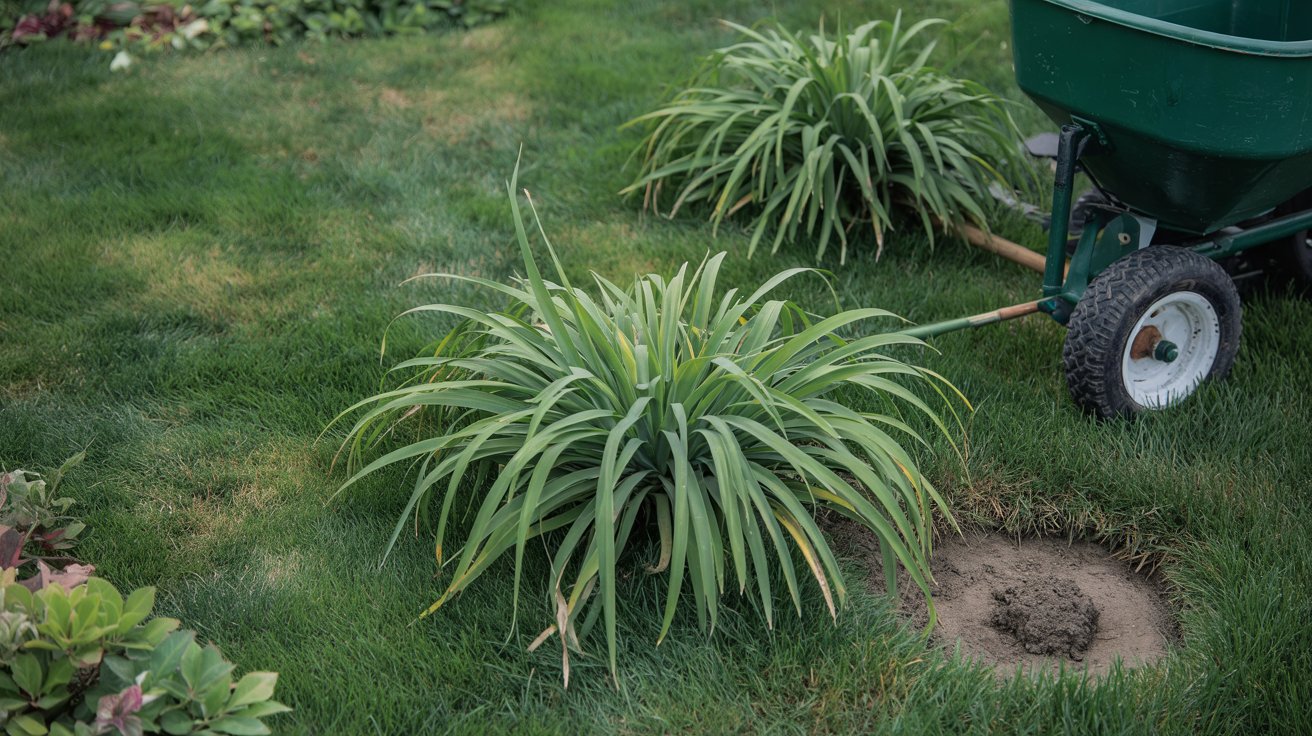
Crabgrass (Digitaria spp.) is a warm-season annual that germinates in late spring, spreads aggressively through summer, sets thousands of seeds, then dies at first frost - leaving those seeds to repeat the cycle next year.
A single plant can produce up to 150,000 seeds in one season.
The good framework for beating it has four steps: identify it correctly, apply a pre-emergent at the right soil temperature, treat any existing patches before they seed out, and build a lawn dense enough to crowd out new seedlings.
The UF/IFAS crabgrass guide confirms that pre-emergent timing is the single most critical factor in long-term control.
Calendar dates alone won't save you. A warm March in Georgia means germination weeks earlier than a cool May in Minnesota.
Soil temperature, not the month, is the real trigger - and this plan is built around that fact.
Crabgrass is a warm-season annual weed controlled best by pre-emergent herbicides applied when soil temps reach 55–58°F. Missed the window?
Raise mowing height, improve lawn density, and use targeted post-emergent treatment. Prevention through proper lawn care is always more effective than chasing existing patches.
How to Identify Crabgrass?
Before you treat anything, you need to confirm you're actually looking at crabgrass and not a similar-looking grass like goosegrass or tall fescue clumps. Misidentification wastes product and can injure your lawn.
Remember it later
Planning to try this recipe soon? Save it for a quick find later!
Two species account for most infestations: Digitaria ischaemum (smooth crabgrass) and Digitaria sanguinalis (large crabgrass). Both share a prostrate, star-burst growth habit and a tendency to form flat, low-spreading patches that seem to appear overnight in thin or stressed turf.
The Penn State crabgrass ID guide details the key structural differences between these two species, which matter when choosing control methods.
Large crabgrass is the easier one to spot: its leaf blades and sheaths are covered in coarse, visible hairs. Smooth crabgrass has hairless or nearly hairless blades and tends to stay lower to the ground.
Both species produce finger-like seedheads arranged in a spoke pattern - a reliable identifier once the plant matures in mid-to-late summer.
The ligule is another quick check. Crabgrass has a membranous ligule (a thin white tissue at the blade-sheath junction), which distinguishes it from goosegrass, which has a split ligule.
The UMN Extension crabgrass page walks through these ligule and leaf-sheath characteristics in practical terms for homeowners.
| Feature | Smooth Crabgrass | Large Crabgrass |
|---|---|---|
| Scientific name | Digitaria ischaemum | Digitaria sanguinalis |
| Leaf hairs | Absent or sparse | Dense, coarse hairs |
| Sheath hairs | None to few | Prominent hairy sheath |
| Plant height | Low, very prostrate | Taller, more upright |
| Ligule | Membranous, white | Membranous, white |
| Seedhead | 3–6 finger-like spikes | 4–9 finger-like spikes |
| Patch pattern | Dense, flat mats | Star-burst, lower canopy |
| Germination period | Late spring–early summer | Late spring–early summer |
Patch location also helps. Crabgrass favors hot, compacted, or thin areas - driveway edges, south-facing slopes, and spots where your lawn took drought stress last summer.
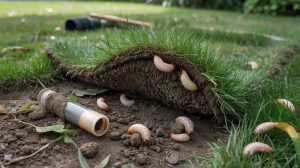
If a weedy patch consistently returns in those same spots, crabgrass is a very likely culprit. Dealing with multiple lawn pests at once is common; if you're also seeing white grub damage nearby, the two problems often share the same stressed turf conditions.
Pre-Emergent Timing and Prevention Plan
A pre-emergent herbicide doesn't kill existing crabgrass - it creates a chemical barrier in the top layer of soil that prevents germinating seeds from establishing. Get it down before seeds sprout and you stop the problem at the source.
The Penn State turf weed management guide identifies soil temperature as the primary germination trigger: crabgrass seeds begin sprouting when soil reaches 55-58°F at a 2-inch depth for several consecutive days. That threshold, not a calendar date, is your application target.
Two important cautions: First, do not overseed within 6-8 weeks of applying most pre-emergents - the barrier that stops crabgrass also prevents desirable grass seed from germinating. Check your product label for exact re-seeding intervals.
Second, delay fertilizer applications in some regions to avoid pushing lush, tender growth right before a crabgrass flush; timing fertilizer after the pre-emergent is watered in is the safer sequence.
In zones 7–10, soil temps hit 55°F as early as late February or early March. In zones 5–6, that window typically falls in mid-to-late April. Check local lawn care timing resources and use a real thermometer rather than relying on regional averages alone.
Dealing with Existing Crabgrass
If crabgrass is already visible in your lawn, the pre-emergent window has passed for those plants. Shift focus to limiting their spread, preventing seed-set, and building the conditions that favor your lawn over the weed next season.
Raise your mowing height to 3-4 inches for cool-season grasses and the upper end of the recommended range for warm-season types. Taller turf shades the soil surface, which reduces the light crabgrass seedlings need to establish.
Mow often enough to remove no more than one-third of the blade at a time - scalping stresses your grass and opens bare patches that crabgrass colonizes quickly.
- Irrigation: Water deeply and infrequently - roughly 1 inch per week - rather than light daily watering. Shallow irrigation keeps the top inch of soil moist, which favors crabgrass germination more than deep-rooted turf grass.
- Fertilization: Feed your lawn on schedule to maintain density, but avoid heavy nitrogen applications in late spring, which can push soft growth that competes poorly against heat-tolerant weeds.
- Hand removal: For small, isolated patches, pull plants before seedheads form. Remove the entire crown - fragments left behind can re-root. Bag the material rather than composting it.
- Post-emergent herbicides: Selective post-emergent options exist for cool-season lawns; products containing quinclorac are commonly used. Warm-season lawns have fewer selective options, so cultural control becomes even more important.
The UF/IFAS crabgrass resource stresses that a dense, healthy turf is the most durable long-term defense. Overseed thin areas in fall for cool-season lawns — a thick stand leaves no bare soil for crabgrass to exploit come spring.
Post-emergent chemicals should be a last resort, not the first response. Misapplication on warm-season turf can cause significant browning, and repeat treatments are rarely as effective as a solid pre-emergent program combined with sound cultural practices.
If you're fighting multiple lawn intruders at once, knowing how to remove lawn clover uses some of the same dense-turf principles.
When reading herbicide labels, check for turf tolerance notes specific to your grass species. St.
Augustine grass, for example, is sensitive to several common post-emergent active ingredients. A product safe on tall fescue may injure your warm-season lawn badly.
Crabgrass Preventers and Product Options
Choosing the right pre-emergent comes down to active ingredient, lawn type compatibility, and whether you plan to overseed. All products listed below require proper watering-in and carry restrictions around seeding - always read the full label before applying.
The Penn State turf management resource and the UF/IFAS crabgrass overview both confirm that application timing matters more than product choice - even the best active ingredient fails if applied after germination begins.
| Active Ingredient | Common Brand Forms | Overseeding Wait | Notes |
|---|---|---|---|
| Pendimethalin | Granular & liquid | 3–4 months | Widely available; orange-tinted granules. Suitable for most turf types. |
| Prodiamine | Granular & liquid | 3–4 months | Long residual; used in split-rate programs. Low cost per application. |
| Dithiopyr | Granular & liquid | 3–4 months + early post activity | Can control very young crabgrass seedlings (1-tiller stage); slightly more flexible timing. |
| Bensulide | Granular | 4 months | Older chemistry; effective but longer seed-free interval. Less common now. |
For homeowners who prefer to avoid synthetic herbicides, effective lawn weed control through organic inputs does exist - corn gluten meal is the most studied option, though its efficacy is significantly lower than synthetic pre-emergents and timing requirements are even stricter. It also adds nitrogen, so factor that into your fertility plan.
Whatever product you select, calibrate your spreader to the label rate and make a single, even pass rather than guessing by eye.
Never apply a pre-emergent herbicide to a lawn you intend to overseed within the product's restricted window — you will prevent your desirable grass seed from germinating as effectively as crabgrass seed. Plan overseeding for fall after the crabgrass barrier has broken down.
If you're comparing organic pest and weed strategies more broadly, the discussion of neem oil versus insecticidal soap is a useful reference for understanding how contact-based treatments differ from residual soil barriers - a meaningful distinction when budgeting your lawn program. For lawns that face pressure from both weed and insect damage, Japanese beetle control and mole removal often become part of the same seasonal plan.
If deer are browsing new turf repairs, combining weed and pest control with strategies to deter deer from your yard rounds out a complete lawn-protection approach. And if you're noticing distorted plant growth in nearby beds, ruling out aphid infestations on garden plants is worth a quick check before attributing all damage to crabgrass stress.

Frequently Asked Questions
Prodiamine and dithiopyr are widely considered the most effective options. Dithiopyr also controls early-emerged seedlings at the one-tiller stage, giving slightly more flexible application timing than other active ingredients.
Most pre-emergents require a 3–4 month wait before overseeding. Applying seed too soon results in poor germination because the herbicide barrier blocks all seeds equally, not just crabgrass.
Most granular pre-emergents remain active for 8–12 weeks under normal conditions. Heavy rainfall or irrigation can shorten effectiveness, which is why split applications are recommended in long, warm growing seasons.
Corn gluten meal is the primary organic pre-emergent studied for crabgrass. It provides roughly 60% suppression under ideal conditions — far lower than synthetic options — and must be applied at high rates of 20 lbs per 1,000 sq ft.
Yes. Crabgrass is a warm-season annual that germinates each spring from seed, produces up to 150,000 seeds per plant during summer, then dies completely at the first hard frost each fall.
Pin it for your next how to get rid of crabgrass project.