Squirrels are fast, persistent, and surprisingly good at problem-solving. If you've watched a squirrel drain a feeder in under ten minutes, you already know that a casual deterrent won't cut it.
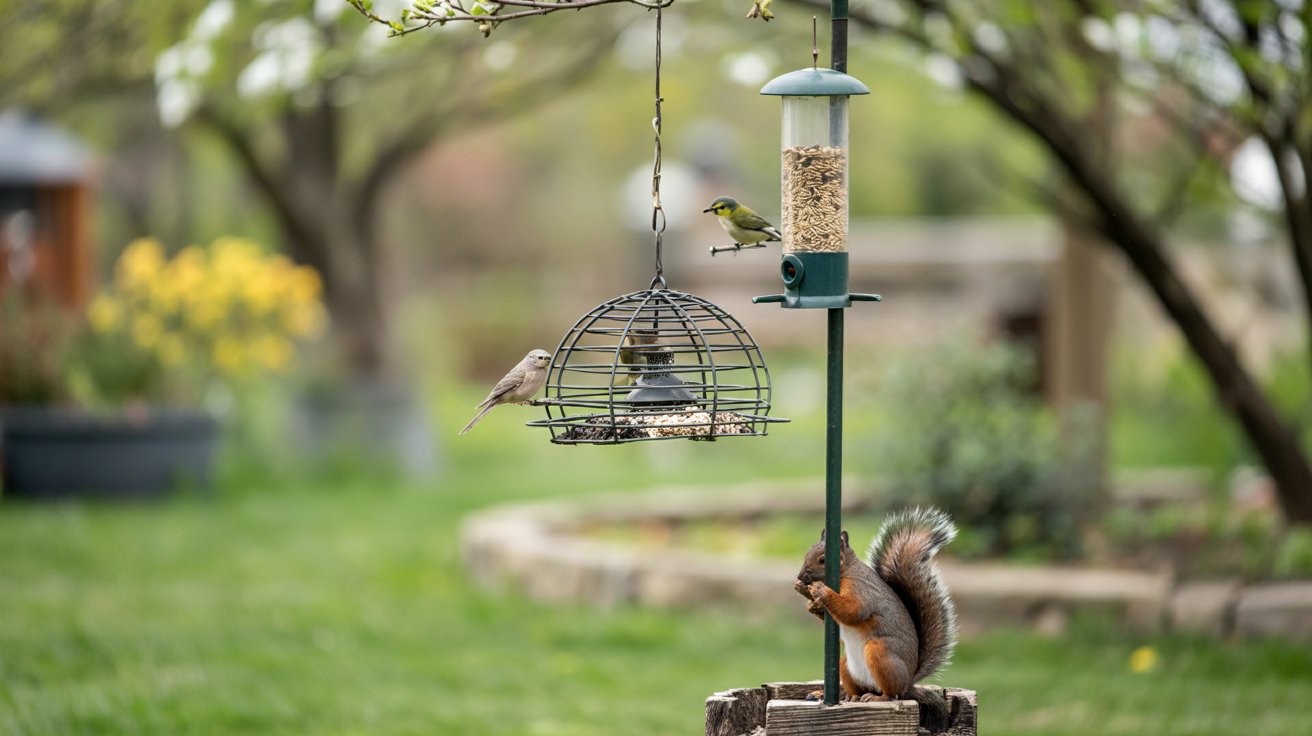
The good news isn't that there's one magic fix - it's that a layered approach actually works. Combine smart placement with physical hardware and you can stop most squirrels cold, most of the time.
This guide gives you a concrete weekend plan, then builds in the context and troubleshooting you need when squirrels adapt. Whether you're dealing with Sciurus carolinensis (gray squirrel) or the smaller Tamiasciurus hudsonicus (red squirrel), the same core framework applies.
If you want to bring in more birds while keeping squirrels at bay, understanding what draws birds to your yard helps you set up feeders in the right spots from the start.
To keep squirrels off bird feeders, mount feeders on a smooth metal pole with a baffle, position them at least 10 feet from any launch point, and use a weight-activated or cage-style feeder as backup. Combine placement and hardware for the best result.
Immediate Steps to Squirrel-Proof Your Feeders
Start with the basics before buying any gadget. Most squirrel access problems come down to two things: wrong pole height and a feeder too close to a jumping-off point.
Remember it later
Planning to try this recipe soon? Save it for a quick find later!
Fix those first, then layer in hardware.
According to Penn State Extension, a pole-mounted feeder with a properly installed baffle is the single most effective passive deterrent available. The steps below get you there.
Use a wide catch tray that collects fallen seed before it hits the ground. Empty it daily in summer when squirrel activity peaks. A tray also reduces mold and keeps your feeding station tidier for birds.
Once the pole, baffle, and clearance are right, upgrade the feeder itself. A tube feeder with metal ports resists chewing and pairs well with a cage or weight-activated collar for a second layer of defense.
Never grease a pole with petroleum jelly or cooking oil to deter squirrels. These substances coat bird feathers and can impair their ability to fly or stay warm. Stick to physical baffles only.
Squirrel Behavior and Access: What They Can and Can't Do
Understanding how squirrels move helps you stop them at the right point. Sciurus carolinensis, the eastern gray squirrel, is by far the most common feeder raider in North American suburbs.
Gray squirrels are heavier and rely more on jumping, while red squirrels are lighter and better at climbing narrow poles.
Research shared through the Urban Wildlife Project shows squirrels can leap up to 10 feet horizontally from a tree branch and about 4 feet vertically from the ground. Those two numbers define your clearance targets.
| Ability | Typical Squirrel Limit | Safe Placement Target |
|---|---|---|
| Horizontal jump (from branch) | Up to 10 ft | ≥ 10 ft from any launch point |
| Vertical leap (from ground) | Up to 4 ft | Feeder ≥ 5 ft high |
| Pole climbing | Any rough surface | Smooth metal pole ≤ 1.5 in |
| Drop from above | From overhanging branches | No branches within 10 ft overhead |
| Chewing access | Plastic, wood, thin metal | Metal ports and cage wire ≥ 16 gauge |
Squirrels also learn by watching. If one squirrel cracks your setup, others in the same territory will copy the method within days.
This is why patching one gap immediately matters - don't wait a week to fix a baffle that has slipped out of position.
Common feeder access routes to check in your yard include tree limbs within 10 feet at any angle, fence rails directly under the feeder line, roof overhangs, and stacked garden furniture near the pole.
Even a 4-inch-wide fence rail gives a squirrel enough surface to launch from.
Red squirrels weigh roughly half as much as gray squirrels - about 5 ounces compared to 16 to 24 ounces. That lighter body means weight-activated feeders, which cut off port access when anything heavier than a songbird lands, may not trigger on red squirrels.
Plan accordingly if red squirrels are your main problem.
Hardware Options: Baffles, Cages, and Clever Designs
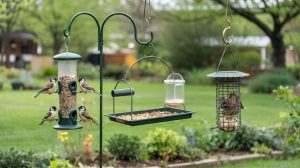
Once placement is sorted, the right hardware closes the remaining gaps. Three main options dominate the market: pole baffles, cage-style feeders, and weight-activated port feeders.
Each solves a different access route.
Cornell Cooperative Extension's feeder location guidance emphasizes that physical barriers at the pole are more reliable than feeder design alone. Nebraska Extension similarly notes in its selective feeding guide that baffle placement combined with correct distances outperforms repellents and gimmicks.
Weight-activated feeders add a third option. When a squirrel lands on the perch ring, its weight closes the seed ports automatically.
These work well for gray squirrels but may not trip on red squirrels. Brands like Squirrel Buster and Yankee Flipper use this mechanism.
- Works on any feeder type mounted on the same pole
- No batteries, no moving parts, minimal upkeep
- Doesn't limit bird size — cardinals and jays still feed freely
- Deters squirrels even when hung from a tree branch or pergola
- Protects feeder from chewing damage over time
- Works in yards where a freestanding pole isn't practical
For most setups, the best result comes from pairing a torpedo baffle with a metal-port tube feeder. The baffle blocks pole climbers; the metal ports block chewers.
Use a cage feeder as a secondary station hung from a separate hook at least 10 feet from any tree.
Placement Playbook: Distances, Height, and Seasonal Tweaks
Even perfect hardware fails if the feeder is in the wrong spot. Placement is not a one-time decision - it needs a small seasonal adjustment as foliage and squirrel behavior shift through the year.
Mass Audubon's bird feeding guidelines recommend keeping feeders a minimum of 10 feet from trees, shrubs, fences, and structures in all directions, not just horizontally. Overhead branches are just as much of a problem as lateral ones.
| Season | Main Pressure | Adjustment |
|---|---|---|
| Spring | Hungry post-winter squirrels | Check baffle position after ground thaw shifts pole |
| Summer | Full canopy adds new launch points | Re-measure clearance to leafed-out branches |
| Fall | Squirrels caching aggressively | Add a second baffle or move pole 1–2 ft further from trees |
| Winter | Snow raises ground level | Raise baffle 6 in if snow pack builds near pole base |
In the South and West, squirrel activity stays high year-round with no winter lull. In USDA zones 8–11, treat every month like fall and keep the 10-foot clearance rule non-negotiable. In zones 4–6, you get a brief reprieve in January and February when squirrels are less active.
Summer is when placement rules get tested hardest. Deciduous trees that were bare in February now send branches 2 to 4 feet closer to your feeder line once they fully leaf out.
Walk your yard in late May with a tape measure and re-check every launch point.
One underused trick: orient the feeder pole so it sits in the center of an open lawn patch, away from garden beds and hedges at the perimeter. Squirrels prefer moving along edges and vertical surfaces.
An open, exposed pole in the middle of a flat area is genuinely less appealing to approach - something worth considering when you plan how to keep up with summer yard changes.
If your yard has no open center, position the feeder as a focal point for backyard wildlife at least 10 feet from the nearest shrub border, then use a cage feeder on a second hanging hook as backup.

Maintenance, Troubleshooting, and Safe Deterrents
Baffles slip, cages rust, and squirrels probe for new angles every season. A deterrent system that isn't maintained will fail within a few months.
Keep a short inspection routine and most problems are preventable.
Penn State Extension notes that ground cleanup is as important as hardware - a swept area beneath your feeder removes the reward that keeps squirrels circling back. Pair that with a regular hardware check and you close the loop.
Nebraska Extension's guidance also makes clear that safe feeding practices mean avoiding chemical repellents entirely around bird feeding stations.
- Inspect baffles monthly - check that the baffle hasn't dropped down the pole or shifted after rain.
- Wipe cage feeders quarterly with a diluted bleach solution (1:9 ratio) to remove mold and seed residue.
- Use safflower seed as a partial substitute - most squirrels ignore it while chickadees and cardinals eat it readily.
- Switch seed mixes seasonally - straight sunflower hearts are tidy and leave no hull debris that piles up beneath feeders.
- No petroleum jelly or oil on poles - both coat feathers and harm birds that brush against the surface.
- No capsaicin sprays on seed unless the product is specifically formulated for feeders - uncontrolled application can irritate birds' eyes.
- Don't use live traps without a plan - relocating squirrels more than a mile away is often illegal without a permit.
- Skip hanging feeders from trees if squirrels are persistent - no cage design fully compensates for a direct branch launch.
Capsaicin-based "hot" seed mixes are marketed as bird-safe, but birds can still inhale capsaicin dust when they crack seeds. If you use them, stick to seed that has a light coating rather than a heavy powder, and follow extension guidance on safe application rates.
If squirrels have started chewing your feeder housing, replace plastic components with metal equivalents immediately. A chewed port lets rain into the seed chamber, causing rapid mold.
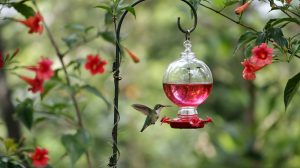
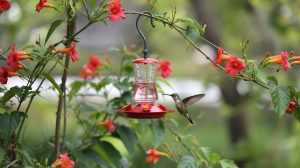
While you're replacing parts, check whether upgrading to a full-cage or weight-activated model makes sense - a comparison of feeder designs by build quality can help narrow that down. For a separate nectar station, a leak-resistant hummingbird feeder design also reduces the sweet spills that attract squirrels to that area of the yard.
A wildlife-friendly yard setup also helps - diverse plantings away from the feeder give squirrels their own foraging territory, which reduces pressure on the feeding station over time.
Frequently Asked Questions
Baffles work on most gray squirrels but red squirrels, weighing only about 5 ounces, sometimes navigate around standard torpedo models. A wider wrap-around baffle at least 18 inches in diameter handles both species more reliably.
At least 10 feet horizontally from any branch, fence, or raised surface. Gray squirrels can leap up to 10 feet from a stationary position, so this distance is a hard minimum, not a rough estimate.
Light-coated capsaicin seed is generally tolerated by birds, but loose powder can irritate their respiratory systems. Penn State Extension and Nebraska Extension both recommend physical barriers over chemical deterrents near active feeders.
No feeder is guaranteed, but weight-activated models like the Squirrel Buster close seed ports under weights above roughly 3 ounces — stopping gray squirrels in nearly all cases when placement rules are also followed.
Check baffle position monthly, clean cage feeders with diluted bleach quarterly, sweep fallen seed every 2–3 days, and re-measure clearance distances each spring once trees fully leaf out to catch new launch points.
Pin it for your next how to keep squirrels off bird feeders project.