Walk down any suburban street on a Saturday morning and you'll spot two types of lawns: edges that look razor-cut and edges that look roughly hacked.
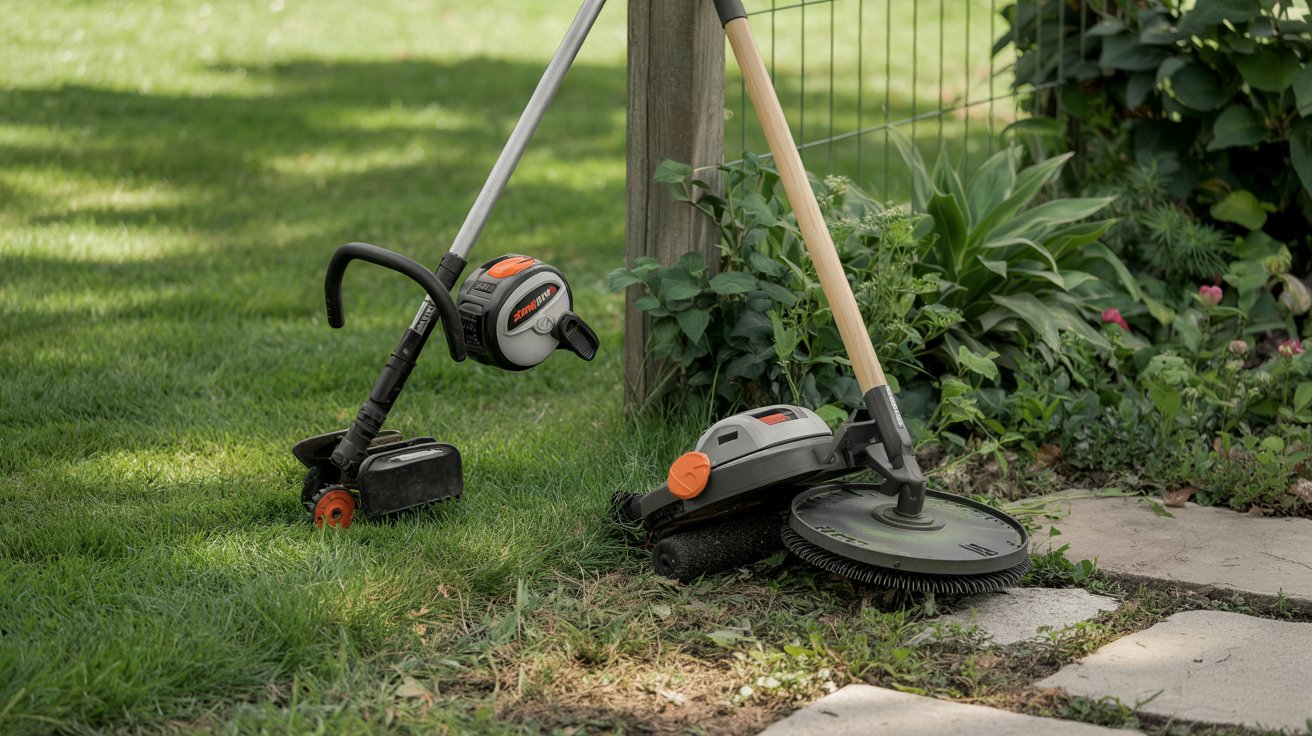
The difference usually comes down to one question - did the owner use a string trimmer, a dedicated lawn edger, or both?
These tools share the same basic job of tidying grass where a mower can't reach, but they do it in fundamentally different ways.
A string trimmer spins a nylon line horizontally to cut grass sideways - useful along fences, tree bases, and uneven terrain. An edger runs a vertical blade or line along hard surfaces like driveways and sidewalks, cutting a clean, defined boundary between lawn and pavement.
For most homeowners managing a quarter-acre lawn with mixed terrain, the trimmer wins as a first tool purchase. But if crisp pavement lines matter to you, the edger earns its place in the shed.
This comparison walks through cost, durability, and real-world use so you can spend money on the right tool - or decide a single combo unit covers everything you need.
A string trimmer handles most homeowner needs including light edging, while a dedicated edger delivers consistently sharper lines along driveways and sidewalks. For small to mid-size yards, start with a trimmer.
Add an edger when finish quality becomes a priority or your lawn borders significant hardscaping.
Verdict at a Glance
For the typical homeowner with a small to mid-size lawn, a quality string trimmer is the right first purchase. It handles overgrown patches, fence lines, slopes, and - with proper technique - can double as an edger along most surfaces.
Remember it later
Planning to try this recipe soon? Save it for a quick find later!
A dedicated edger is worth adding when your yard has long runs of pavement edges - driveways, sidewalk borders, or landscaping beds - and you want that cut-with-a-ruler look consistently. Professional landscapers almost always run both tools on the same property for good reason.
Some tools blur this line entirely. Oregon's ST275, for example, features interchangeable trimmer heads that rotate between trimming and edging positions on one power unit - a genuine single-machine solution for homeowners who want flexibility without two separate purchases.
Still, combo heads often compromise on edge crispness. As Grainger's equipment comparison notes, results run crisper with a tool built specifically for edging.
The four decision factors that matter most are yard size, finish quality, budget, and future-proofing. A 1,500 sq ft yard with gravel beds and no driveway border?
A trimmer is all you need. A 5,000 sq ft corner lot with 200 feet of sidewalk?
Buy both - or at minimum, a true combo unit.
If you're still weighing power source decisions beyond these two tools, the gas vs. electric question applies broadly to all outdoor power equipment and shares the same core trade-offs.
Costs and Durability
Purchase price tells part of the story. Total cost of ownership - including replacement line, blades, fuel or batteries, and expected lifespan - tells the rest.
Corded electric string trimmers sit at the low end of the market, typically $60-$120 for reliable models, according to comparisons at Top Ten Reviews. Gas-powered trimmers push into the $150-$300+ range and require ongoing fuel, air filter, and spark plug maintenance.
| Tool & Power Source | Typical Price Range | Expected Lifespan |
|---|---|---|
| Corded Electric Trimmer | $60–$120 | 5–8 years |
| Battery Trimmer (18–80V) | $100–$250 | 4–7 years (battery cycles) |
| Gas Trimmer | $150–$350 | 8–12+ years |
| Corded Electric Edger | $80–$150 | 5–8 years |
| Battery Edger (18–80V) | $120–$280 | 4–7 years (battery cycles) |
| Gas Edger | $180–$350 | 8–12+ years |
| Combo Attachment Unit | $100–$250 | 5–9 years |
Gas models offer the longest working life under heavy use, but weight and maintenance costs are real trade-offs - a gas trimmer can weigh 12-18 lbs compared to 7-10 lbs for a cordless electric.
For homeowners trimming once a week, that weight difference accumulates across a season.
Battery-powered models bring a separate ownership math: lithium-ion packs typically last 300-500 charge cycles before capacity drops noticeably.
If you're buying into a battery ecosystem (like Milwaukee, DeWalt, or EGO), one battery powers multiple tools including cordless leaf blowers and hedge trimmers, which significantly improves the value per dollar spent on batteries.
Maintenance costs favor electric tools over gas. A gas trimmer requires fresh fuel, annual carburetor cleaning, air filter replacement, and spark plug swaps every season or two.
A corded electric trimmer needs almost nothing beyond replacement line, which costs $5-$15 per spool. Battery models fall in between - no fuel, but eventual battery pack replacement at $30-$100 depending on voltage.
Edger blades on dedicated units are another ongoing cost. Steel edger blades dull over a full season and typically run $8-$20 to replace.
You can sharpen some models with a file, extending blade life through two or three seasons with moderate use. For more context on outdoor equipment investment, browsing lawn tool buying decisions can help you map out what to prioritize first.
If you already own a battery platform like EGO or DeWalt, buying a same-brand edger attachment rather than a standalone unit typically saves $40–$80 since you skip the second battery purchase entirely.
Combo attachment systems - where one powerhead accepts a trimmer head, edger blade, hedge trimmer, and blower - offer the best cost-per-tool ratio upfront. The powerhead runs $120-$200 and attachments add $40-$100 each.
If you need a clean hedge finish along with edging and trimming, this approach can replace three separate tools.

Use-Case Scenarios and the Flex Approach
Knowing what each tool costs is useful. Knowing which tool fits your actual yard saves more money.
For a small lawn under 3,000 sq ft with minimal hardscape border, a string trimmer handles 95% of the work. You can rotate the trimmer head 90 degrees and walk the pavement edge with the line vertical - it cuts a visible line, just not as deep or clean as a dedicated blade.
The technique takes a few practice passes to master.
When using a string trimmer to edge, move slowly and consistently along the pavement line, keeping the guard pointing toward the grass. A fresh line spool gives a cleaner cut than worn-down line. According to The Lawn Review, most homeowners use a trimmer for routine touch-ups and bring out the edger only for final refinements before a special occasion or end-of-season cleanup.
For a mid-size lawn of 3,000-8,000 sq ft with a driveway and one or two sidewalk runs, you're in the flex zone. A combo attachment tool makes strong sense here.
You get dedicated edger performance on the hardscape runs and trimmer capability everywhere else, without paying for two full power units.
Large lawns over 8,000 sq ft - especially corner lots with significant sidewalk frontage - almost always justify owning both tools separately. Running 300 feet of driveway edge with a tilted trimmer is exhausting and inconsistent.
A wheeled edger with a guide does it in a straight pass. If your irrigation layout creates defined turf zones near hardscaping, crisp edges become visually critical to the whole lawn presentation.
- Small lawn, no long hardscape borders: A string trimmer alone covers all realistic needs, saving you the cost and storage space of a second tool.
- Mid-size lawn with driveway or walkway: A combo attachment system or a trimmer with an edger-capable rotating head gives you both functions without doubling your tool budget.
- Large lawn with significant pavement frontage: Buy dedicated tools for each job - the time and finish quality savings justify the cost over a full season.
- Budget-first buyer: Start with a corded electric trimmer at $60-$80 and practice edging technique; add a standalone edger later if results consistently disappoint.
- Performance-first buyer: Invest in a clean curb appeal setup by pairing a battery trimmer with a matching battery edger from the same brand - shared batteries drop total cost significantly.
In warm-season grass regions (Bermuda, Zoysia, St. Augustine), grass spreads aggressively into pavement cracks and requires edging every 2–3 weeks during summer. In these climates, a dedicated edger pays back faster because trimmer-edging frequent enough to keep up with Bermuda is genuinely labor-intensive.
The combo question also hinges on storage. Two standalone tools need wall space or a dedicated corner of the shed.
One powerhead with two snap-on attachments hangs on a single hook. For homeowners with tight garages or minimal storage, the attachment route solves a real problem beyond just cost.
As Grainger's comparison points out, combo solutions save initial cost but may compromise edge crispness - meaning you should weigh yard size and finish priorities honestly before defaulting to the convenience option.
If you're also planning weekend projects like backyard fire pit installation where clean grass borders matter aesthetically, a dedicated edger justifies itself quickly.
For anyone still weighing power source trade-offs - particularly gas versus battery across multiple tools - the same logic that applies to water system decisions applies here: the right system depends on your yard's specific layout, not just price per unit.
And if you're adding heavier-duty tools to your garage, reviewing chainsaw options for homeowners shows how battery ecosystem thinking stretches across the full tool lineup.
Frequently Asked Questions
Most small-lawn homeowners manage fine with just a trimmer. Add a dedicated edger when your property has 150+ feet of pavement border and finish quality matters consistently.
Yes — rotate the head 90 degrees so the line runs vertically and walk the pavement line slowly. Results are acceptable but less precise than a dedicated blade edger.
Gas trimmers typically last 8–12 years under heavy use. Battery models average 4–7 years before pack capacity degrades, though the motor itself often outlasts the battery.
Yes — models like the Oregon ST275 switch between trimmer and edger positions on one powerhead. Edge quality improves with dedicated units if you edge more than twice monthly.
Electric models need line or blade replacement only. Gas models require annual spark plug swaps, air filter cleaning, and fresh fuel — adding roughly $20–$40 per season in parts.
Pin it for your next string trimmer vs edger project.