Germination can hinge on tiny physical differences you'd never notice by eye. Perlite and vermiculite look similar in a bag, but they behave almost opposite inside a growing medium - one drains fast, one holds water tight.
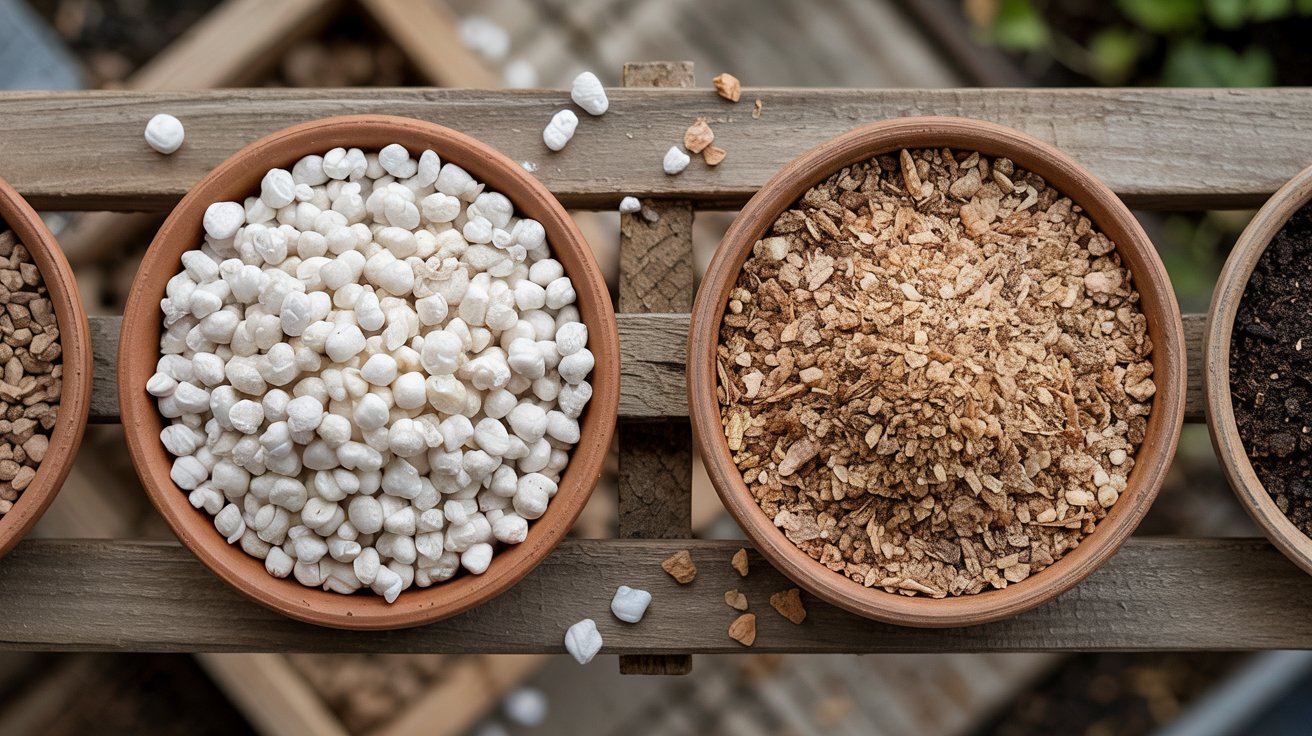
Picking the wrong one for your seed type or climate can mean soggy, rotted seedlings or seedlings that dry out before roots form.
Both minerals are heat-expanded, lightweight, and sterile. That's where the similarities end.
If you're building a seed-starting mix from scratch, the numbers matter. Vermiculite holds 220-325% of its own weight in water; perlite keeps roots aerated but drains freely.
Understanding that gap helps you dial in ratios rather than guess.
Knowing what different soil types need makes these amendments much easier to apply. Cost plays a role too - at current prices, vermiculite runs more than twice the price of perlite per cubic foot, which changes the math for large seed-starting operations.
Perlite improves drainage and aeration; vermiculite boosts moisture retention and nutrient buffering. Most seed-starting mixes use peat as a base with one or both amendments.
A peat:perlite:vermiculite (2:1:1) blend suits most seeds. Perlite costs roughly $24 per 4.4 cu ft; vermiculite runs about $63 for the same volume.
Direct Verdict: Perlite vs Vermiculite
Perlite and vermiculite are not interchangeable. Perlite's job is to open up pore space so excess water drains and roots get oxygen.
Remember it later
Planning to try this recipe soon? Save it for a quick find later!
Vermiculite's job is to hold water and slow moisture loss between waterings - it also buffers nutrients through its cation-exchange capacity, which perlite essentially lacks.
For seed starting, the choice depends on the seed's moisture sensitivity and your watering cadence. Moisture-loving seeds like basil and impatiens lean toward vermiculite-heavier mixes.
Succulents, lavender, and other dry-preference seeds want perlite to dominate. Most vegetable and flower seeds land in the middle, which is why the peat:perlite:vermiculite (2:1:1) baseline exists.
Both amendments appear in common seed-starting formulas: peat:perlite (2:1) for drier preferences, peat:vermiculite (2:1) for moisture-lovers, and the balanced 2:1:1 blend for general use. Neither mineral adds fertility on its own - they modify physical structure, not nutrient content.
Cost is a real factor. At roughly $23.99 vs. $62.99 for the same bag volume, perlite is the budget choice for bulk seed starting.
If you're starting hundreds of trays, that gap adds up fast. If you need moisture buffering and are starting a smaller batch of finicky seeds, the vermiculite cost is justified.
What They Are and How They Work?
Perlite is an amorphous siliceous volcanic glass. When raw perlite ore is rapidly heated to around 1,600°F, trapped water vaporizes and the glass pops - expanding up to 20 times its original volume.
The result is a white, porous particle riddled with tiny air pockets that improve drainage and aeration in any growing medium.
Vermiculite is a micaceous mineral - a layered silicate - that similarly expands under heat into accordion-like plates. Those plates trap water between their layers, giving vermiculite its famously high moisture-holding capacity.
According to OSU Extension's soilless media guide, vermiculite's layered structure also gives it meaningful cation-exchange capacity, helping buffer nutrients like calcium and magnesium in the root zone.
Dry perlite dust is a respiratory irritant. Always wear a dust mask and eye protection when pouring or mixing it indoors. Wet the material lightly before use to suppress dust.
| Property | Perlite | Vermiculite |
|---|---|---|
| Origin | Volcanic glass | Micaceous mineral |
| Color | White | Golden/brown |
| Water Holding (by weight) | ~100–150% | 220–325% |
| Water Holding (by volume) | 20–50% | 20–50% |
| pH Range | ~7.0–7.5 | ~6.0–9.0 |
| CEC (nutrient buffering) | Negligible | Moderate–high |
| Durability in media | High | Can compress over time |
| Particle grades available | Fine, medium, coarse | Fine, medium, coarse |
Vermiculite's pH range of roughly 6-9 is worth noting. Most seeds prefer slightly acidic to neutral media, so a peat base (pH ~3.5-5.5 before liming) plus vermiculite can help moderate overall pH.
Perlite contributes almost nothing to pH buffering.
Durability differs too. Perlite particles stay structurally stable for years; vermiculite can compress under repeated watering and foot traffic in beds, reducing its aeration benefit over time.
For containers and seed trays, that compression is rarely a problem - seedlings move on before it matters. For long-term raised bed soil, perlite holds its structure better.
5-Step Decision Framework for Seeds
Choosing between perlite, vermiculite, or a blend doesn't require a laboratory. Run through these five steps before you fill a single tray, and you'll have a mix target in under five minutes.
The 2:1:1 baseline works for most seeds, but don't be afraid to push to 2:1:0.5 for drier climates or seeds that flag quickly, or to 1:1:1 for seeds needing persistent moisture. Record the ratio on the flat so you remember what changed.
| Seed Category | Suggested Ratio (Peat:Perlite:Vermiculite) | Rationale |
|---|---|---|
| Dry-loving (lavender, thyme) | 2:1:0 | Fast drainage, low moisture retention |
| General vegetables (tomato, pepper) | 2:1:1 | Balanced drainage and moisture |
| Moisture-loving (basil, celery) | 2:0.5:1 | Higher moisture retention |
| Fine/delicate seeds (pansies, petunias) | 2:1:1.5 | Consistent surface moisture for germination |
| Arid climate adjustment | 2:1:0.5 | Extra drainage to prevent damping-off |
According to Texas A&M's greenhouse media guidance, the physical structure of the growing medium affects both root oxygen availability and how uniformly water moves through the profile - two factors that directly determine germination speed and seedling survival.
Costs and Buying Guidance
Perlite and vermiculite both come in small retail bags (2-8 qt) for home gardeners and larger bags (4.4 cu ft and up) for greenhouse or bulk use. At sample 2022-2023 pricing, a 4.4 cu ft bag of perlite runs about $23.99 while the same size bag of vermiculite costs around $62.99 - a difference of nearly $39 per bag.
Prices shift by region, brand, and supplier, so check local garden centers and wholesale distributors before ordering online.
| Format | Typical Size | Best For | Cost Note |
|---|---|---|---|
| Small retail bag | 2–8 qt | Home seed trays, single-use mixes | Higher cost per qt |
| Large bag (4.4 cu ft) | ~4.4 cu ft | Seasonal greenhouse use | Better per-volume value |
| Bulk (loose cubic yard) | 1 cu yd+ | Commercial or large-scale propagation | Lowest per-volume cost; needs storage |
Bulk buying reduces cost per volume significantly, but dry amendments need covered storage to stay clean and loose. Moisture contamination in a stored bag of vermiculite can cause clumping.
Perlite is more forgiving in storage - its structure doesn't collapse when exposed to ambient humidity the way vermiculite's plates can.
In practical seed-starting math, vermiculite's higher moisture retention can reduce how often you water, which saves labor and reduces damping-off risk in mixes that would otherwise dry too fast. Perlite's drainage benefit directly lowers overwatering risk.
For tight budgets, starting with a perlite-heavy mix and adding a small top-dressing of fine vermiculite is a cost-conscious way to get surface moisture retention without paying for a 50/50 blend throughout. You can find more on managing amendment costs at scale when planning a full season's growing budget.
Regional availability also matters. Perlite is stocked at virtually every garden center year-round.
Vermiculite can be harder to find in fine grades outside of specialty horticultural suppliers - factor in shipping if you're ordering a specific grade online.
Field-Tested Tips by Seed Type and Climate
The 2:1:1 baseline is a starting point, not a fixed answer. Seed type, local climate, and your watering setup all push the ratio in one direction or another.
These adjustments are grounded in the physical properties covered earlier - apply them when the baseline isn't performing.
Delicate seeds like pansies and petunias need consistent surface moisture to germinate — they're sensitive to even brief dry-out. A vermiculite-heavy top layer (pure fine vermiculite as a ¼-inch cover) keeps the seed zone moist without waterlogging the whole tray.
| Situation | Adjustment | Why It Works |
|---|---|---|
| Hot, dry climate | 2:1:0.5 (more perlite) | Reduces damping-off; improves drainage |
| Cool, humid climate | 2:1:1 or 2:0.5:1 | Less drainage needed; moisture retention helps |
| Delicate seeds (pansy, petunia) | 2:1:1.5 + vermiculite top-dressing | Keeps seed zone consistently moist |
| Succulent/cactus seeds | 1:2:0 (perlite-dominant) | Fast drain; mimics native arid soil |
| Bottom-watering trays | 2:1:1 standard | Capillary uptake works well in balanced mix |
| Overhead misting / heated mat | 2:1:0.5 | Frequent moisture input; less retention needed |
In dry climates - think the Southwest or heated indoor grow rooms in winter - damping-off from overwatering is actually rarer than moisture stress from evaporation. That flips the usual concern: you may need more vermiculite, not less, to keep the mix from drying between checks.
Test a humidity dome over the tray before adding more vermiculite to your mix; the dome alone can solve most moisture-loss problems.
For gardeners also working on mulch layer choices around transplanted seedlings, keeping the root zone consistently moist post-transplant matters as much as it does during germination. The same logic applies: match the amendment ratio to actual evaporation rate, not a generic formula.
Coco coir is worth mentioning as an alternative or supplement to peat in these mixes. It holds water more consistently than peat, has a near-neutral pH (~6-6.8), and is renewable.
Swapping peat for coir in a 2:1:1 mix doesn't change the perlite-vermiculite balance but can make moisture management more predictable, especially for growers who water on a fixed schedule. You can apply similar thinking when you choose heavy-feeding plants that demand well-structured root zones from the start.
Finally, don't overlook grade selection. Fine-grade vermiculite is best for seed starting and top-dressing; coarse-grade suits potting mixes and understanding garden soil structure at a larger scale.
Perlite grades follow the same logic: fine for seed trays, coarse for container drainage layers. Matching grade to application closes the gap between a mix that performs in theory and one that works on the bench.
See how amendments fit into broader growing media decisions beyond just seed starting. For complete potting setups, understanding surface coverage alongside amendment choices rounds out the picture, and checking head-to-head comparisons in other categories shows how this same decision framework applies broadly.
Frequently Asked Questions
Yes. A peat:perlite:vermiculite ratio of 2:1:1 is a widely used baseline. Adjust toward more perlite for drainage or more vermiculite for moisture retention based on seed type.
Neither alone is ideal. Most seeds benefit from a balanced mix: perlite for drainage and aeration, vermiculite for moisture retention. Use both in a peat-based blend for best results, per TAMU growing media guidance.
Both are inert and non-toxic. Dry perlite dust is a respiratory irritant; wear a dust mask and eye protection when handling it indoors, as noted by OSU Extension.
Vermiculite alone can hold too much water for many seeds, increasing damping-off risk. Most growers blend it with peat or coco coir to balance moisture retention with adequate aeration.
Most garden centers carry both. Sample pricing shows perlite around $23.99 and vermiculite around $62.99 per 4.4 cu ft bag; check local suppliers for current stock and regional pricing.
Pin it for your next perlite vs vermiculite project.