Choosing between a soaker hose and drip irrigation comes down to four things: your garden's size, shape, soil type, and how much you want to spend upfront versus over time.
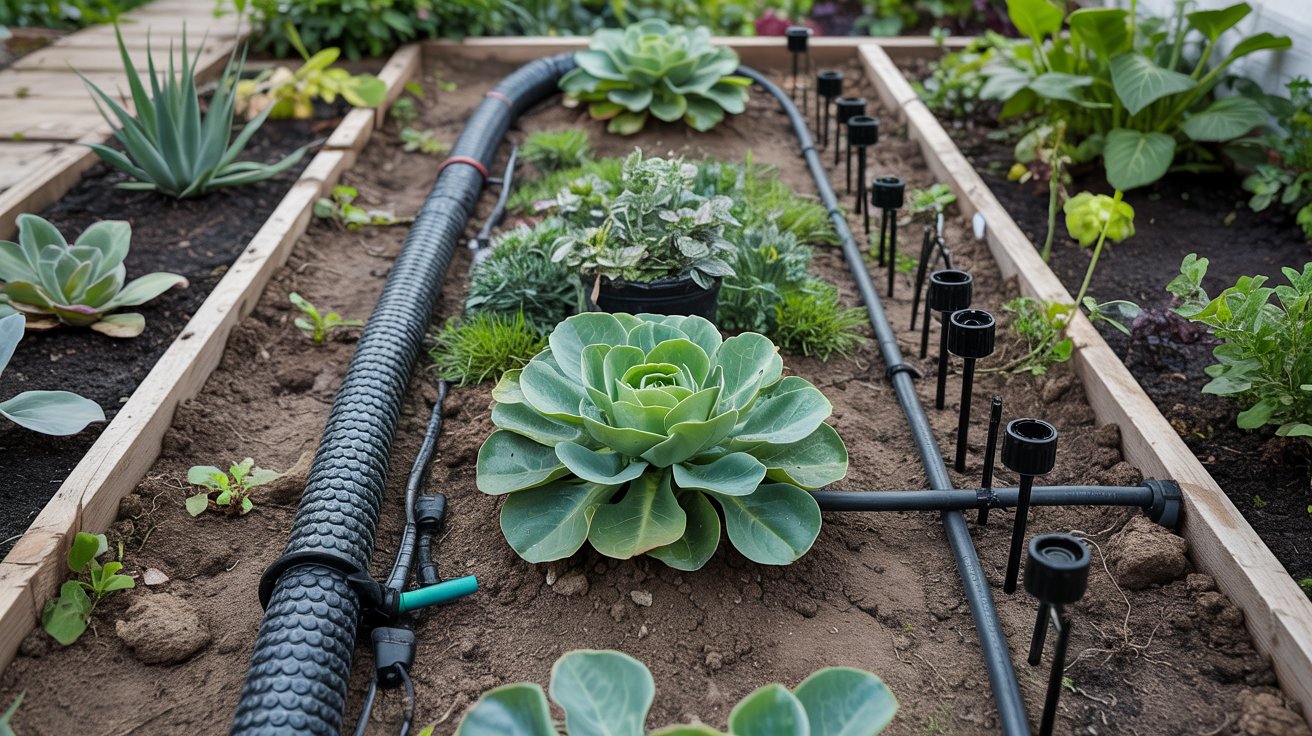
Both systems deliver water at the root zone, cutting evaporation losses that plague overhead sprinklers, but they do it differently and at very different price points.
Soaker hoses are simple, cheap, and fast to set up.
Drip irrigation is more precise, more durable, and scales well across large or irregular spaces. Knowing which suits your setup can mean the difference between a system you use every season and one that sits coiled in the shed.
This guide gives you hard numbers, a clear decision framework, and a step-by-step setup plan so you can pick a system and install it confidently.
Both soaker hoses and drip irrigation cut water use versus sprinklers, but drip is more efficient at 90–95% and scales better. Soaker hoses cost as little as $12–$15 for 50 feet, making them the budget pick for short rows and raised beds.
Head-to-Head Verdict
For most home gardeners with raised beds or short straight rows, a soaker hose is the faster, cheaper answer. For anyone watering a larger in-ground garden, a sloped site, or mixed plantings with irregular spacing, drip irrigation earns its higher price tag.
Remember it later
Planning to try this recipe soon? Save it for a quick find later!
The core difference is control. Drip systems use individual emitters that deliver water at precise, adjustable rates - typically 0.2 to 4 gallons per hour - so you can match output to each plant's needs.
Soaker hoses seep water along their entire length, which works fine for dense plantings but wastes water between widely spaced plants.
Drip irrigation runs at 90-95% efficiency, compared to roughly 70% for conventional sprinkler systems, according to CSU Extension guidance. That gap adds up fast over a full growing season.
Quick scenario guide:
- Raised beds under 25 feet: Soaker hose is faster to set up and costs under $15.
- In-ground vegetable rows or mixed beds: Drip irrigation gives better uniformity and long-term savings.
- Sloped ground: Use drip with pressure-compensating emitters; soaker hoses deliver unevenly on any grade.
- Container gardens: Point-source drip emitters are ideal; soaker hoses are not suited to pots.
- Tight budget, first season: Start with soaker hose, then upgrade if you expand.
Costs and Installation
A 50-foot soaker hose costs about $12-$15 - that's roughly $0.25-$0.30 per foot, as documented by University of Missouri Extension. You connect it to an outdoor tap, lay it along your bed, and you're done.
No emitters to space, no tubing connectors to assemble.
Drip irrigation is a different investment. Installed costs range from $0.50 to $4.50 per square foot, depending on kit quality, bed complexity, and whether you hire a professional or do it yourself.
A DIY kit for a 100-square-foot bed typically runs $50-$100 in materials, while professional installation for a multi-zone system can reach several hundred dollars.
The long-term math favors drip. When paired with mulch and a proper watering schedule, drip systems can cut overall water use by about 50%, per CSU Extension data.
That saving compounds year over year, especially in regions with tiered water billing.
| Factor | Soaker Hose | Drip Irrigation |
|---|---|---|
| Material cost | $0.25–$0.30/ft | $0.50–$4.50/sq ft |
| DIY time | 5–10 minutes | 30 min–3 hours |
| Professional install | Rarely needed | $200–$800+ |
| Lifespan | 2–5 years | 10–20+ years |
| Water savings | Moderate | Up to 50% vs sprinklers |
If you're comparing the full cost of watering options, see what a sprinkler system actually runs before committing to any setup.
Soaker hoses also pair well with a rain barrel for gravity-fed irrigation in small beds, which can bring the cost of each watering cycle close to zero.
Performance and Water Delivery
Efficiency numbers only tell part of the story. Uniformity - how evenly water reaches every plant - matters just as much, and the two systems behave very differently across varied conditions.
Soaker hoses emit water along their full length, which means flow rate varies with distance from the tap and with soil back-pressure. On clay soils, water may pool near the hose instead of penetrating evenly.
On sandy soils, it can drain away before reaching roots.
Drip systems deliver water directly to the root zone through individual emitters, maintaining consistent output across varied soils and slopes. Pressure-compensating emitters hold a steady flow rate even when elevation changes along the line.
Drip systems operate at lower pressures - typically 15-30 PSI - and connect easily to timers and controllers for full automation. Emitters range from 0.2 to 4 gallons per hour depending on type, letting you dial in exactly what each plant requires.
For a deeper look at how drip stacks up against overhead watering, the water savings comparison is worth reading before you buy.
Mulch amplifies the performance gap. Covering drip lines with 2-3 inches of mulch cuts surface evaporation significantly; you can read the full technique in this guide on applying mulch correctly.
Soaker hoses also benefit from mulch, but because their flow is less uniform to begin with, mulch alone won't fully compensate on longer runs or slopes.
Best-Use Scenarios
Soaker hoses are the right tool for raised beds up to 25 feet long and for gardeners who want water running within minutes of purchase. Dense plantings like lettuce rows, carrots, or bush beans benefit most because the continuous seep matches their closely spaced roots.
Beyond that length, uniformity drops. A soaker hose run longer than 25 feet will deliver noticeably more water near the tap end and less at the far end.
On any slope, gravity compounds the problem further.
For rectangular in-ground beds, line-source drip tubing with inline emitters spaced every 6 or 12 inches mimics soaker hose simplicity at higher efficiency. Save point-source emitters for widely spaced plants like tomatoes, peppers, or fruit trees.
Drip irrigation handles irregular bed shapes, container gardens, and orchard rows where soaker hoses can't reach.
Point-source emitters let you place water exactly at each plant's base, which is especially useful for widely spaced crops or mixed beds where some plants need more water than others.
Line-source drip tubing suits lawns and rectangular vegetable beds best; embedded emitters in dripline work well for perennial borders and shrub beds that won't be replanted often.
According to MO Extension research, soaker hoses perform reliably in short, flat rows but lose consistency on longer runs or sloped ground.
- Raised bed under 25 ft, flat: Soaker hose is the fast, affordable choice.
- In-ground vegetable garden: Drip with inline emitters every 6-12 inches.
- Fruit trees or shrubs: Point-source drip emitters at 1-2 per plant.
- Containers: Micro drip emitters on ¼-inch tubing; soaker hoses don't fit.
- Sloped bed: Pressure-compensating drip emitters only.
For tools to manage installation, a good pair of durable garden gloves will save your hands when cutting and pushing fittings into mainline tubing.
Implementation Quick-Start
Setting up either system takes less than an afternoon when you work through it step by step. The process is nearly identical at the start - assess, measure, choose - and diverges only at the hardware stage.
Before buying anything, measure your beds and note whether your ground is flat or sloped. A single zone covering one bed is the right starting point; add zones later as your garden grows.
University of Missouri Extension recommends beginning with a one-zone layout for a single bed, then expanding to multiple zones as your garden scales - a method that keeps troubleshooting simple and costs manageable.
You can review the full range of watering and setup equipment options as you plan each new zone.
If you're sourcing a hose for the mainline connection or testing soaker hose runs, checking hose length and pressure ratings beforehand prevents flow issues at the emitters.
And once the system is running, keep a leaf blower nearby - clearing debris from paths around drip lines prevents clogging when mulch shifts after rain.
Never run a drip system without a pressure regulator. Most drip emitters and soaker hoses are rated for 8–30 PSI; standard household tap pressure often runs 40–80 PSI and will split fittings or blow emitters off the line.
Frequently Asked Questions
Yes, but keep them on separate zones. Soaker hoses and drip emitters run at different flow rates, so mixing them on one line creates uneven pressure and inconsistent watering across the bed.
For widely spaced crops like tomatoes or peppers, yes. Point-source drip emitters keep foliage dry, reducing fungal disease risk — a notable advantage over soaker hoses in humid climates.
At minimum: a backflow preventer, a 150-mesh filter, a pressure regulator set to 15–25 PSI, mainline tubing, and emitters or inline drip tape matched to your plant spacing.
In hot, arid climates, drip's 90–95% efficiency gives it a clear edge. In cool, humid climates with clay soils, soaker hoses can perform nearly as well in short flat beds.
Backflow prevention is recommended for both, but filtration matters most for drip systems. Emitter openings as small as 0.016 inches clog easily without a 150-mesh or finer inline filter.
Pin it for your next soaker hose vs drip irrigation project.