A new driveway is one of the more expensive single-day projects a homeowner will approve, yet most people enter the bidding process with no baseline numbers.
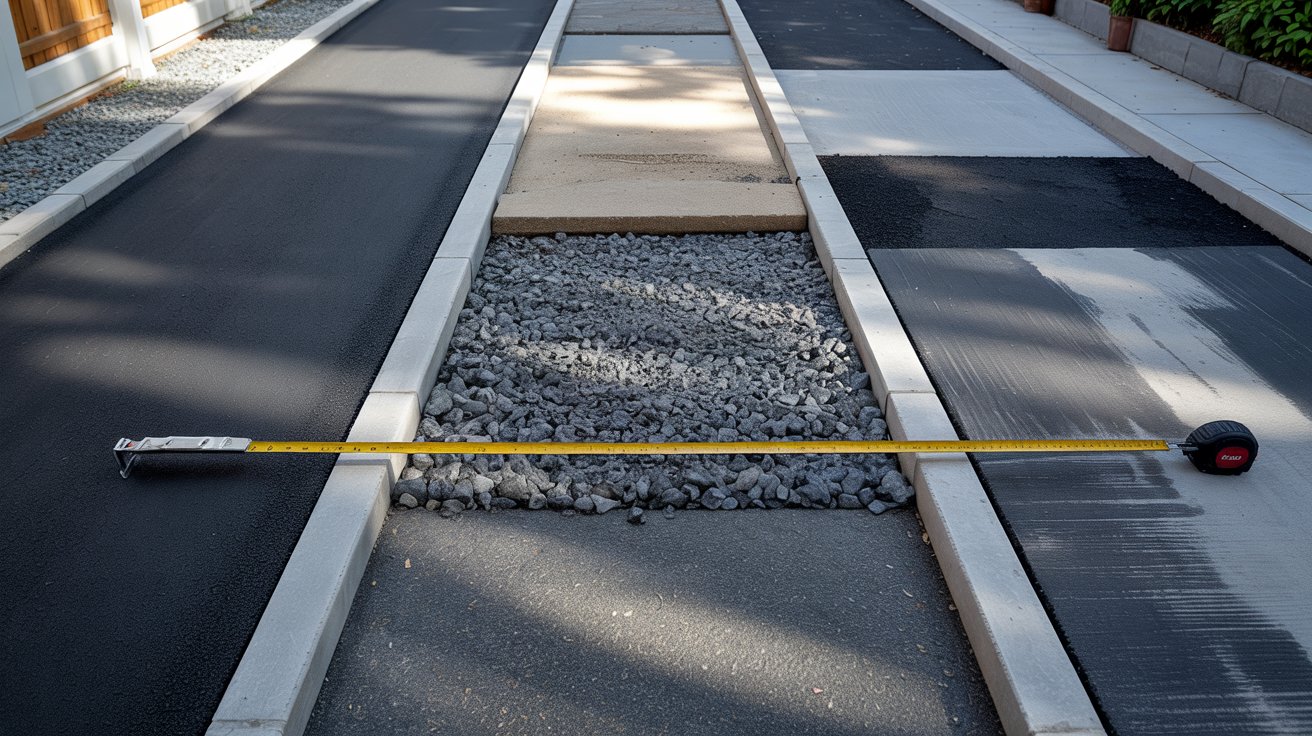
Installed costs swing from under $1 per square foot for gravel to more than $15 per square foot for stamped concrete, and the gap between a rough estimate and the final invoice can easily hit four figures if you skip the prep work.
Material choice drives the largest share of that cost, but it's not the only factor. Base prep, regional labor rates, site grading, and add-ons like drainage and sealant all stack up quickly.
This guide breaks down current installed price ranges for asphalt, concrete, and gravel, then walks through a five-step method to build your own estimate before you call a single contractor.
If you're weighing other outdoor surface upgrades at the same time, the numbers here will give you a useful cost anchor for everything else on your list.
All prices below reflect national averages for installed work in 2024-2025. Your quote will vary based on where you live and what your site needs.
Installed driveway cost ranges from $1–$3/sq ft for gravel to $4–$8/sq ft for asphalt to $6–$15/sq ft for concrete. A standard two-car driveway (400–600 sq ft) typically costs $1,500–$6,000 for asphalt or $3,000–$9,000 for concrete fully installed.
Cost Snapshot by Driveway Material
Getting a realistic number starts with knowing what each material actually costs installed - not just the raw material price, but labor, base prep, and finishing combined. These ranges reflect what homeowners are paying contractors in 2024-2025 across most U.S. markets.
Remember it later
Planning to try this recipe soon? Save it for a quick find later!
A standard two-car driveway runs roughly 400 to 600 square feet, though longer rural runs can push past 1,000 square feet. That size difference alone can double your total bill, which is why per-square-foot pricing matters more than any single project number.
Gravel sits at the bottom of the price range for good reason: installation is fast, materials are cheap, and there's no curing time.
According to gravel driveway pricing data, most homeowners pay $300 to $4,500 for a complete gravel project, with per-square-foot costs landing between $1 and $3 installed.
Concrete is the premium option. Decorative finishes like stamping or exposed aggregate push costs toward $15 per square foot or beyond, but even plain broom-finish concrete rarely comes in below $6 per square foot installed.
| Material | Cost per Sq Ft | Typical Project Total | Lifespan |
|---|---|---|---|
| Gravel | $1–$3 | $500–$1,500 | Ongoing (regrade every 2–5 yrs) |
| Asphalt | $4–$8 | $2,000–$4,000 | 20–30 years |
| Plain Concrete | $6–$10 | $3,000–$5,000 | 30–40 years |
| Stamped Concrete | $10–$15 | $5,000–$7,500 | 30–40 years |
| Pavers | $10–$20 | $5,000–$10,000 | 25–50 years |
You can find detailed per-ton and per-yard pricing breakdowns if you want to price the materials separately - our gravel bulk pricing guide covers exactly that for homeowners sourcing materials directly.
Asphalt vs Concrete: Cost and Durability
These two materials account for most installed driveways in the U.S., and choosing between them comes down to three things: upfront budget, climate, and how much maintenance you're willing to do over time.
Asphalt costs $4 to $8 per square foot installed and typically lasts 20 to 30 years with proper sealing. Concrete runs $6 to $10 per square foot for a plain finish and lasts 30 to 40 years - but it cracks in freeze-thaw climates and is harder and more expensive to repair.
You can review how concrete project pricing breaks down for other surfaces to see how driveway work compares to slabs and patios.
Asphalt wins on upfront cost and cold-climate durability. Concrete wins on long-term lifespan and curb appeal flexibility, especially if you want a decorative finish.
Resealing asphalt every three to five years adds roughly $0.15 to $0.25 per square foot per application - a real but manageable ongoing cost.
- Lower installed cost — typically $2–$4/sq ft cheaper than concrete
- Flexible enough to handle freeze-thaw cycles without cracking
- Faster to install and ready for use within 24–48 hours
- Easier and cheaper to patch when damage occurs
- Longer lifespan — often 30–40 years versus 20–30 for asphalt
- No softening in extreme summer heat
- Decorative options (stamped, stained) not available with asphalt
- Requires less frequent maintenance over its lifetime
If you're in a northern state with hard winters, asphalt is the practical choice. If you're in the Sun Belt and want the surface to last as long as the house, concrete's longer lifespan makes the higher upfront cost worth calculating against lifetime maintenance bills.
Compare how gravel and concrete perform side by side in patio applications for more context on material behavior.

Gravel Driveway Costs and When to Choose It
Gravel is the least expensive driveway surface by a significant margin, and for the right property it's genuinely the smartest choice - not just the budget fallback.
Rural properties with long runs, seasonal-use homes, and wooded lots with natural drainage all benefit from gravel's low cost and easy repair.
Installed cost runs $1 to $3 per square foot, and a complete project - including materials, delivery, grading, and labor - typically lands between $300 and $4,500 depending on size and site prep, according to gravel project cost research.
That makes it the only driveway material where a small property can get a finished surface for a few hundred dollars.
| Cost Component | Typical Range | Notes |
|---|---|---|
| Gravel materials | $0.50–$1.50/sq ft | Crushed stone, pea gravel, or limestone |
| Delivery | $50–$150 per load | Varies by distance from quarry |
| Base prep / grading | $200–$800 | Depends on slope and soil type |
| Labor (spreading) | $0.25–$0.75/sq ft | Often included in contractor quotes |
| Edging/border | $1–$3 per linear ft | Prevents lateral spreading |
| Full project (500 sq ft) | $500–$1,500 | Average two-car driveway |
Three factors drive gravel cost more than anything else: driveway size, required depth, and whether base prep is needed. A stable, well-drained site may need only 4 inches of gravel.
A clay-heavy or poorly drained lot may require a compacted stone base layer underneath, adding $200 to $500 to the job.
- Depth matters: Standard installation calls for 4-6 inches of gravel. Deeper beds cost more but hold up longer and resist rutting.
- Gravel type affects price: Pea gravel ($35-$55 per ton) is cheaper than crushed limestone ($45-$65 per ton), but it shifts underfoot and is harder to drive on.
- Edging is worth adding: Steel or plastic edging at $1-$3 per linear foot stops gravel migration and reduces annual regrading needs.
- Weed fabric saves time: Installing landscape fabric under the gravel adds roughly $0.10-$0.20 per square foot but cuts weeding significantly.
Gravel requires regrading every two to five years as it compacts and migrates. Budget $150–$400 per regrading session if you hire it out, or do it yourself with a landscape rake for the cost of an afternoon.
If you enjoy working with loose stone on other projects, our guide on building a gravel patio yourself uses the same base-prep principles and can save you money on a combined project.
Regional Factors and Common Add-Ons That Raise the Final Price
Two homeowners with identical driveway dimensions can receive quotes that differ by thousands of dollars. Regional labor rates, local permitting rules, and what's already on the ground are the biggest variables that contractors price into every bid.
Labor rates in the Northeast and West Coast run 20-40% higher than the national midpoint. In the South and Midwest, you'll generally find more competitive bids.
According to data on asphalt installation pricing, drainage needs and base prep requirements are the two modifiers that most often catch homeowners off guard on final invoices.
Many municipalities require a permit for new driveway installation, particularly when it connects to a public road. Permits typically cost $50–$200, but skipping one can result in fines or a required tear-out.
- Old surface removal: Tearing out an existing concrete or asphalt driveway adds $1-$2 per square foot, or $500-$1,200 for a standard two-car drive.
- Grading and excavation: Sloped or uneven lots need machine grading, which typically runs $500-$2,000 depending on severity.
- Base prep: Installing a compacted gravel sub-base under asphalt or concrete adds $1-$3 per square foot but is often non-negotiable for long-term performance.
- Drainage solutions: A French drain or channel drain along the driveway edge runs $500-$2,500. If you need a full system, our guide on French drain installation breaks down the process and cost.
- Sealcoating: Applied at the time of installation, sealcoating asphalt costs $0.15-$0.25 per square foot and extends the surface life immediately.
- Heated driveway systems: Electric radiant heating embedded under concrete or pavers adds $12-$25 per square foot - a significant premium for snow-country homeowners.
Site access also matters. Narrow lots, tight entry angles, or overhead obstructions can limit the equipment a contractor can use, which slows labor and raises cost.
Note that a fence along your property line may need to be temporarily removed for equipment access if it runs close to the driveway edge.
Get at least three bids and ask each contractor to itemize base prep separately from materials and labor. That single step makes it easy to compare apples to apples and spot the bid that's cutting corners on the sub-base.
Asphalt driveway costs also shift with petroleum prices, which can move quoted rates by 10-20% within a single year, according to data on asphalt cost variables. Lock in quotes during late fall or winter when demand is lower in most regions.

Estimate Your Driveway Cost in 5 Steps
Before you call contractors, run through this five-step method to build your own working estimate. It won't replace a professional bid, but it tells you whether a quote is in the right ballpark - or wildly off.
This same logic applies whether you're pricing a driveway alone or combining it with a larger outdoor project. A full backyard cost estimator can help you stack these numbers alongside patio, fencing, and landscaping budgets if you're planning multiple improvements at once.
Frequently Asked Questions
Installed costs run $1–$3/sq ft for gravel, $4–$8 for asphalt, and $6–$15 for concrete. Decorative finishes push concrete past $15/sq ft.
Asphalt is cheaper upfront by $2–$4 per square foot, but concrete's 30–40 year lifespan can make it lower cost per year over time.
Gravel installs for $1–$3 per square foot. A full project including delivery, grading, and labor typically runs $300–$4,500 based on size and site conditions.
Base prep and old surface removal are the biggest cost adders — grading alone can run $500–$2,000, and demo adds $1–$2 per square foot on top of materials.
Asphalt lasts 20–30 years with sealing every 3–5 years. Concrete lasts 30–40 years. Gravel has no fixed lifespan but needs regrading every 2–5 years.
Pin it for your next how much does a driveway cost? project.