Large yards punish bad sprinkler choices fast. A unit rated for 3,000 square feet won't cut it on a half-acre, and running four mismatched heads on separate timers wastes water while still leaving dry patches.
This guide ranks the best lawn sprinkler options for large yards by category, then walks through coverage planning, side-by-side comparisons, and honest budget breakdowns.
According to the WaterSense sprinkler benchmarks, efficient sprinkler products can cut outdoor water use by 20-50% compared to standard heads - a meaningful number on a yard that drinks 30+ gallons per watering.
Pairing the right sprinkler with a WaterSense-labeled controller adds weather-based scheduling that prevents overwatering on rainy weeks.
Large yards need high-coverage sprinklers matched to your yard shape, water pressure, and budget. Oscillating heads suit rectangular lawns, impact sprinklers handle irregular terrain, and smart systems cut water waste season-long.
Plan zones before you buy.
Top Picks for Large Yards
The right category matters more than any single brand name. Large lawns - anything over 5,000 square feet - need sprinklers with a high throw radius, adjustable arc, and enough flow rate to cover zones without dropping pressure at the head.
Remember it later
Planning to try this recipe soon? Save it for a quick find later!
Three categories consistently perform at scale: oscillating sprinklers for flat rectangular lawns, impact (rotor) sprinklers for large irregular spaces, and smart in-ground systems for homeowners who want hands-off scheduling. Below are our category leaders with the specs that matter most for large-yard planning.
You can also compare drip irrigation vs. sprinkler systems if your lawn has mixed bed-and-turf zones.
The table below summarizes our top picks by category. GPM figures assume standard residential pressure of 45-55 PSI.
Price tiers reflect current retail ranges for reputable models.
| Category | Coverage | Typical GPM | Price Range | Best For |
|---|---|---|---|---|
| Oscillating (e.g., Melnor 65003) | Up to 5,800 sq ft | 2.8–4.0 | $25–$60 | Flat rectangular lawns |
| Impact / Rotor (e.g., Orbit 58322) | Up to 5,600 sq ft | 1.5–3.5 | $15–$55 | Irregular or sloped yards |
| Smart In-Ground (e.g., Rachio 3) | Per zone, scalable | Variable | $150–$450+ | Water-constrained or large estates |
| Traveling Sprinkler (e.g., Orbit 58322T) | Up to 13,500 sq ft | 2.0–3.0 | $50–$130 | Very large open lawns |
Oscillating Sprinklers
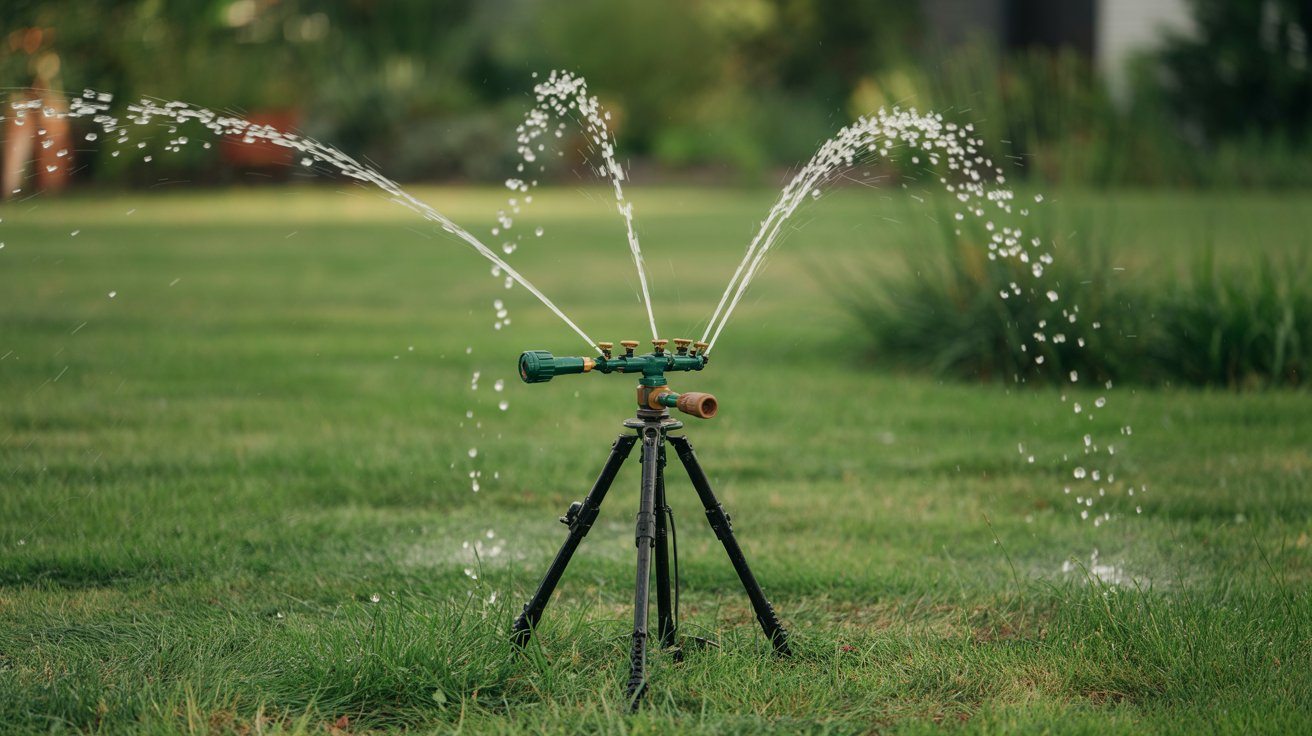
Oscillating heads sweep back and forth in a rectangular pattern, making them near-perfect for standard suburban lots with square edges. Top models cover up to 5,800 square feet and allow you to dial in width and range independently.
Look for metal internals and a turbo-drive gear train - plastic gears strip within two seasons on a large yard running daily cycles. Melnor's XT series and Gilmour's Pattern Master both clear this bar under $60.
Impact Sprinklers
Impact sprinklers use a spring-loaded arm that clicks against the water stream, rotating the head in a slow arc. They handle low-pressure conditions down to 25 PSI better than any other above-ground type, which matters for yards at the end of a long supply line.
Spike-mounted impact heads (like the Orbit 56667) let you reposition coverage without tools. For large lawns with mature trees or flower beds breaking up the turf, a pair of impact heads on risers often outperforms four oscillating units.
Check our full sprinkler system cost breakdown to budget for multi-head setups.
Smart Sprinkler Systems
Smart controllers - particularly WaterSense-certified controllers - adjust run times based on local weather data, soil type, and slope. On a large yard, that intelligence compounds: skipping one unnecessary cycle per week across six zones saves thousands of gallons per season.
The Rachio 3 (8-zone) and RainBird ST8I are the most affiliate-common picks at $150-$200. Both integrate with Amazon Alexa and Google Home.
Installation requires existing in-ground lines or a new pipe run, so budget $500-$1,500 for professional zone installation if starting from scratch.
Plan for Coverage: Map, Zone, and Flow
Buying the right sprinkler is half the job. Without a coverage plan, even premium heads leave dry edges or create runoff on slopes.
CSU Extension's lawn irrigation scheduling guide recommends mapping zones before selecting any equipment - a step most homeowners skip.
Use this five-step sequence before you order anything. It takes about 30 minutes and prevents the most common large-yard mistakes: under-pressure zones, gaps at property edges, and wasted overlap in the middle.
Most residential water meters support 10–15 GPM total. Running more than 3–4 standard sprinkler heads at once can drop pressure below each head's rated threshold, cutting effective coverage radius by 20–30%.
Once zones are mapped, a well-planned year-round lawn care schedule helps you align irrigation cycles with seasonal demand - watering more in July heat and dialing back in September.

Oscillating vs. Impact vs. Smart Sprinklers: Side-by-Side
Each sprinkler type solves a different problem. Choosing wrong costs time and money, so here's a direct comparison across the four factors that matter most for large lawns.
CSU Extension's efficient watering guidance notes that fine-mist oscillating heads lose more water to evaporation and wind drift than rotor or impact heads - a real factor in hot, windy climates.
- Perfectly even water distribution on flat rectangular turf
- Easy adjustment of width and range without tools
- Low cost per square foot covered
- Widely available and simple to replace
- Impact handles low pressure and large radii better than oscillating
- Smart controllers eliminate guesswork and cut seasonal water bills
- Rotor heads lose less water to wind and evaporation
- Smart systems scale across unlimited zones without added hardware
Scenario verdicts: For a flat 10,000-square-foot rectangular backyard, two quality oscillating heads on a timer beat everything at $120 total. For an irregular 15,000-square-foot yard with trees and a slope, three impact heads outperform.
For any lawn above 20,000 square feet or in a water-restricted municipality, a smart controller paired with rotor heads is the only setup worth building. Denver Water's lawn watering tips reinforce that rotating heads deliver more consistent results per gallon in arid and semi-arid regions.
If you're also deciding between fuel types for your mowing setup, our gas vs electric mower comparison follows the same decision framework.
Budget, Value, and Where to Buy
Price tiers in the sprinkler category map closely to durability and zone scalability - not coverage area.
A $25 oscillating head can cover the same square footage as a $200 smart head, but it won't last as long or save as much water over three seasons.
Entry-tier oscillating heads work fine for seasonal use on a budget. Mid-range impact heads in brass or heavy-gauge zinc last 8-12 years versus 2-3 years for plastic-bodied units.
Smart controllers pay back their premium through water savings - CSU Extension's irrigation scheduling data shows weather-adjusted controllers reduce water use by 15-30% annually on large turf areas.
| Tier | Typical Features | Warranty | Best Use |
|---|---|---|---|
| Entry ($20–$55) | Plastic body, fixed arc, basic timer | 1 year | Seasonal, low-frequency use |
| Mid ($40–$120) | Metal internals, adjustable arc, spike mount | 2–5 years | Regular large-yard watering |
| Smart ($150–$300) | Wi-Fi, weather data, app control | 3 years | Daily scheduling, water savings |
| Pro in-ground ($500+) | Pop-up heads, multi-zone valve, controller | 5–10 years | Permanent large-estate systems |
Buy from retailers that stock replacement nozzles and O-rings for the brand you choose. Amazon, Home Depot, and Walmart carry the widest parts inventory for Orbit, Melnor, Rainbird, and Hunter.
Our roundup of lawn and garden equipment reviews covers accessories and add-ons for each brand.
Denver Water's watering efficiency tips also note that watering in early morning (before 10 a.m.) reduces evaporation loss by up to 30%, extending the effective value of any sprinkler tier.
For a drip-based alternative on mixed yards, compare options in our top drip irrigation kits guide.

Installation, Maintenance, and Optimization
A solid setup takes under two hours for above-ground systems and prevents 90% of common coverage problems. Follow these steps each season.
Set your controller to cycle-and-soak on slopes: run each zone for 8 minutes, pause 30 minutes, then repeat. This prevents runoff on grades above 5% and gets water deeper into the root zone.
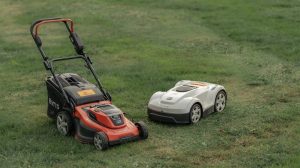
Pairing your sprinkler setup with smart summer garden maintenance habits - adjusting run times as temperatures climb - keeps large lawns green without overwatering. Also consider a robot lawn mower to reduce soil compaction from foot traffic, which improves water absorption over time.
For a complete equipment picture, our drip irrigation setup guide covers hybrid lawn-and-bed configurations, and the best mower for small yards is worth bookmarking if you manage multiple properties.
Frequently Asked Questions
For rectangular lawns over 5,000 sq ft, a quality oscillating head covers up to 5,800 sq ft per unit. Irregular or sloped yards over 10,000 sq ft perform better with impact sprinklers set to 45 PSI.
Divide total lawn area by each head's rated coverage, then add 15% for head-to-head overlap. A 15,000 sq ft yard typically needs 3–4 oscillating heads or 2–3 impact heads per zone.
Yes, on lawns with 4+ zones. WaterSense-labeled smart controllers save 15–30% on water annually, typically paying back their $150–$300 cost within 3 seasons through lower utility bills.
Oscillating heads sweep in a rectangular pattern using fine streams; rotor/impact heads rotate in a circle using larger droplets. Rotor heads lose less water to wind and work at pressures as low as 25 PSI.
Break the irregular shape into rectangles and triangles, calculate each area separately, and sum them. Add 15% overlap to your total when selecting the number of heads needed per zone.
Pin it for your next best lawn sprinkler for large yards project.