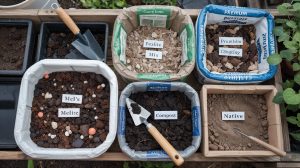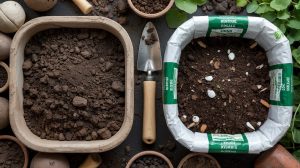
Soil texture is the single factor that controls how fast water drains away, how much moisture roots can access between rains, and whether nutrients stay put or wash out with the next watering.
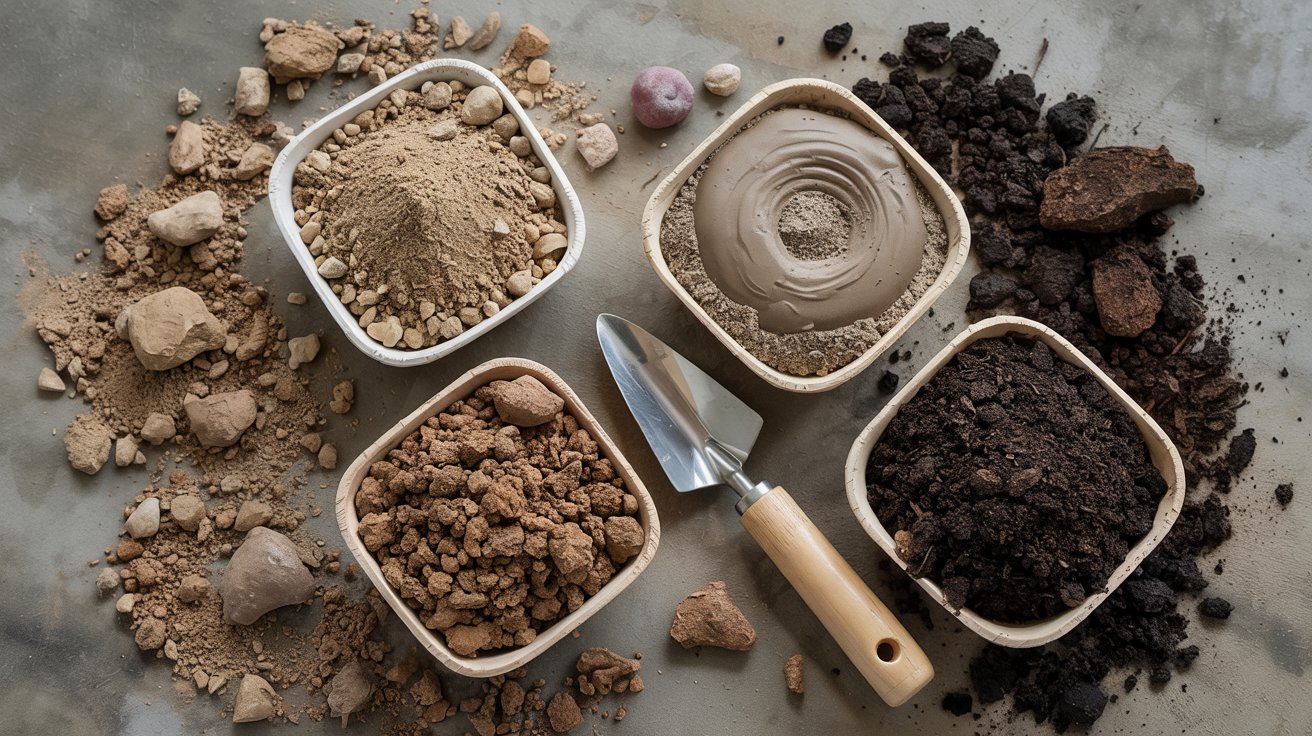
Most gardeners buy amendments or adjust their watering schedules without knowing what texture they're working with-and that's usually where the trouble starts.
The three mineral particles that build every soil are sand, silt, and clay. Their relative proportions determine everything else.
Understanding texture doesn't require a lab. A handful of damp soil and a mason jar can tell you most of what you need to know, and that knowledge changes how you water, fertilize, and amend your beds.
If you want to build better growing conditions from the ground up, texture is where to start.
This hub defines each soil type, shows you how to identify your texture at home, walks through the full USDA classification system, and offers region-specific amendment guidance you can apply this season.
Garden soil texture is determined by the ratio of sand, silt, and clay particles. Each texture affects drainage, water retention, and nutrient storage differently.
Loam—a balanced mix of all three—is the benchmark for most crops. Testing your soil takes minutes and guides every amendment decision.
Types of Garden Soil: Sand, Silt, Clay, and Loam
Soil texture describes the proportion of sand, silt, and clay particles in a given sample. soil texture basics from Oregon State Extension confirm that these proportions are fixed-you can't change the mineral ratio, only work with or around it through amendments and management.
Remember it later
Planning to try this recipe soon? Save it for a quick find later!
Each particle type behaves differently in the ground. Sand grains are the largest (0.05-2 mm), feel gritty between fingers, and create large pores that drain quickly.
Silt particles (0.002-0.05 mm) feel smooth or floury and hold moderate moisture. Clay particles are the smallest (under 0.002 mm), feel sticky and plastic when wet, and pack together tightly.
Loam is not a separate mineral type. It's a textural class defined as a roughly balanced mixture-typically around 25-50% sand, 25-50% silt, and under 27% clay-that stores enough water yet drains well enough to prevent waterlogging.
Most vegetables and ornamentals perform best in loam or near-loam soils.
| Texture | Particle Size | Drainage | Water Retention | Nutrient Storage |
|---|---|---|---|---|
| Sand | 0.05–2 mm | Very fast | Very low | Poor |
| Silt | 0.002–0.05 mm | Moderate | Moderate | Moderate |
| Clay | <0.002 mm | Slow | High | High (but locked) |
| Loam | Mixed | Good | Good | Best overall |
Clay soils hold more total water and nutrients than any other texture, but that doesn't always help plants. Much of the water in clay is held at tensions roots can't overcome, making it unavailable for uptake even when the soil looks wet.
Loam avoids this trap by balancing pore sizes.
Sandy soils, by contrast, lose both water and dissolved nutrients with nearly every rain event. Gardeners working sandy ground often need to water every 2-3 days in summer and apply fertilizer in smaller, more frequent doses.
Understanding your texture class is what makes those decisions accurate rather than guesswork. You can also explore reliable soil testing kits to confirm texture and pH together.
Texture and Drainage: How Soil Texture Affects Water Movement
Pore space is the hidden variable. Sand creates large macropores that drain in minutes but dry out fast.
Clay creates tiny micropores that drain slowly, hold water tenaciously, and restrict the oxygen movement roots need to survive. Silt sits between the two extremes in every measurable way.
The USDA texture triangle documents how texture governs water and nutrient holding capacity simultaneously-the same structure that slows drainage also increases cation exchange capacity (CEC), which is the soil's ability to hold positively charged nutrient ions like calcium, potassium, and magnesium.
| Texture | Drainage Rate | Plant-Available Water | Aeration | CEC (meq/100g) |
|---|---|---|---|---|
| Sand | Fast (>25 mm/hr) | Low (5–8%) | Excellent | 2–4 |
| Silt loam | Moderate (6–12 mm/hr) | High (18–23%) | Good | 10–15 |
| Clay | Slow (<1 mm/hr) | Moderate (15–18% available) | Poor | 20–60 |
| Loam | Moderate (6–12 mm/hr) | High (18–22%) | Good | 12–25 |
Clay's high CEC sounds like an advantage, and in some ways it is. The problem is compaction and anaerobic conditions-when clay stays waterlogged, soil oxygen drops and beneficial microbes die off, locking those nutrients away from plant roots.
Sandy soils have the opposite problem. Nutrients applied as fertilizer dissolve and leach through the profile before roots can absorb them, requiring more frequent feeding to compensate.
If water pools on your bed for more than 30 minutes after an inch of rain, you likely have a clay-dominated texture. Sandy soil that dries out within 24 hours of watering signals low water-holding capacity and benefits from organic matter additions before the next season.
Loam's advantage isn't a single dramatic property-it's the absence of extremes. A comparison of topsoil and garden soil products often comes down to which one approximates loam texture most closely in your region.
Identify Your Soil Texture at Home: Hand Test and Jar Test
Two field methods give reliable texture estimates without any lab equipment. The ribbon (hand-feel) test works in minutes.
The jar test takes a few hours but gives a visual, quantitative breakdown of particle fractions in your sample.
Before either test, collect soil from at least 4-6 spots in your bed, at a depth of 4-6 inches, and combine them into one composite sample. Remove visible rocks, roots, and debris, then moisten the soil to a dough-like consistency-damp but not dripping.
This matters because dry soil won't form ribbons regardless of clay content.
Both tests have error margins. The hand test is highly skill-dependent, and organic matter can mimic clay behavior if present in high amounts.
For beds where the texture class is ambiguous, a certified soil lab test costs $15-$30 and eliminates guesswork entirely. Pair that with a well-made compost routine and you'll have hard data to guide every amendment decision.
The USDA Texture Triangle: The 12 Textural Classes
The USDA system divides all possible sand-silt-clay combinations into 12 named textural classes. Each class represents a range of particle proportions, and knowing yours tells you which water, drainage, and fertility behaviors to expect without any additional testing.
Gravel and coarse fragments (particles over 2 mm) are excluded from the texture triangle itself-they don't contribute to water or nutrient storage-but they modify field behavior significantly. A gravelly sandy loam drains faster and has less plant-available water than a clean sandy loam.
USDA texture classes are assigned based on the fine-earth fraction only, with gravel noted separately in the full soil description.
| Textural Class | Key Characteristic | Garden Drainage |
|---|---|---|
| Sand | 90%+ sand | Very fast — needs frequent water |
| Loamy sand | High sand, slight cohesion | Fast |
| Sandy loam | Dominated by sand, some silt/clay | Fast–moderate |
| Loam | Balanced mix; ideal for most crops | Moderate — best all-around |
| Silt loam | Silt dominant; smooth feel | Moderate |
| Silt | Near-pure silt; rare in gardens | Moderate–slow |
| Sandy clay loam | Moderate clay, gritty | Moderate–slow |
| Clay loam | Balanced clay and silt | Slow |
| Silty clay loam | High silt and clay | Slow |
| Sandy clay | High sand and clay, low silt | Slow — compacts under traffic |
| Silty clay | High silt and clay, plastic | Very slow |
| Clay | 40%+ clay; heavy and plastic | Very slow — needs amendment |
Most home garden beds fall into sandy loam, loam, silt loam, or clay loam categories. Pure clay and pure sand are uncommon in managed gardens but do appear in new construction sites where topsoil has been stripped, and in naturally sandy coastal or riverine soils.
Knowing your class means you can match plants to conditions or amend with a specific target in mind rather than applying generic bag-of-amendment advice. Growing heavy-feeding plants like high-performance garden roses in clay loam, for example, requires active drainage improvement before planting.
Amending Soil Texture: How to Improve Sandy and Clay Soils
Amendments can't change a soil's mineral particle size-that's fixed geology. What they can do is alter soil structure, which determines how particles clump together, how pores form, and ultimately how water and roots move through the profile.
For sandy soils, the goal is increasing water and nutrient retention. Organic matter-compost, aged manure, or leaf mold-is the most effective tool.
Adding 2-4 inches of compost and working it into the top 8-12 inches raises organic matter content, improves CEC, and slows drainage without reducing aeration. According to organic amendment research from Colorado State Extension, organic amendments increase organic matter content and improve aeration, water infiltration, and nutrient holding capacity simultaneously.
For clay soils, the amendment approach is different. Organic matter again leads the list-it promotes aggregation, which creates macropores in otherwise tight clay.
Cover crops with fibrous roots (like annual ryegrass or radish) also break clay structure mechanically over a single season. What to avoid:
- Adding sand to clay: Small amounts of sand fill the pore spaces in clay without improving drainage, producing a concrete-like mixture that's worse than either material alone.
- Inorganic amendments alone: Products like perlite or coarse grit improve drainage temporarily but don't feed soil biology or build CEC.
- High-salt amendments: Some composted manures carry high soluble salt loads. Check the EC (electrical conductivity) rating before applying to salt-sensitive crops.
Never add sand directly to clay soil as a drainage fix. The sand particles fill clay's existing micropores and the result compacts harder than the original clay. Use finished compost or aged wood chips instead, applied annually at 1–3 inches per season.
Organic amendments break down over 1-3 years, so improvements need repeating. Mulching over amended beds with organic mulch options slows moisture loss and feeds the amendment layer as it decomposes.
For container situations where native soil isn't a factor, check high-quality potting mixes formulated for specific drainage needs.
Regional Tips and Quick Reference for Your Climate
Soil texture tendencies aren't random-they follow geology and climate. Knowing your region's typical texture saves time and money by pointing you toward the right amendment category before you even test.
The University of Maryland Extension's soil basics resource notes that texture varies widely even within small landscapes, but regional patterns still hold. Using your local extension service to find baseline texture data for your county is faster than starting from scratch.
A reliable home soil test kit gives you a site-specific starting point to layer over those regional baselines.
| Region | Common Texture | Primary Challenge | First Amendment Move |
|---|---|---|---|
| Pacific Northwest | Silt loam to clay loam | Winter waterlogging | Raised beds, compost, cover crops |
| Southeast US | Sandy loam to loamy sand | Low water/nutrient retention | Heavy compost additions annually |
| Midwest (corn belt) | Silt loam to silty clay loam | Compaction under wet traffic | Avoid tillage when wet; add organic matter |
| Southwest / Arid West | Sandy loam to loamy sand | Salinity, rapid drainage | Low-salt compost; drip irrigation |
| Northeast US | Glacial till; variable | Rocky, acidic, variable drainage | pH test first; lime + compost as needed |
In arid climates, salt accumulation is a secondary concern-irrigation water deposits minerals, and amendments need to have low EC ratings to avoid making that worse. In humid regions, the priority shifts to drainage and compaction prevention.
Plants like drought-tolerant succulents are naturally matched to sandy, fast-draining soils and need no drainage amendments at all. Knowing how to apply mulch effectively is especially valuable in hot, dry regions where surface moisture loss undoes amendment gains quickly.
Your local cooperative extension office publishes county-level soil surveys that identify your probable texture class before you dig a single hole-a step worth taking before any major bed renovation.
Frequently Asked Questions
Sand particles (0.05–2 mm) drain fast and hold little water. Silt (0.002–0.05 mm) is smooth and holds moderate moisture. Clay (under 0.002 mm) drains slowly but stores the most nutrients.
Finished compost applied at 2–3 inches annually is the most reliable fix. Fibrous cover crops like radish also break clay structure. Never add sand—it creates a near-concrete mixture.
Work 2–4 inches of compost into the top 8–12 inches each season. This raises cation exchange capacity and slows drainage without reducing the aeration that sandy soils do well.
High organic matter floats rather than settling, so it skews jar test results. Remove visible organic debris before testing, and treat heavily amended soils as approximate rather than definitive.
Most organic amendments decompose within 1–3 years depending on climate and soil biology. Annual top-dressing with 1–2 inches of compost maintains structure improvements in active garden beds.
Pin it for your next garden soil types explained project.