Walk into any garden center and you'll find both landscape fabric and bags of mulch stacked side by side, with no guidance on which one actually belongs in your yard.
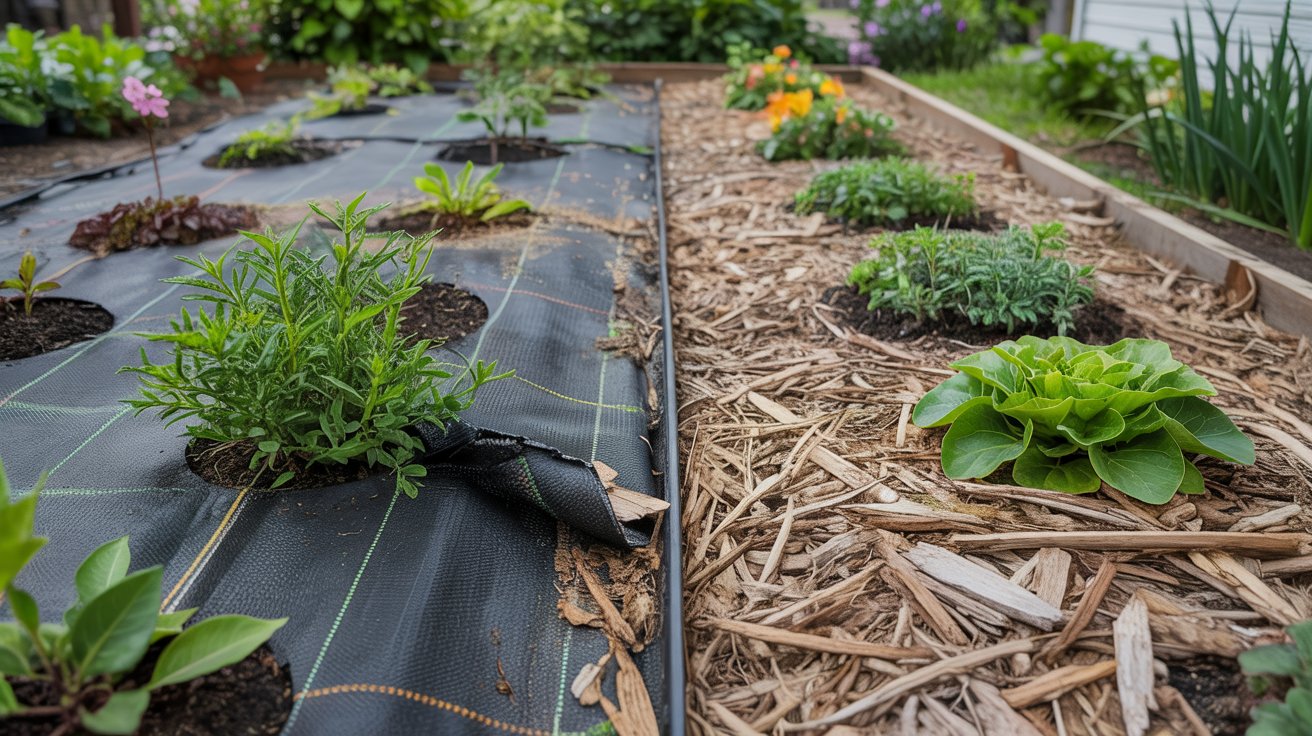
Most gardeners grab one or the other based on gut feel, then spend years dealing with the consequences - fabric that weeds punch through anyway, or mulch beds that need topping off every spring.
This comparison cuts through the noise.
Weed barrier fabric and mulch solve the same surface problem - unwanted plants stealing water and nutrients - but they work through completely different mechanisms and leave your soil in very different states five years from now.
Before you buy anything, check out which mulch type fits your bed to understand what organic options are actually available for your situation.
Finish this article and you'll know the right call for your specific bed, a realistic cost estimate, and a step-by-step plan ready for this weekend.
Weed barrier fabric offers faster, stronger short-term weed suppression but degrades over time and harms soil biology. Organic mulch builds soil health, retains moisture naturally, and requires periodic top-offs.
For most residential garden beds, mulch at 4 inches depth is the better long-term choice.
Weed Barrier vs Mulch: The Verdict
If you're protecting a permanent border with no future planting plans - think gravel paths, utility-zone shrubs, or hardscape edges - fabric under mulch can make sense.
Remember it later
Planning to try this recipe soon? Save it for a quick find later!
According to UC IPM, landscape fabric research confirms that fabric beneath mulch outperforms mulch alone on weed control when installed correctly.
For any bed where you plant seasonally, move things around, or care about long-term soil structure, mulch alone is the smarter call.
The University of Illinois Extension is direct: fabric isn't permanent and creates mounting maintenance problems over time as debris accumulates on top and weeds root into the material itself.
The core tradeoff comes down to timeline. Fabric front-loads your weed control; mulch distributes it.
Short-term ease versus long-term health is the real decision, not just cost.
Colorado State Extension recommends 4 inches of mulch as the target depth for effective weed suppression in most landscape beds - a benchmark worth keeping in mind as you plan material quantities.
Weed Suppression and Soil Health
Fabric works by blocking sunlight at the soil surface, which prevents weed seeds from germinating. It's effective early - but debris, dust, and decomposed mulch accumulate on top over time, creating a growing medium that airborne seeds use without hesitation.
Organic mulch suppresses weeds differently. It smothers germinating seeds through physical depth while also releasing allelopathic compounds that inhibit some species.
Learn how to apply mulch to garden beds correctly to get the most from both effects.
Penn State Extension found that landscape fabric can lead to serious plant health and soil condition problems after several years of use. Roots from established shrubs grow into and through the fabric, making removal a significant project.
Soil biology is where the two options diverge most sharply. Earthworms, beneficial fungi, and microbial communities all depend on organic matter cycling from the surface downward.
Mulch feeds this process continuously as it decomposes.
Fabric cuts off that cycle. It restricts oxygen exchange, slows water infiltration, and - over time - creates a compacted, biologically depleted layer beneath it.
| Factor | Weed Barrier Fabric | Organic Mulch (4") |
|---|---|---|
| Year 1 Weed Control | 90–95% effective | 70–80% effective |
| Year 5 Weed Control | Declining; roots in fabric | Consistent with top-offs |
| Earthworm Activity | Reduced significantly | Supported and increased |
| Soil Organic Matter | No contribution | Adds 0.5–1" per year |
| Microbial Diversity | Suppressed under fabric | Active and diverse |
| Removal Difficulty | High after 5+ years | N/A — no removal needed |
When you layer compost under mulch before planting, you set up a self-improving system. The mulch on top slows weed germination while also feeding the compost layer beneath.
Understanding how organic inputs differ from synthetic ones helps clarify why this soil-building approach compounds in value over time.
Colorado State Extension's guidance on mulch depth and soil biology underscores that a 4-inch organic layer consistently improves soil structure season after season - something no synthetic fabric can replicate.
If you want to kill weeds without chemicals, mulch at proper depth is one of the most effective non-toxic tools available. Fabric is the other - but only while it's intact and debris-free.
Moisture, Temperature, and Drainage Impacts
Both options reduce soil moisture loss, but they behave differently as temperatures swing. Organic mulch acts as a buffer - it slows evaporation in summer heat and moderates soil temperature swings that stress roots.
University of New Hampshire Extension recommends 2-3 inches near plant bases and 2-4 inches across bed surfaces to balance moisture retention with adequate airflow at the crown.
Fabric traps heat more aggressively. On a hot July afternoon, soil under black landscape fabric can run 10-15°F warmer than mulched soil nearby - a meaningful stress factor for shallow-rooted perennials.
If you choose to layer fabric under mulch, apply the mulch at 2–3 inches rather than 4 — the fabric handles light blocking, so you only need the mulch layer for temperature regulation and appearance. Keep mulch pulled back 2 inches from all plant stems.
Drainage is another gap. Utah State University Extension research on water-wise mulch application shows that compacted or poorly installed fabric layers reduce infiltration rates, directing rainfall as runoff rather than absorbing it.
A simple organic mulch layer at 3-4 inches keeps drainage natural while still slowing evaporation.
For beds comparing different mulch materials on drainage, organic wood-based options consistently outperform synthetic alternatives on moisture cycling. Both fabric and rubber mulch share the drainage limitation that organic options don't.
Costs, Installation, and Maintenance
Material costs favor mulch by a wide margin for most residential projects. A basic woven landscape fabric runs $0.10-$0.50 per square foot for materials, but total installed cost - including pins, labor, and edge cutting - typically lands between $0.50 and $1.50 per square foot according to cost data from landscape fabric installation sources.
For a 100 sq ft bed, expect $50-$150 upfront.
Mulch runs significantly cheaper up front. Estimate your mulch budget per cubic yard to confirm quantities - a 100 sq ft bed at 4 inches needs roughly 1.2 cubic yards, typically costing $30-$60 delivered.
Fabric maintenance costs are often underestimated. After year three, fabric beds require regular removal of debris that accumulates on top, patching of torn sections, and management of weeds rooted into the fabric itself.
Mulch maintenance is simpler: add 1-2 inches each spring to compensate for decomposition. Over a five-year window, a mulch-only bed typically costs 30-40% less than a fabric bed of the same size when you account for annual upkeep.
- Fabric hidden costs: Landscape pins ($10-$20), edge overlap material, and eventual removal labor - fabric pulled up after 7+ years often takes hours and tools.
- Mulch efficiency tip: Apply in fall after cutting back perennials; the mulch protects roots over winter and you get double duty from one application.
- Comparing wood types: Hardwood vs softwood longevity affects how often you top off - hardwood bark breaks down slower and stretches your annual budget further.
For large projects over 500 sq ft, the math shifts slightly - fabric's stronger first-year suppression can offset the higher install cost if weed pressure is extreme and replanting is not planned.
Best-fit Scenarios and Quick Decision Flow
Run through these four questions to land on the right choice in under ten minutes. Each answer narrows your path.
The practical summary: use fabric only for permanent, non-replanted zones with extreme weed pressure. Use mulch for everything else.
Comparing mulch against rock landscaping follows a similar logic — rock suits permanent hardscape zones but warms soil and offers no biological benefit, much like fabric.
- Fabric is right when: You have a permanent shrub border, extreme perennial weed history, no replanting plans, and budget for professional installation.
- Mulch is right when: You have a living bed, seasonal planting habits, soil health concerns, or a limited budget. Refer to soil health fundamentals to build a soil-first foundation before choosing any surface treatment.
- Both together work when: Weed pressure is high, the bed is semi-permanent, and you apply mulch on top of fabric at 2-3 inches to reduce heat buildup and improve appearance.
The best-fit choice isn't about which product looks tidier in the store - it's about which one still makes sense in your garden five years from now. For most home gardeners, that answer is mulch.
Frequently Asked Questions
No. Landscape fabric typically lasts 5–10 years before degrading; weeds eventually root into the material itself, making removal difficult.
Yes, if you use fabric — apply 2–3 inches of mulch on top to reduce heat buildup and prevent UV degradation of the fabric itself.
Apply 4 inches of organic mulch for reliable weed suppression in most landscape beds; keep it at 2–3 inches directly around plant stems.
Cardboard sheet mulching (lasagna method), thick newspaper layers, and 4-inch organic mulch all suppress weeds without the long-term soil drawbacks of synthetic fabric.
Woven polypropylene fabric typically lasts 5–10 years; cheaper non-woven versions may degrade in as few as 3 years under UV exposure and foot traffic.
Pin it for your next weed barrier fabric vs mulch project.