Picking between gravel and concrete for your patio comes down to three things: budget, how long you plan to stay, and how much upkeep you're willing to do. Get those three right and the choice almost makes itself.
Gravel runs $1.50-$4.00 per square foot installed. Concrete lands at $4-$8.
That gap shrinks over a 25-year window once you factor in concrete's near-zero annual maintenance.
Neither material is universally better. Gravel wins on speed, drainage, and first cost.
Concrete wins on durability, comfort underfoot, and resale appeal. We'll walk through each dimension so you leave with a clear answer, not just more options.
If you're also weighing whether a patio makes sense over a deck entirely, our patio vs. deck comparison covers that ground first.
Gravel costs less upfront and installs fast, but needs annual raking and edging. Concrete costs more initially yet lasts 20–30 years with minimal work.
Budget-conscious or rental-property owners lean gravel. Long-term homeowners with stable ground lean concrete.
Gravel vs Concrete: The Verdict
Both materials make a functional patio. The right one depends on your timeline, climate, and whether you want a surface you maintain or a surface you ignore.
Remember it later
Planning to try this recipe soon? Save it for a quick find later!
Gravel installs in a weekend for a fraction of the concrete price. According to patio cost data, gravel runs $1.50-$4.00 per square foot while concrete lands at $4-$8 per square foot installed.
That's roughly a 2-3× price gap before you ever sit outside.
Concrete, meanwhile, earns its cost back through longevity. Mississippi State University Extension research puts concrete patio lifespan at 20-30 years with basic care.
A gravel patio can last just as long structurally, but it needs regular top-offs and re-raking to stay tidy.
Comfort is an underrated factor. Concrete gives you a flat, hard surface where furniture legs sit square and heels don't sink.
Gravel shifts under chairs and can be awkward in dress shoes.
Drainage flips the equation in wet climates. Gravel lets rain pass straight through with zero runoff calculations.
Concrete requires a 1-2% slope away from the house to prevent pooling, which adds layout complexity and cost.
For a fuller picture of how concrete stacks up against other hard surfaces, see how concrete compares to pavers in our dedicated breakdown.
Costs and Lifespan: What It Really Costs Over Time
Upfront price is only part of the story. Lifecycle cost - what you pay over 10, 20, or 30 years - often reverses the apparent savings of the cheaper option.
A typical ground-level patio runs $3,000-$5,500 total according to industry cost data, though that range widens fast with size and site prep.
A 200-square-foot gravel patio might cost $600-$800 in materials alone if you install it yourself, while the same size in concrete typically runs $1,500-$2,500 with a contractor.
Gravel has hidden recurring costs. You'll spend $50-$150 per year topping off displaced stone, pulling weeds that push through landscape fabric, and re-edging the border.
Over 20 years, that adds $1,000-$3,000 to the "cheap" option.
Concrete's main recurring cost is sealing, which runs $0.25-$0.75 per square foot every 3-5 years. On a 200-square-foot slab, that's roughly $50-$150 per seal cycle - far less than annual gravel maintenance.
- Gravel 20-year cost (200 sq ft): $800-$4,500 depending on DIY vs. pro install plus annual upkeep.
- Concrete 20-year cost (200 sq ft): $1,500-$3,600 covering install plus sealing every 4 years.
- Break-even point: Concrete typically matches gravel's total cost at roughly the 8-12 year mark.
You can get a more detailed breakdown of how to budget your patio project before committing to either material. If you want to understand concrete pricing specifically, our concrete pricing guide covers contractor quotes, thickness options, and finish upgrades.
For gravel, raw material price varies by stone type. Pea gravel and crushed limestone are the most affordable.
Decomposed granite costs slightly more but compacts firmer underfoot. Check our guide on gravel material costs to compare stone types before ordering.
Order gravel by the ton, not the bag. A ton of pea gravel covers roughly 100 square feet at 2 inches deep and costs $30–$50 delivered, versus $6–$8 per 0.5-cubic-foot bag at a big-box store.
Durability, Maintenance, and Practicalities
Both materials can last decades, but they fail in different ways and for different reasons. Knowing the failure modes helps you pick the right surface for your specific yard conditions.
Concrete cracks. Freeze-thaw cycles in Zones 4-6 are the main culprit - water enters micro-pores, freezes, expands, and widens gaps over time.
A proper 4-inch slab with control joints every 8-10 feet manages this well, but poorly poured concrete can crack within 3-5 years.
| Task | Gravel | Concrete |
|---|---|---|
| Weed control | Landscape fabric + annual pulling | None if sealed |
| Surface leveling | Rake annually | Not needed |
| Sealing | Not required | Every 3–5 years |
| Crack repair | Add gravel, done | Epoxy filler, $20–$50 |
| Winter prep | None needed | Avoid de-icing salts |
| Drainage management | Natural, zero effort | Requires slope or French drain |
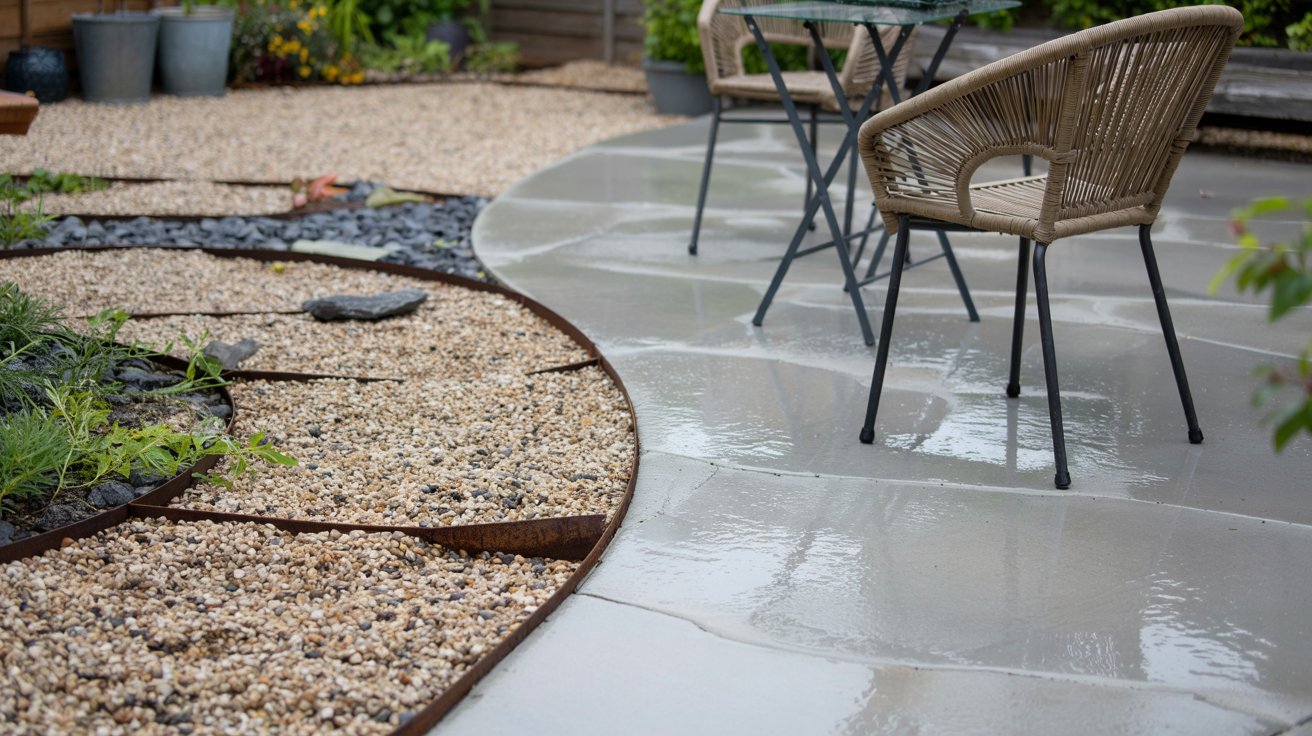
Gravel's biggest maintenance burden is migration. Without solid edging - steel, aluminum, or concrete borders - gravel wanders into lawn and garden beds constantly.
Plan for edging as a non-optional cost.
Seasonal maintenance for both surfaces is manageable but different. Research on hardscape seasonal care confirms that consistent upkeep extends patio lifespan significantly regardless of material.
For concrete, that means keeping de-icing salts away in winter - they accelerate surface spalling fast.
- Gravel in cold climates: Frost heave can displace gravel borders and edging. Re-seat edging each spring.
- Concrete in hot climates: Thermal expansion matters. Control joints are critical in Zone 8+ to prevent buckling.
- Gravel drainage: Fully permeable - zero runoff added to your yard's water load.
- Concrete drainage: Impermeable surface requires deliberate slope planning or a catch drain at the perimeter.
If your yard already has drainage problems, retaining wall solutions paired with gravel are often more practical than pouring concrete over unstable or saturated ground.
Never pour concrete over clay-heavy soil without proper compaction and a gravel base. Clay expands when wet and can lift a slab by ½–1 inch, cracking it within a season.
For homeowners still comparing hard surface options, our guide on stamped concrete vs. pavers adds another layer to this decision if aesthetics are a priority.
Quick Path to Decision and Upgrade Paths
If budget is tight right now, gravel is a legitimate starting point - not a compromise. According to patio installation data, gravel is both the cheapest and fastest patio option to install, making it a practical placeholder while you save for concrete.
The upgrade path from gravel to concrete is straightforward if you plan for it upfront. Set your edging at the correct height from day one, compact your base layer to 4-6 inches, and keep the area level.
When you're ready to pour, remove the gravel, verify base depth, and you've already done much of the prep work.
In freeze-thaw zones (USDA Zones 3–6), a gravel patio actually holds up better short-term than freshly poured concrete. Wait until ground conditions stabilize before committing to concrete if you're in a region with hard winters.
A few real-world caveats apply to any upgrade plan.
- Slope correction: If your gravel area isn't graded correctly, fixing it before concrete is far cheaper than re-pouring later.
- Permit requirements: Some municipalities require permits for permanent hardscape over a certain size. Check local rules before pouring.
- Ground stability: Expansive soils or areas prone to settling need professional assessment before any concrete work.
- Timeline: Gravel is usable the same day. Concrete needs 24-48 hours to walk on and 28 days to reach full cure strength.
Want to see how a gravel patio goes together before you commit? Our step-by-step gravel patio build walks through the full process from excavation to edging.
For broader backyard planning context, our backyard hardscape overview covers how patios, paths, and fencing interact as a system.
If fencing is also on your list, knowing your fence installation budget alongside patio costs helps you prioritize projects in the right order.

Frequently Asked Questions
Concrete lasts 20–30 years structurally. Gravel lasts indefinitely with annual top-offs, but the surface shifts and requires more ongoing labor to stay functional.
Yes. Gravel runs $1.50–$4.00 per square foot installed, making it the lowest upfront cost of any patio surface, especially as a DIY project.
Yes. Gravel is fully permeable, allowing rainwater to drain straight through with no runoff. This makes it ideal for yards with poor drainage or storm-water restrictions.
Seal it every 3–5 years, avoid de-icing salts in winter, and fill any cracks with epoxy filler promptly to prevent water infiltration from widening them.
Gravel is one of the most DIY-friendly patio options. Most homeowners complete a 200-square-foot gravel patio in a single weekend with basic tools and rented compactor.
Pin it for your next gravel vs concrete patio project.