Picking between a pergola and a gazebo feels simple until you're standing in a lumber yard with a $15,000 gap between the two quotes in your hand.
Both structures add outdoor living space, but they solve different problems - and buying the wrong one means living with a structure that either cooks you in summer or sits unused because it feels too permanent for your rental.
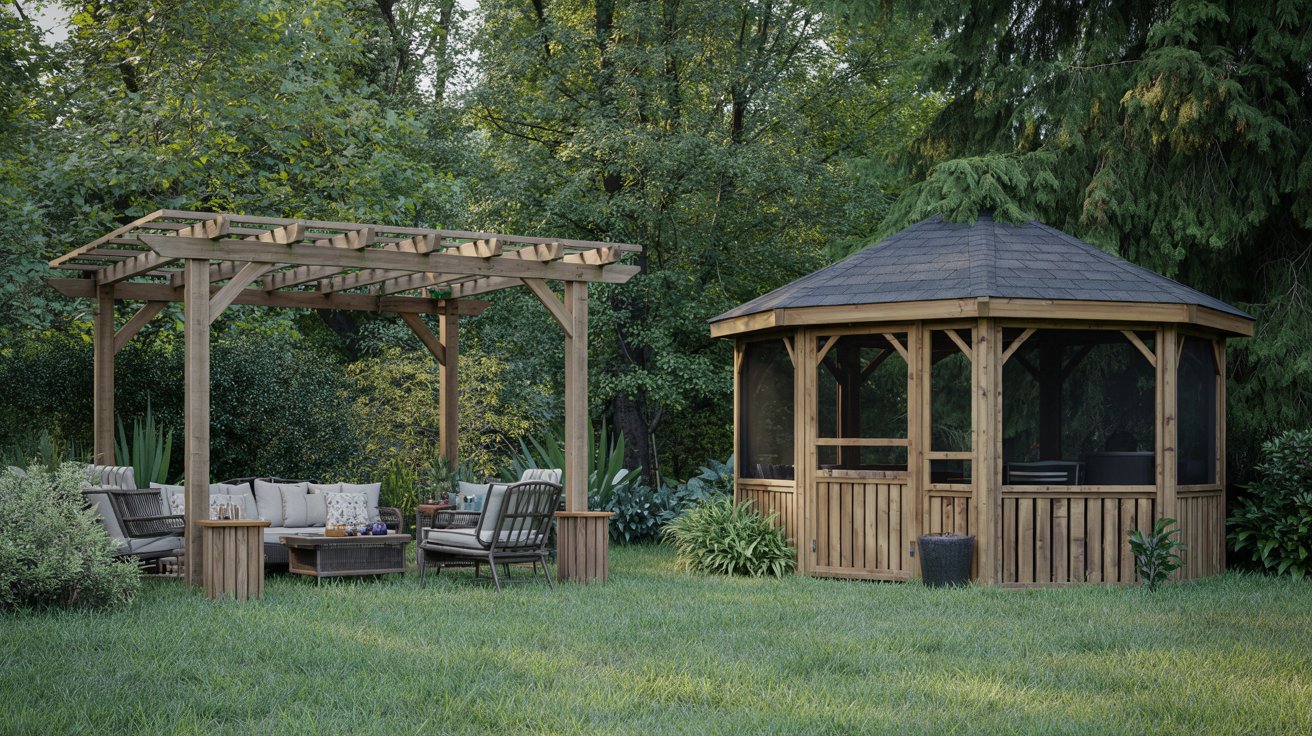
A pergola is an open-frame structure with a slatted or lattice roof that filters light without blocking it entirely. A gazebo uses a solid roof and, often, partial side enclosures to deliver true weather protection.
If you're also budgeting fence installation costs or a new deck alongside your shade structure, the price gap between these two options matters a lot. We'll give you real numbers for both.
This comparison covers cost ranges, roof performance, materials, and a decision framework so you finish reading with a clear direction - not a longer list of questions.
A pergola suits mild climates and open-air aesthetics at a lower upfront cost. A gazebo delivers full weather protection and year-round usability at a higher price.
Your climate, budget, and how much shelter you actually need are the three deciding factors.
Head-to-Head Verdict: Pergola vs Gazebo
The clearest way to split these two structures is by what they protect you from. University of Illinois Extension notes that pergolas provide partial shade through an open framework, while gazebos offer more enclosed protection under a solid roof.
Remember it later
Planning to try this recipe soon? Save it for a quick find later!
That single difference drives nearly every other tradeoff - cost, maintenance, ventilation, and year-round usability.
If you want filtered afternoon light, good airflow, and a structure that doesn't dominate a smaller yard, a pergola wins.
If you live in a rainy climate, want a dry place to sit through a summer storm, or plan to use the space from spring through fall, a gazebo earns its higher price.
Pergolas win on cost and flexibility. Forbes home improvement data shows pergolas generally cost less upfront than gazebos, especially for wood or aluminum kits - making them the default choice when budget is the primary filter.
Gazebos win when weather is the main variable. A household in the Pacific Northwest or a humid Southern climate will use a gazebo significantly more hours per year than a pergola, which shifts the long-term value calculation.
Quick decision criteria:
- Budget under $5,000: A pergola is your realistic path - most gazebos don't start until $5,000 installed.
- Rainy or stormy climate: A gazebo pays off faster when afternoon rain is routine, not rare.
- Small yard (under 200 sq ft available): A pergola's rectangular footprint fits tighter spaces better than an octagonal gazebo.
- Aesthetics first: Pergolas blend into most landscape styles; gazebos read as a focal destination piece.
- Year-round use goal: Only a gazebo (with optional screen panels or curtains) gets you close to four-season outdoor living.
For detailed pergola pricing by size and material, see our breakdown of total pergola installation costs before you contact contractors.
Costs at a Glance: Price Ranges and What Affects Them
Raw kit prices mislead more buyers than any other factor in this category. A $1,200 pergola kit from a big-box store becomes a $4,000-$6,000 project once you add concrete footings, hardware, and a few hours of professional labor.
Budget from the installed number, not the box price.
Gazebo pricing jumps sharply with roof complexity. A simple pine or cedar hexagonal gazebo runs $5,000-$10,000 installed for a standard 12-foot model, while a hardwood or aluminum-framed structure with a metal roof and screen panels can push past $20,000.
Forbes pergola cost guidance confirms that pine is the most common entry-level wood, typically landing in the lower-to-mid per-square-foot range when materials and labor are combined. Cedar costs more upfront but resists rot without chemical treatment.
Three factors push any project toward the high end of its range:
- Size: Both structures scale predictably - every additional 50 square feet adds roughly $800-$2,000 depending on material.
- Roof type: A louvered or motorized pergola roof adds $2,000-$5,000 over a fixed-slat design.
- Site prep: Sloped yards, existing concrete removal, or long material hauls each add $500-$1,500 to the base quote.
If you're weighing this purchase alongside other yard projects, our backyard budget estimator helps you see the full picture before committing. You can also review gazebo cost specifics for a deeper breakdown by size and style.
Design and Weather: Roofs, Shade, and Performance
The roof is where pergolas and gazebos separate completely. A pergola's open frame - whether flat slats, crossed beams, or a lattice panel - blocks some direct sun but lets wind and rain pass through freely.
A gazebo's solid roof (shingles, metal panels, or polycarbonate) stops rain entirely and cuts direct sun to near zero underneath.
University of Illinois Extension notes that pergola open frameworks maximize air flow, which matters most in hot, humid summers where trapped heat under a solid roof makes a space uncomfortable. Gazebos trade that ventilation for complete weather protection.
| Roof Type | Rain Block | Sun Block | Airflow | Best Climate |
|---|---|---|---|---|
| Open slat (pergola) | None | 30–50% | Excellent | Dry, hot |
| Louvered pergola | Light rain only | Up to 90% (closed) | Good | Mixed |
| Polycarbonate roof | Full | Partial (diffused) | Moderate | Rainy, mild |
| Solid shingle/metal (gazebo) | Full | Complete | Moderate | All climates |
Louvered pergola roofs deserve a separate mention because they blur the line between the two categories. Motorized louvers let you dial from full open (maximum airflow) to fully closed (rain-tight) with a switch - at a cost premium of $3,000-$6,000 above a standard pergola.
Wind performance depends on enclosure, not just roof style. An open pergola in a coastal or high-wind zone offers almost no wind break.
A gazebo with solid knee walls or removable screen panels cuts wind significantly, making it usable on breezy evenings when a pergola would feel exposed.
Seasonal use follows directly from these roof differences. In a climate with four to six months of rain, a pergola realistically gives you three to four usable months per year.
A gazebo in the same climate can push that to seven or eight months, especially if you add an outdoor heater in shoulder seasons.
If you're planning a deck beneath or adjacent to your shade structure, reviewing deck construction costs alongside your structure quote avoids surprises when the two projects overlap.
Materials, Aesthetics, and Longevity
Material choice affects three things at once: upfront cost, annual maintenance workload, and how long the structure looks good without major repair. Wood, vinyl, and aluminum each make a different set of promises - and keep them in different ways.
| Material | Typical Lifespan | Maintenance | Best Use |
|---|---|---|---|
| Pine (pressure-treated) | 10–15 years | Stain every 2–3 years | Budget pergolas |
| Cedar / Redwood | 15–25 years | Seal every 3–5 years | Mid-range pergolas |
| Vinyl (PVC) | 20–30 years | Annual wash only | Low-maintenance pergolas |
| Powder-coat aluminum | 25–40 years | Almost none | Premium pergolas, gazebo frames |
| Hardwood (ipe, teak) | 30–50 years | Oil annually | High-end gazebos |
Timber and metal frames come in a wide range of finishes, and that choice affects both curb appeal and upkeep frequency.
A shade structure brochure from Heartland Pergolas illustrates how finish and frame material interact - a rough-sawn cedar looks natural but needs more frequent sealing than a smooth painted finish.
Vinyl is worth reconsidering if you've dismissed it as cheap-looking. Modern extruded vinyl pergola kits hold color for 20+ years and require only an annual rinse with a garden hose.
The tradeoff is limited color options (usually white or tan) and a less organic aesthetic than real wood.
Aluminum pergola and gazebo frames, catalogued across configurations by Raber Patios' 2024 structures catalog, represent the lowest lifetime maintenance of any frame material. Powder-coated aluminum won't rot, won't warp, and resists UV fading for decades.
The look is contemporary rather than traditional, which suits some yard styles better than others.
For a direct material durability comparison relevant to another common outdoor structure, our vinyl vs wood fence breakdown covers the same tradeoffs in a fencing context.
Buy the most durable material your budget allows for the frame, then scale back on decorative features. A well-built aluminum or cedar frame lasts decades; a cheap pine kit with premium lighting still rots in 10 years.

Who Should Pick Which, and When to Decide
Most buyers over-research the aesthetics and under-research the practical constraints. Before settling on a structure, check three things that can override your preference entirely: your HOA rules, your local permit requirements, and your available footprint.
University of Illinois Extension guidance notes that local climate and HOA rules directly influence which shade structures are even allowed - and whether permits are required. Freestanding structures often have different permit thresholds than attached ones, so a pergola attached to your house may trigger a building permit even if the same freestanding structure wouldn't.
Check with your municipality before finalizing a design.
Here's a practical decision model based on common scenarios:
- Hot, dry climate + tight budget: A cedar or pressure-treated pine pergola covers your needs without overspending on weather protection you won't use.
- Rainy or humid climate + frequent outdoor entertaining: A gazebo with a solid roof and optional screens pays back in usable hours within two to three seasons.
- Small urban yard (under 150 sq ft): A rectangular pergola fits without overwhelming the space; most gazebos need at least a 12×12-foot clear area.
- HOA-restricted neighborhood: Confirm approved structure types and height limits before purchasing - some HOAs ban gazebos or require specific materials.
- DIY capability: If you're comfortable with basic carpentry, a DIY pergola build can cut installed cost by 40-60%. Gazebo roofing is more complex and usually benefits from professional help.
Pull your permit before ordering materials. Some jurisdictions require a site plan review that adds two to four weeks to project start. Ordering lumber the same week you submit paperwork is the most common timeline mistake in backyard builds.
If your project involves multiple backyard upgrades - a retaining wall, new patio, or fencing - budget them together. Reviewing retaining wall installation costs and patio vs deck tradeoffs alongside your shade structure decision prevents budget surprises mid-project.
For a broader look at how these structures fit into complete outdoor spaces, our outdoor living design resources cover the full range of options.
Frequently Asked Questions
Pergolas are consistently cheaper. A basic installed pergola starts around $1,500; most gazebos begin at $5,000 installed, with premium models reaching $27,000.
Often yes, especially when attached to a house. Freestanding pergolas under a certain square footage may be exempt, but rules vary by municipality — always check locally before building.
A solid-roof gazebo blocks rain completely and reduces wind significantly. Adding screen or curtain panels increases protection further, but no freestanding structure is rated for extreme storms.
Powder-coated aluminum leads with a 25–40 year lifespan and near-zero maintenance. Hardwoods like ipe or teak follow closely, lasting 30–50 years with annual oiling.
Lifespan depends more on material than structure type. A cedar pergola lasts 15–25 years; a well-built hardwood or aluminum gazebo can exceed 30–40 years with proper upkeep.
Pin it for your next pergola vs gazebo project.