Clematis is one of the few flowering vines that can bloom from early spring through hard frost, cycling through waves of color if you match the right variety to the right trellis and prune at the right time.
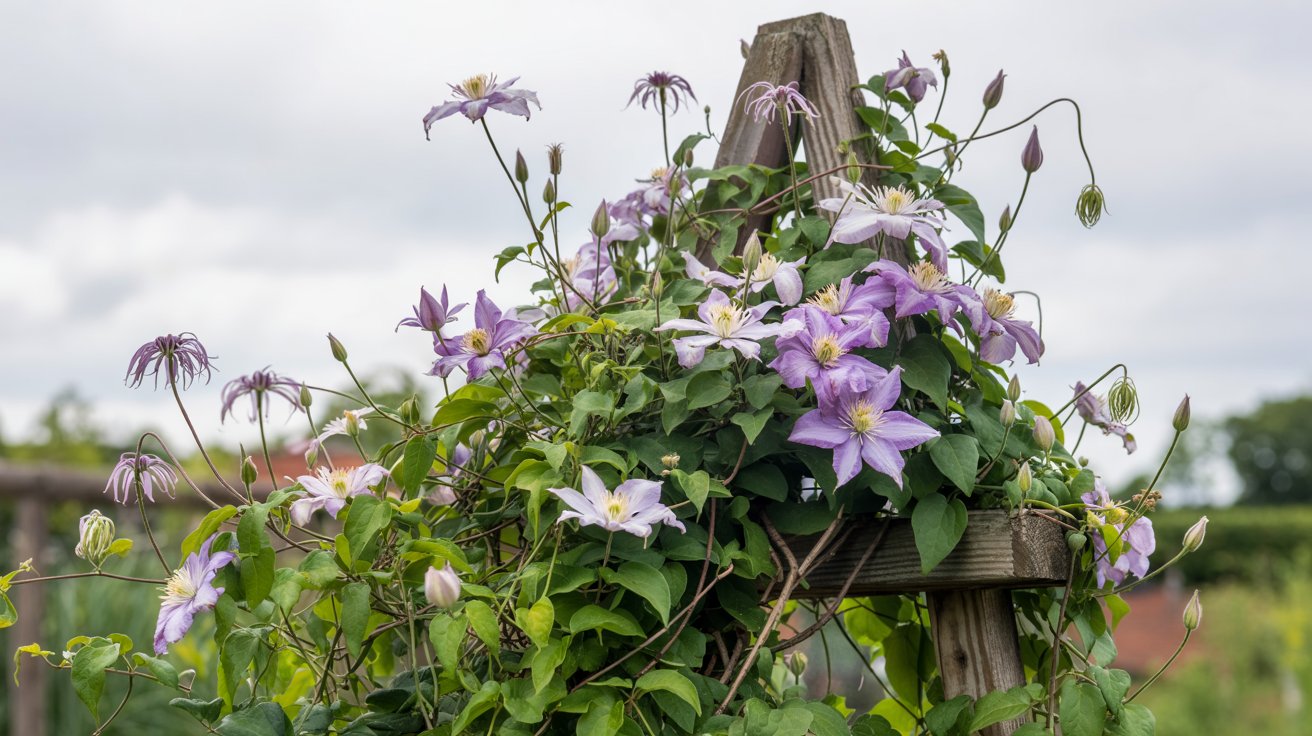
Most gardeners kill their plants with good intentions - cutting back at the wrong moment wipes out an entire season of flowers.
The fix is simpler than it sounds. Clematis falls into three pruning groups, and once you know which group your plant belongs to, every other decision - when to feed, how to train, when to cut - follows a clear pattern.
These vines climb by wrapping their leaf stems around any thin support, which means they work beautifully on wire mesh, twiggy sticks, or open lattice, but struggle against flat fences without added attachment points.
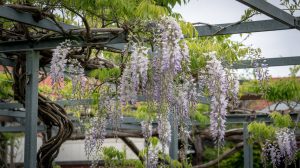
training a heavy wisteria vine requires thick timber supports, while clematis can thrive on something as simple as garden netting stapled to a post.
Clematis also plays well with other plants - especially climbing hydrangea companions or roses - where the vine fills vertical space between flowering shrubs. Container growing is genuinely possible for compact varieties, opening up options for balconies and tight urban plots.
This guide covers pruning groups, trellis sizing, seasonal feeding, and variety selection across the full growing calendar, with month-by-month planting guidance built into the structure.
Clematis is a versatile flowering vine spanning three pruning groups that dictate bloom timing and cut-back schedules. Success depends on matching your variety to the correct pruning group, providing a thin-support trellis, keeping roots cool and moist, and feeding twice each growing season.
Clematis Essentials
A large-flowered or small-flowered deciduous vine that climbs by twisting leaf petioles around thin supports. Bloom timing ranges from March through November depending on variety and pruning group. Most types reach 6–20 feet tall with minimal horizontal spread, making them ideal for vertical garden design.
Remember it later
Planning to try this recipe soon? Save it for a quick find later!
Clematis belongs to the buttercup family Ranunculaceae and includes over 300 species, ranging from ground-hugging perennials to vigorous 30-foot climbers. The Clemson Home & Garden factsheet groups them by bloom timing and pruning needs, which is the most practical starting framework for any new grower.
All groups share the same basic care requirements. Full sun for 6+ hours daily produces the strongest bloom, though afternoon shade helps in Zone 8-9 where summer heat is intense.
Soil should be fertile, well-drained, and slightly alkaline - a pH of 6.5 to 7.0 suits most varieties.
Water deeply twice per week in dry spells, aiming at the root zone rather than the foliage. Wet leaves promote fungal issues, especially clematis wilt, which can blacken stems overnight.
A 3-inch layer of mulch over the root zone keeps soil cool and moisture-stable without waterlogging the crown.
The classic rule - "heads in the sun, feet in the shade" - means planting low-growing perennials or a flat stone at the base to protect roots from heat. This one habit prevents more problems than any feeding schedule.
- Light: Minimum 6 hours of direct sun for peak flowering; partial shade works for small-flowered species.
- Water: 1 inch per week minimum; increase to twice weekly during bloom periods in summer heat.
- Soil pH: 6.5-7.0; add ground limestone to acidic beds to bring pH up before planting.
- Root zone: Keep cool with mulch or a ground cover plant - roots dislike heat even when tops are in full sun.
- Support diameter: Structures under ½ inch wide work best, since leaf petioles can't wrap around thick posts without help.
Clematis planted next to acid-tolerant azaleas may need separate soil amendment, since azaleas prefer a much lower pH. Keep beds distinct if you're mixing these two in a border.
Pruning Groups, Varieties, and Pruning Timing
Identifying your clematis's pruning group is the single most important step in its care. Cut back a Group 1 vine in late winter and you'll remove every flower bud set during fall - you won't see a bloom until the following year.
The RHS pruning guide and the University of Delaware factsheet both divide clematis into three clean groups based on when flowers form and when to cut.
Group 1 vines bloom in early spring on old wood grown the previous season. Common examples include Clematis montana, C. alpina, and C. macropetala.
Only light tidying is needed immediately after flowering - removing dead or overcrowded stems, not a hard cut.
Clematis montana can reach 25-30 feet in a single season once established, making it poorly suited to small gardens unless you have a large pergola or mature tree to cover.
C. alpina and C. macropetala stay under 10 feet, which makes them far more manageable on a garden arch or post.
Group 2 produces its main flush on old wood in late spring, then a smaller second flush on new growth in summer.
This group includes the large-flowered hybrids most people picture when they think of clematis - 'Nelly Moser,' 'The President,' and 'Henryi.' Deadhead after the first flush and trim side shoots back by half to encourage the second bloom.
Group 2 pruning is the trickiest because timing is tight. Cut too early and you lose the spring show; cut too late and there's no energy left for summer flowers.
Wait until the last first-flush flowers fade - usually late May or early June in most zones.
Group 3 blooms entirely on new wood produced in the current season, which means a hard cut to 12-18 inches above ground in late winter causes zero flower loss. Clematis viticella, C. texensis, and the popular 'Jackmanii' all fall here.
This group is the most forgiving and often the best starting point for new growers.
- 'Jackmanii': Classic purple Group 3; grows 10-12 feet and blooms July through October on new wood.
- 'Nelly Moser': Large pink-striped Group 2; needs good wall protection from harsh afternoon sun or colors fade.
- 'Freckles': Group 1 evergreen; cream-pink flowers in winter to early spring, Zones 7-9 only.
- 'Arabella': Non-climbing Group 3 perennial; stays under 4 feet and works in containers or mixed borders.
- 'Henryi': Group 2 with large white blooms; reliable repeat bloomer when cut back correctly after first flush.
If you've inherited an unidentified clematis, watch it through one full season before pruning. Note whether it flowers in spring (likely Group 1 or 2) or waits until July (almost certainly Group 3).
That observation alone tells you how to treat it from then on - and it pairs well with learning when peonies bloom in the same border to plan color succession.
If you don't know the group, don't prune hard. A light tidy-up after flowering is always safer than a hard cut on an unknown vine. One lost season of bloom beats killing years of root establishment.
Trellis, Training, and Climate Considerations
Clematis climbs by wrapping its leaf petioles - not tendrils or aerial roots - around whatever it touches. That distinction matters because supports must be thin enough to grip, ideally under ½ inch in diameter.
Wide boards, brick walls, or solid fencing need horizontal wires added every 12 inches before the vine can climb unaided.
The University of Vermont Extension recommends planting clematis at least 6 inches away from any wall or fence to allow air circulation and prevent the root zone from sitting in a rain shadow.
Walls deflect rainfall, and a dry root zone is the fastest path to wilting and poor growth.
For a standard garden fence, staple galvanized wire mesh with 2-inch grid spacing directly to the surface - clematis petioles find the openings quickly and self-attach within days of planting.
This setup costs under $15 for a 10-foot run and works better than most decorative trellises that space wires too far apart.
Freestanding structures - obelisks, arches, and post-and-wire frames - let you position the vine as a focal point anywhere in a bed. An obelisk 5-6 feet tall suits Group 2 and compact Group 3 varieties perfectly.
Taller structures (8-10 feet) are worth considering for 'Jackmanii' and vigorous viticella types that put on 8-10 feet of new growth each season.
Training in the first season is critical. Fan stems outward horizontally as the new plant establishes, even though the instinct is to send everything straight up.
Horizontal training forces bud break along the full length of each stem, producing a bushy base rather than a bare-legged vine with flowers only at the top.
- Windy sites: Use rigid mesh panels rather than loose netting, and tie young stems loosely with soft twine every 6-8 inches to prevent whipping and stem snap.
- South-facing walls: Stone or brick walls radiate heat overnight in summer, which can dry roots rapidly - double your mulch depth to 4-5 inches on these exposures.
- Containers: Use a minimum 15-gallon pot with a 4-foot obelisk insert; non-climbing Group 3 types like 'Arabella' or 'Alionushka' suit containers better than vigorous species.
- Cold climates (Zone 4-5): Group 3 vines are the safest bet - they die back to the crown in winter and regrow reliably in spring with no special protection needed.
In Zones 6 and warmer, Group 1 evergreen types like C. armandii can cover a wall year-round, providing fragrant white flowers in late winter.
For those wanting to add winter structure to the garden, pairing an evergreen clematis against a Japanese maple's bare framework creates strong off-season interest.
Group 2 plants trained against walls benefit from a south or west-facing aspect in Zones 5-6, where the extra warmth accelerates the second bloom flush. In Zone 8-9, the same exposure causes heat stress - east or north walls suit Group 2 better in warm climates, limiting direct afternoon sun that bleaches large flowers.
You can compare this approach to how crepe myrtle sun placement shifts between cooler and warmer zones.
Avoid planting clematis directly beneath deciduous trees where root competition is heavy and light is intermittent. The vine needs reliable sun to set buds - dense shade under a canopy produces long, weak growth with few flowers regardless of pruning.
Low-maintenance shade-tolerant hostas are a better fit for those dim spots.
Seasonal Care Calendar and Flexible Design
Clematis responds well to a consistent feeding schedule. Apply a high-potassium fertilizer (like a tomato feed or rose feed, 0-6-6 or similar) in early spring as growth emerges, then again after the first bloom flush.
Avoid high-nitrogen feeds that push leafy growth at the expense of flowers.
The Iowa State University Extension notes that bloom windows and training needs differ significantly across clematis types, reinforcing the value of a group-specific calendar rather than a generic vine-care routine.
Group 3 types bloom from July through September; Group 1 types from March through May - your feeding, pruning, and trellis work should mirror that schedule.
Prep/Prune
Feed/Train
Peak Bloom
February is the action month for Group 3: cut all stems back to the lowest pair of healthy buds, typically 12-18 inches above soil.
New growth emerges fast once temperatures lift, and this hard reset prevents a tangled woody base that reduces air circulation and bloom density over time.
October through November is the window to plant new clematis, mulch root zones for winter, and loosely tie any remaining Group 1 or 2 stems to prevent wind damage.
Late-season flowering plants pair naturally with Group 3 clematis, since both peak in August-September and wind down together as frost approaches.
For small spaces, prioritize Group 3 non-climbing types or container-grown compact varieties. A single Group 3 plant in a large container with a 4-foot obelisk delivers reliable summer color on a balcony or patio without requiring permanent structural support.
Swap out annually or cut back hard each February and refresh with compost - the same easy rhythm that makes growing zinnias in containers so accessible to smaller gardens.
Frequently Asked Questions
Group 1 blooms on old wood and is pruned after flowering in spring. Group 2 gets a light cut after its first flush. Group 3 is cut hard to 12–18 inches in late winter.
Non-climbing Group 3 varieties like 'Arabella' and 'Alionushka' stay under 4 feet tall and work well in containers or compact borders without a large trellis.
Yes — use a minimum 15-gallon pot and a 4-foot obelisk. Compact Group 3 types perform best in containers; refresh compost each spring and cut back hard in February.
Group 2 hybrids like 'Henryi' and 'The President' offer two distinct flushes — spring and summer — giving the longest combined bloom window of any single clematis plant.
Identify the pruning group first by watching when it blooms. Group 3 gets a hard late-winter cut; Group 1 needs only light tidying after spring flowers fade.
Pin it for your next how to grow and care for clematis project.