Most people shopping for solar pathway lights waste money in one of two ways: they buy the cheapest set available and end up replacing it in six months, or they pay for premium features their shaded front walkway can't use. Neither outcome is satisfying.
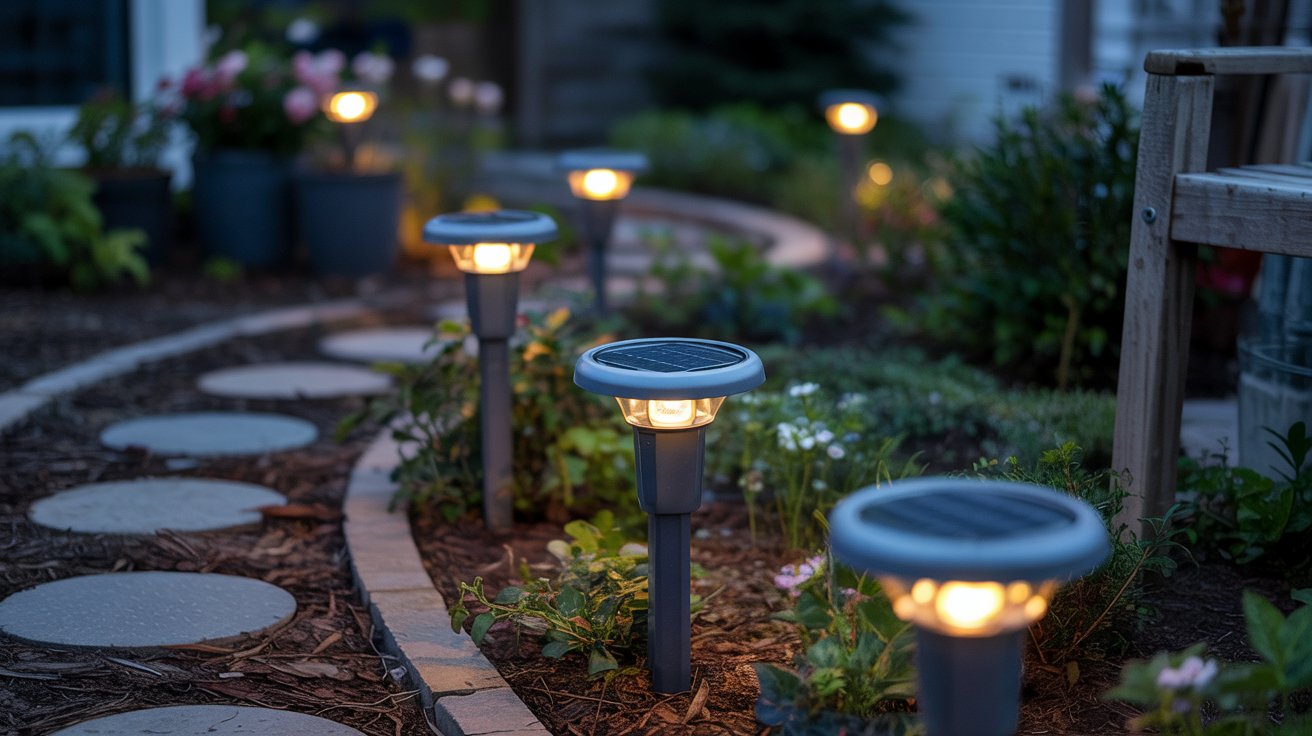
This guide maps four budget tiers to real performance numbers so you can match your spending to your actual conditions before clicking "add to cart."
The single most useful number on any solar light's spec sheet is lumens, not watts. A pathway light delivering 10-20 lumens marks a soft decorative glow, while 50-100 lumens gives you genuine safe footing on a 3-foot-wide walk.
Battery type matters almost as much as panel size. outdoor solar lighting commonly uses nickel-metal hydride (NiMH) or NiCd cells, and according to the DOE homeowner solar guide, sealed lead-acid batteries also appear in heavier-duty outdoor fixtures.
NiMH degrades more slowly in heat, which matters if your walkway bakes in afternoon sun.
IP ratings seal the deal on durability. IP44 keeps out splashing water; IP65 and above handles direct rain and hose spray.
Anything below IP44 belongs indoors. For the outdoor lighting decisions most homeowners face, IP65 is the practical minimum for year-round installs.
A quick look at tested prices across major review sources, including HGTV's solar light picks, shows the market runs roughly $22 to $58 per light at retail, with sets skewing the per-unit cost lower.
That spread maps almost perfectly onto four tiers worth understanding before you buy.
Solar pathway lights split into four budget tiers from entry-level decorative glow to pro-grade security lighting. Match your lumens need, IP rating, and battery type to your walkway width, climate, and how long you expect the lights to last.
| Tier | Lumens | Battery | IP Rating | Warranty |
|---|---|---|---|---|
| Entry ($5–$12) | 8–15 lm | NiCd 200–400 mAh | IP44 | None–30 days |
| Mid ($13–$25) | 15–40 lm | NiMH 400–600 mAh | IP44–IP54 | 90 days–1 year |
| Premium ($26–$45) | 40–80 lm | NiMH 600–1200 mAh | IP65 | 1–2 years |
| Pro ($46–$60+) | 80–150 lm | Li-ion 1200+ mAh | IP65–IP67 | 2–3 years |
Per-unit price in a set is almost always lower than buying individual lights. Calculate the per-light cost before comparing sets to singles — a 12-pack listed at $60 works out to $5 per light, which is entry-tier performance regardless of packaging claims.
How to Compare Lights Across Budget Tiers?
A consistent rubric saves you from being swayed by marketing language. Work through these five factors in order every time you evaluate a solar pathway light, and you'll surface the real differences between a $10 stake and a $50 fixture fast.
Remember it later
Planning to try this recipe soon? Save it for a quick find later!
According to DOE solar lighting guidance, nightly run times drop by 30-50% in winter compared to summer peak.
That means a light rated for 8-hour runtime in July may only run 4-5 hours in December, so you need to size battery capacity for your worst-case season, not your best.
| Factor | Entry Priority | Mid–Premium Priority | Pro Priority |
|---|---|---|---|
| Lumens | 8–15 lm decorative | 20–80 lm functional | 80–150 lm security |
| Battery | NiCd, 200–400 mAh | NiMH, 400–1000 mAh | Li-ion, 1200+ mAh |
| IP Rating | IP44 minimum | IP54–IP65 | IP65–IP67 |
| Warranty | 30 days (typical) | 90 days–1 year | 2–3 years |
| Panel Quality | Small mono/poly | Mid mono, tilt-fixed | Large mono, adjustable |
When comparing two lights online, paste both spec sheets into a note and check mAh, IP, and warranty side by side. Ignore claimed "hours of light" without also checking battery mAh — runtime claims are often measured under ideal lab conditions, not real winter skies.
Budget-by-Budget Picks
Rather than naming a single "winner," this section gives you two benchmark options per tier with direct metrics so you can match a style and price to your walkway.
Prices reflect current retail averages based on tested products across major guides, including Bob Vila's tested path lights.
Solar lighting reduces your electric bill and scales with how well you site the panels, as noted by the DOE energy saver program - but only if the product is sized right for your yard's sun hours.
Skimping on panel quality in a shaded yard cancels any savings.
- Brighter output: 20–80 lm covers functional walkway lighting, not just decoration.
- Longer battery: NiMH cells hold charge better across temperature swings than NiCd.
- IP65 option: Withstands direct rain without sealing failure over one to two seasons.
- Warranty value: 90 days to 2 years means real recourse if a unit fails early.
- Lower upfront cost: $5–$12 per unit is fine for temporary seasonal installs or low-traffic decorative edging.
- Easy to replace: Cheap enough to swap the whole set rather than repair individual units.
- No commitment: Good for testing placement before investing in a permanent install.
| Metric | Premium ($26–$45) | Pro ($46–$60+) |
|---|---|---|
| Lumens | 40–80 lm | 80–150 lm |
| Battery | NiMH 600–1200 mAh | Li-ion 1200+ mAh |
| Runtime (summer) | 8–10 hr | 10–12 hr |
| IP Rating | IP65 | IP65–IP67 |
| Warranty | 1–2 years | 2–3 years |
| Best fit | 3–4 ft paths, residential | Wide drives, security zones |
Prices across the $22-$58 range reviewed by HGTV's product reviews confirm that mid-to-premium tier covers the majority of residential walkway needs. Pro-tier is worth the spend only if you need security-level brightness or have a north-facing install that demands maximum panel efficiency.
For most front-walk installs, you'll find everything you need in the right lighting combination at the mid-to-premium price point.

Install and Maintenance: Quick-Start Plan
Solar pathway lights are among the easiest outdoor fixtures to install - no electrician, no conduit, no permit. But a sloppy install kills performance fast.
These steps keep your lights charging efficiently from day one.
Before buying, confirm whether the manufacturer offers replacement batteries or bulbs, because many entry units are sealed with no replacement path, according to the DOE's solar lighting resource. A sealed unit that can't be serviced becomes landfill when its battery fails, usually after 1-2 years.
Don't install solar pathway lights directly under or beside a porch light, security flood, or streetlamp. Ambient artificial light confuses the dusk sensor and keeps the LED off all night. Space your solar fixtures at least 10 feet from any constant artificial source.
For larger landscape lighting projects, solar pathway lights work best as part of a layered plan that also includes hardwired accent or flood fixtures for high-traffic zones.
Pair them with patio string lights to extend the ambiance from walkway to seating area without adding to your electric bill.
Performance by Climate: What Region Changes
Where you live changes which spec to prioritize. A light that runs perfectly in Phoenix for two years may fail its first winter in Minneapolis.
Sun hours per day is the single biggest variable - most solar pathway lights are rated for 6 hours of direct sun, and anything less reduces runtime proportionally, per the DOE's outdoor solar lighting page.
The DOE's outdoor lighting design guide confirms that solar works across all U.S. climates, but site-specific sun exposure dictates whether you size for the minimum or maximum panel output. Factor your region before locking in a tier.
Southwest, Southeast, and similar high-sun zones get 5-7 daily sun hours consistently. Entry and mid-tier lights perform reliably here because panels charge fully most days. Focus your budget on durability: look for UV-stabilized housing (ABS plastic rated for UV exposure) and stainless or powder-coated stakes to resist heat corrosion. Lights with heat-tolerant NiMH batteries outlast NiCd by 6-12 months in sustained high temps. Spacing can stretch to 8 feet in these zones without losing functional light coverage.
Pacific Northwest, Midwest, and Mid-Atlantic regions average 3-5 sun hours in summer and as few as 2 in winter. Mid-tier lights with 600 mAh or higher NiMH batteries hold up well from April through October. For year-round use, step up to premium tier with 1000+ mAh capacity to cover 3-hour winter charging days. IP65 is non-negotiable here - fall and spring rain is sustained, not occasional. Choose fixtures with a tilt-adjustable panel so you can optimize the angle as the sun's arc shifts from June to December.
Northern states, Canada, and high-elevation zones face the toughest conditions: 1-3 sun hours in winter, snow cover on panels, and temperatures that drain NiCd and NiMH batteries fast. Only premium or pro-tier lights with Li-ion batteries and large monocrystalline panels hold acceptable runtime from November through March. Plan to bring lights inside during weeks of heavy snow or temperatures below -10°F. Stainless steel stakes and IP67-rated housings resist freeze-thaw cracking. Adding a south-facing tilt of 15-30 degrees can recover 20-30% of lost winter charging in these zones.
If your walkway has tree canopy shade for more than 2 hours daily, treat your site as one climate zone colder for sizing purposes — even in sunny regions. A shaded install in Dallas behaves like an open install in Chicago when it comes to panel output.
Finishing choice also depends on region. Powder-coated metal stakes resist rust in wet climates far longer than chrome-plated zinc.
In coastal areas, look specifically for marine-grade finish or 304 stainless steel hardware. Plastic housing rated UV50+ holds color for 3-5 years in high-sun zones before fading to yellow.
These details don't show up in lumens specs but determine whether you're replacing stakes after one winter or five.
If you're investing in a full outdoor living setup, solar pathway lights pair naturally with durable outdoor furniture and weather-resistant outdoor rugs to create a cohesive, low-maintenance yard.
For larger projects like a DIY outdoor kitchen, budget your lighting separately - pathway lights handle navigation while task lighting handles the cooking zone.

Frequently Asked Questions
Mid-to-premium tier lights with 40–80 lumens, NiMH or Li-ion batteries at 600+ mAh, and IP65 ratings represent the strongest performers. Look for monocrystalline panels and a 1-year minimum warranty.
A standard 3-foot-wide path needs 20–40 lumens per fixture spaced 6 feet apart. Wider driveways or stairs need 60–100 lumens per light for safe footing.
Yes, but runtime drops 30–50% in low-sun winter months. Li-ion batteries handle cold best; NiCd degrades fastest below freezing and may need indoor storage in severe climates.
IP65 is the practical minimum for year-round outdoor installs — it resists sustained rain and hose spray. IP44 only handles splashing and is unsuitable for climates with heavy seasonal rain.
Entry-tier lights typically last 1–2 seasons before battery failure. Premium units with replaceable NiMH cells and IP65 housing last 3–5 years with annual panel cleaning and battery replacement every 2 years.
Pin it for your next best solar pathway lights project.