Most homeowners pick the wrong one - not because they chose the wrong materials, but because they started with aesthetics instead of site conditions. A beautiful composite deck on a flat, well-draining yard costs twice as much as a paver patio and solves a problem that doesn't exist there.
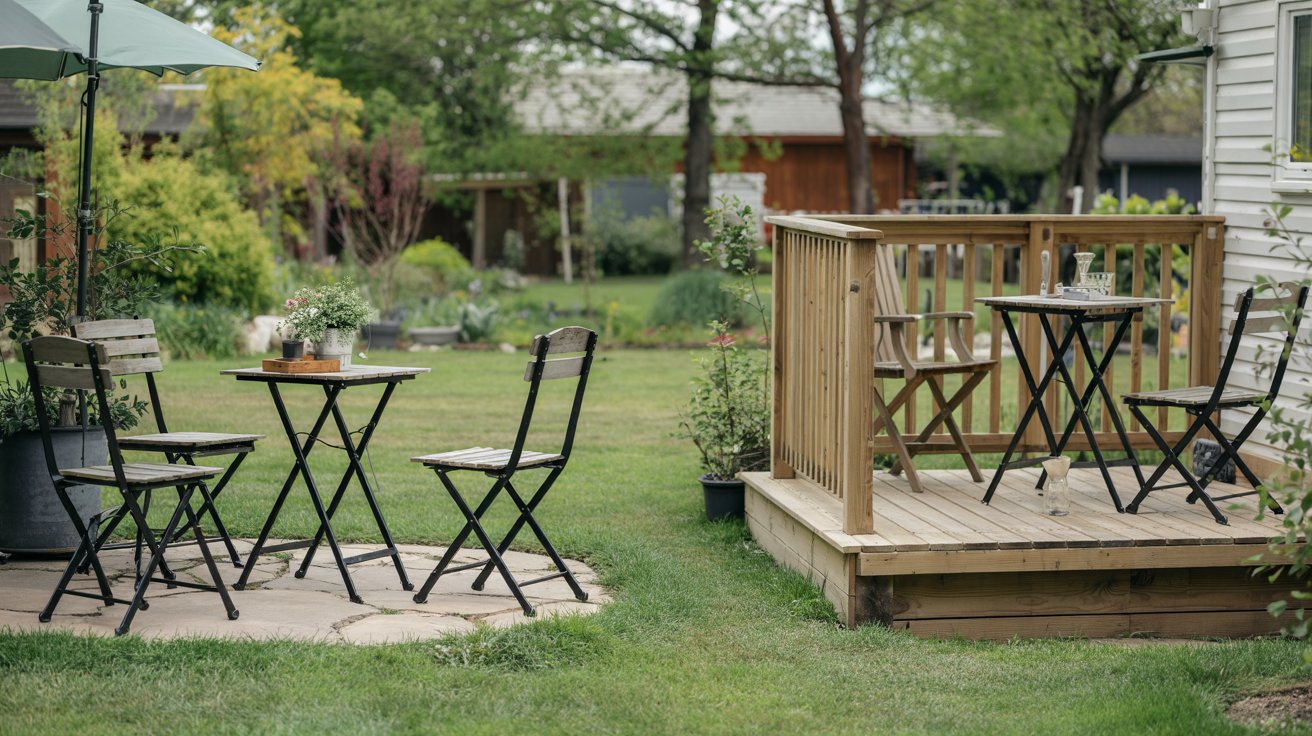
Matching the structure to your actual lot is the decision that matters most.
A patio costs $8–$25 per sq ft installed and lasts 30–75 years on flat ground with minimal upkeep. A deck costs $20–$60 per sq ft but handles slopes, drainage, and elevation that a patio simply cannot.
Budget and site grade drive this decision more than personal style.
Key Differences at a Glance
The gap between these two structures is wider than most people expect. Cost, site prep, permits, and long-term upkeep all point in different directions depending on which you choose.
Remember it later
Planning to try this recipe soon? Save it for a quick find later!
Permit requirements alone can add weeks and several hundred dollars to a deck build. Local codes vary significantly, so check with your municipality before finalizing plans for either structure.
Any elevated deck over 30 inches typically requires a permit, footing inspections, and railing approval. Skipping permits can force demolition or block a future home sale — confirm requirements with your local building department first.
Patio vs Deck Cost Breakdown
Price is the factor that ends most debates quickly. A patio installation runs $8-$12 per sq ft for poured concrete and $12-$25 per sq ft for pavers including labor.
A 300 sq ft concrete patio comes in around $2,400-$3,600 installed.
Deck pricing starts where patio pricing ends. Pressure-treated wood lands at $20-$30 per sq ft installed, while composite decking pushes $35-$60.
That same 300 sq ft space costs $6,000-$18,000 as a deck depending on material and complexity.
To estimate concrete accurately, factor in base prep, reinforcement, and finishing - they add $2-$4 per sq ft beyond the pour itself. Deck costs spike further when the structure requires tall footings or a ledger connection to the house.
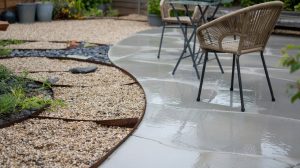
If budget is tight but you want the paver look, building a gravel patio with defined borders costs $3–$7 per sq ft and can be done in a weekend. It won't match a paver patio's durability, but it beats waiting years to afford one.

Maintenance Over Time
Patios win on maintenance - decisively. A concrete patio needs occasional power washing and resealing every 5-10 years.
Paver patios need joint sand replenished every few years, but neither demands the annual attention that wood decks require.
- Concrete patio: Power-wash once a year; seal every 5-10 years at $0.50-$1.50 per sq ft; repair cracks as they appear.
- Paver patio: Refill polymeric sand every 2-4 years; reset any shifted pavers; reseal if desired (not mandatory).
- Pressure-treated wood deck: Clean annually; stain or seal every 2-4 years; replace boards that rot or splinter after 10-20 years.
- Composite decking: Soap-and-water wash twice a year; inspect fasteners annually; no staining, but surface scratches don't repair easily.
A pressure-treated deck at year 15 often needs $1,500-$3,000 in board replacements before it looks good again. That maintenance gap adds real dollars over a 20-year period that the upfront cost comparison doesn't show.
A quality pressure washer handles annual cleaning for both structures - budget $150-$300 for a unit that lasts a decade of seasonal use.
When a Patio Makes More Sense?
A flat backyard on stable native soil is ideal patio territory. You skip footings, reduce excavation, and put money into surface quality instead of structure.
That's where patios return the most value per dollar.
- Tight budget: A 400 sq ft concrete patio costs $3,200-$4,800 installed - often half the cost of a comparable deck.
- Long-term value: Properly built paver and concrete patios last 30-75 years with almost no structural maintenance.
- Stormwater management: Permeable pavers let rainwater infiltrate rather than run off - useful on lots with drainage restrictions or near downslope neighbors.
- No permit hassles: Ground-level patios under 200-300 sq ft often need no permit, letting you build and use the space within days of completion.
- Outdoor cooking and fire features: Built-in firepits, seating walls, and natural stone accents integrate more naturally into a patio than a deck.
When comparing surface materials, the durability difference between concrete and pavers matters for high-traffic areas - pavers allow for individual replacement while concrete requires patching the whole slab.
Permeable paver systems can qualify for stormwater credit programs in some municipalities, offsetting a portion of installation cost. Check with your local water authority before you finalize your surface choice.

When a Deck Makes More Sense?
Sloped lots change the math entirely. A yard that drops 3-4 feet from the back door makes a patio impractical without major regrading - and regrading a 400 sq ft area can cost $2,000-$5,000 before you've bought a single paver.
A deck on posts solves that problem directly.
- Sloped or uneven terrain: Footings and posts bridge grade changes without disturbing existing soil - ideal for hillside lots or yards with shallow bedrock.
- Door-height access: When your back door opens 18-36 inches above grade, a deck matches that height without stairs eating half your usable space.
- Under-deck storage: Elevated decks create dry enclosed storage underneath - practical for bikes, tools, or seasonal furniture in wet climates.
- Multi-level entertaining: Decks can step down across different levels, separating a dining area from a lounge zone on the same structure.
- Electrical and lighting: Running conduit through a deck frame to power string lights, outlets, or ceiling fans is far simpler than embedding conduit in concrete.
If you're weighing board materials before committing to a deck, the composite vs wood decision has long-term cost and maintenance implications worth reviewing before you build.
In USDA zones 3–5, pressure-treated wood decks experience significant freeze-thaw stress on fasteners and boards. Composite decking handles thermal expansion better in those zones and extends the replacement cycle by 10–15 years compared to wood.
Pros and Cons Side by Side
No structure is universally better. Each has real trade-offs that matter depending on your site, budget, and how you plan to use the space.
- Lower installed cost — often 40–60% less than an equivalent deck
- 30–75 year lifespan on a solid compacted base with minimal structural upkeep
- No permit required in most jurisdictions for ground-level installations under 300 sq ft
- Permeable paver options reduce stormwater runoff and may qualify for incentives
- Handles slopes and uneven grades without costly regrading or excavation
- Natural drainage between boards eliminates standing water problems
- Easier to integrate electrical, lighting, and structural features like pergolas and railings
- Under-deck space provides dry covered storage in regions with heavy rainfall

The Overlap Zone: When Either Works
On a flat lot with a back door at grade level, the structural argument disappears. Both a low deck on short concrete piers and a paver patio deliver the same usable footprint for an outdoor dining or lounge area.
At that point, the decision comes down to three practical factors.
- Budget ceiling: If you're working with under $5,000 for a 250 sq ft space, a patio is the clear path - a deck at that size and budget means cutting corners on materials.
- Aesthetic preference: Natural stone and paver patterns suit some home styles better; stained wood or composite suits others. Neither is wrong on a flat site.
- Future flexibility: Patios are harder to expand or modify once poured. Decks can be extended by adding bays to the existing frame if you want more space in a few years.
For a flat 8-12 foot square space - a small bistro area or grill pad - a low deck on precast piers and a paver patio are functionally identical. Your backyard design goals and existing hardscape style should make that call.
What the Surface Finish Costs You Long-Term?
Material choice within each category creates as much price spread as the patio-vs-deck decision itself. Stamped concrete sits in an interesting middle ground - it looks like pavers but behaves like a slab.
If the look of decorative concrete appeals to you, the cost difference between stamped concrete and pavers narrows to $2-$5 per sq ft, but stamped concrete can't be repaired section by section the way individual pavers can.
A cracked stamped slab often needs a full resurface.
- Stamped concrete: $12-$18 per sq ft installed; looks premium but cracks from freeze-thaw in zones 3-5 and requires full-slab repairs.
- Concrete pavers: $12-$25 per sq ft installed; individual units replace without disturbing the whole surface - lower repair cost over 20+ years.
- Pressure-treated wood deck: Lowest entry cost at $20-$30 per sq ft, but board replacement at years 10-15 adds $1,000-$4,000 back.
- Composite decking: $35-$60 per sq ft upfront; no staining, no rotting, and 25-50 year lifespan makes it cost-competitive over a 30-year window.
If you're still deciding on patio surface, comparing gravel versus concrete as a base material shows where each performs well and where each fails under heavy use or wet conditions.
To get accurate deck cost estimates before committing, factor in footing depth, railing linear footage, and ledger flashing - those line items add $800-$2,500 that basic per-sq-ft quotes omit.

Frequently Asked Questions
A patio is consistently cheaper — concrete runs $8–$12 per sq ft installed versus $20–$30 per sq ft for a pressure-treated wood deck, making a 300 sq ft patio roughly $3,000–$6,000 less than the equivalent deck.
Most jurisdictions require a building permit for any deck elevated more than 30 inches above grade, with mandatory inspections for footings and railings — the process typically adds 2–6 weeks and $150–$500 in fees.
Concrete and paver patios last 30–75 years on a properly compacted base, while pressure-treated wood decks typically last 10–30 years and composite decks 25–50 years with regular cleaning and fastener maintenance.
Yes — a low-profile deck on concrete piers or sleepers can sit directly over an existing patio slab, raising the finished surface 4–6 inches and hiding a cracked or stained concrete surface without demolition.
Concrete pavers require the least intervention over time — individual units replace without disturbing the full surface, polymeric sand refills take under an hour, and no sealing is mandatory to maintain structural integrity.
Pin it for your next patio vs deck: cost pros cons and which to build project.