Choosing between stamped concrete and pavers for a patio is one of the most common decisions homeowners face when planning an outdoor space.
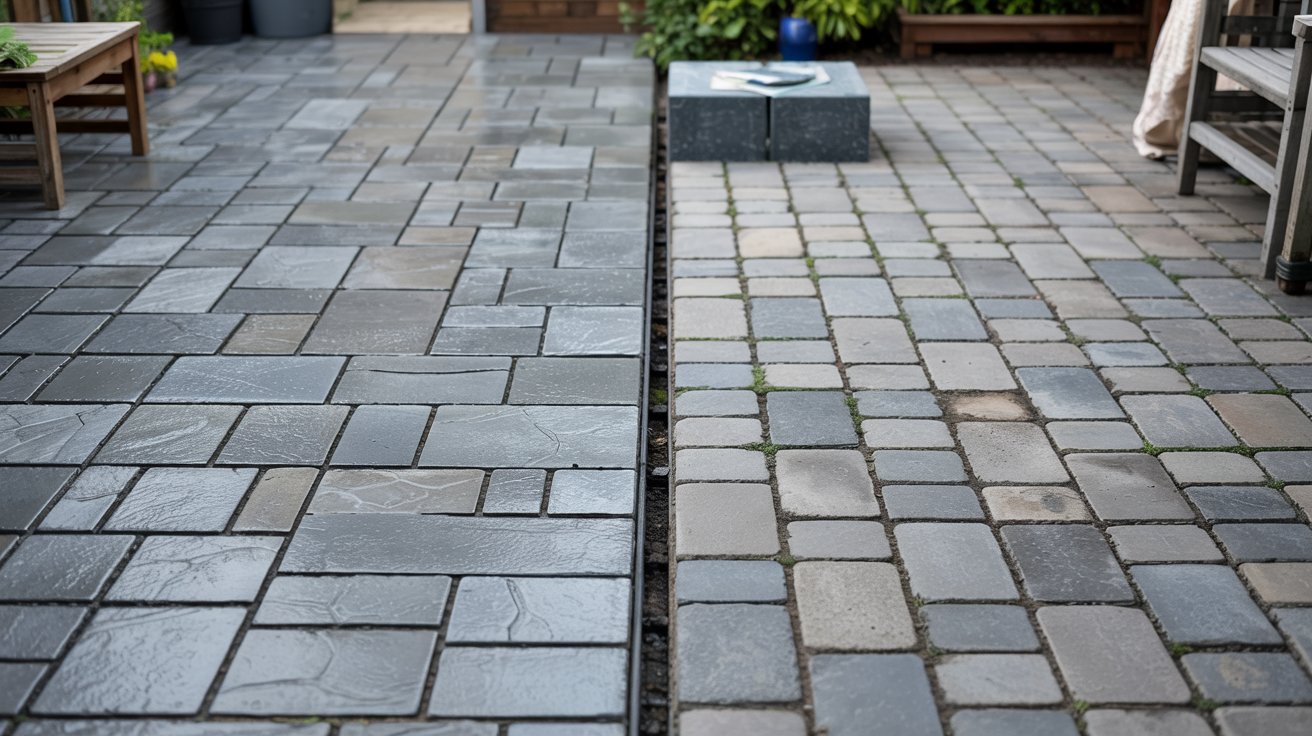
Both look polished, both hold up under foot traffic, and both cost significantly more than plain concrete - yet they behave very differently over time.
Stamped concrete is poured as a single slab, then pressed with pattern molds and colored before it cures. Pavers are individual units - brick, natural stone, or concrete - set into a prepared base.
That structural difference drives almost every other comparison: cost, durability, repairability, and how much maintenance you'll accept year after year. If you're also weighing whether a hard surface makes sense at all, our breakdown of gravel versus concrete patios covers a lower-cost alternative.
This guide covers every angle - upfront price, long-term costs, climate performance, DIY potential, and which surface wins for specific use cases.
Stamped concrete runs $8–$20 per sq ft installed; pavers cost $10–$30 per sq ft. Stamped concrete is cheaper upfront but cracks over time and is hard to repair.
Pavers cost more initially, last longer, and let you replace individual units without redoing the whole surface.
Cost Comparison: Stamped Concrete vs Pavers
For a standard 400-square-foot patio, stamped concrete typically runs $3,200-$8,000 installed, depending on pattern complexity and regional labor rates. Pavers for the same space usually land between $4,000-$12,000, with natural stone at the high end and concrete pavers at the low end.
Remember it later
Planning to try this recipe soon? Save it for a quick find later!
Those numbers shift once you factor in long-term spending. You can see a full breakdown of what drives patio pricing in our total patio cost guide.
Stamped concrete requires resealing every 2-3 years at roughly $1-$2 per square foot each time. Pavers need periodic joint sand replenishment and occasional re-leveling, which costs less per visit but adds up over decades.
Concrete paver costs for driveways follow similar pricing logic — our driveway cost breakdown shows how square footage and material choice affect final bids.
Installation Process and Timeline
Stamped concrete goes down in one pour, which makes installation faster on simple rectangular patios. A crew can typically form, pour, stamp, and color a 400-sq-ft slab in 1-2 days, but you can't use it for at least 7 days while the concrete cures.
Paver installation takes longer upfront. The base work - excavating 6-8 inches, compacting gravel, adding sand - accounts for most of the labor time.
Pavers are walkable immediately after installation, which matters if you're working around outdoor events or contractors finishing other yard work.

Durability and Crack Risk
This is where the two options diverge most sharply. Stamped concrete is a monolithic slab - when the ground shifts, it cracks as one unit.
Freeze-thaw cycles are the main culprit in cold climates, and even a well-installed slab in Zone 5 or colder will show cracks within 10-15 years.
Pavers flex. Because each unit is independent, ground movement causes individual pieces to shift rather than crack.
A settled paver can be lifted, the base corrected, and the paver reset.
According to the Portland Cement Association, control joints cut into slabs reduce cracking but don't eliminate it - they just direct cracks to planned locations.
Patching cracked stamped concrete almost always produces a visible color mismatch. Concrete weathers and fades over time, so new patch mix rarely blends in — even from the same manufacturer.
Appearance and Design Options
Stamped concrete can mimic slate, flagstone, brick, wood planks, and cobblestone. More than 30 standard stamp patterns are available from most concrete suppliers, and custom color hardeners let contractors hit almost any tone.
The tradeoff is that stamped concrete looks like what it is up close - the texture is shallower than real stone and the color is surface-applied, not baked in.
Pavers offer genuine material variety. Concrete pavers work for paver walkway designs and patios alike, while natural options like travertine, bluestone, and tumbled granite each have distinct grain and color variation that stamped concrete can't fully replicate.
For unique layouts - curved edges, inlaid borders, multi-material mosaics - pavers give contractors and DIYers far more flexibility. Stamped concrete struggles with tight curves because the stamp molds require flat, open surfaces to press cleanly.

Maintenance Requirements
Stamped concrete demands consistent sealer attention. Skip a resealing cycle and the surface becomes porous, stains more easily, and loses its color faster.
In freeze-thaw climates, an unsealed slab can spall and flake within 2-3 winters.
Pavers are lower-maintenance overall, but they're not zero-maintenance. Polymeric sand in the joints can wash out over time, and weeds will find gaps if the base wasn't installed with a proper fabric barrier.
- Stamped concrete: Reseal every 2-3 years ($400-$800 per treatment for a 400-sq-ft patio). Clean with pH-neutral cleaner; avoid pressure washing above 1,500 PSI.
- Concrete pavers: Re-sand joints every 3-5 years. Spot-clean stains with a degreaser. Reset any heaved units after harsh winters.
- Natural stone pavers: Some types (travertine, limestone) need sealing annually to prevent staining and etching from rain acid.
Apply a penetrating sealer — not a topical film sealer — to natural stone pavers. Film sealers trap moisture underneath and can cause spalling in freeze-thaw conditions.
DIY Feasibility
Stamped concrete is not a realistic DIY project for most homeowners. Timing the stamp impression requires hitting a narrow window while concrete is still workable - too early and the pattern won't hold, too late and the surface tears.
Color consistency across a large pour is equally difficult without professional equipment.
Pavers are genuinely DIY-able. The base work is labor-intensive but forgiving - if the gravel isn't perfectly level, you can adjust the sand layer.
No specialized timing, no mixing, no chemical reactions to manage.
A DIY paver patio can cut installed costs by 40-50%, since labor makes up roughly half the total quote. Our guide to DIY ground-level installations walks through base prep in detail.
For full side-by-side install difficulty, the concrete vs pavers comparison covers more scenarios.
- Rent a plate compactor for the gravel base - hand tamping leaves soft spots that cause settling.
- Use polymeric sand for joints to resist weeds and ant tunneling.
- Install plastic edge restraints on all sides before you lay the first paver.
- Don't skip the geotextile fabric layer between soil and gravel - weeds grow up through even tightly-set pavers.
- Don't start a stamped concrete pour without a second person experienced in stamping - the window is 20-40 minutes.
- Don't use regular joint sand; it washes out and invites weeds within one season.
Performance by Climate
Climate is the single biggest factor in which material lasts longer at your address. The Interlocking Concrete Pavement Institute recommends pavers specifically for freeze-thaw regions because the flexible system tolerates ground movement that cracks rigid slabs.
In warm, stable climates like the Southeast or Southwest, stamped concrete performs much better. Without repeated freeze-thaw cycles, slabs can hold their original appearance for 20+ years with proper sealing.
| Climate | Stamped Concrete | Pavers |
|---|---|---|
| Freeze-thaw (Zones 3–6) | High crack risk | Strong performer |
| Hot/dry (Zones 9–11) | Excellent long-term | Good, some fading |
| High rainfall | Drainage issues possible | Permeable options available |
| Coastal/salt air | Salt degrades sealer faster | Concrete pavers hold better |
Permeable pavers - units set with wider gravel-filled joints - handle heavy rain better than any stamped slab. EPA research on permeable pavement shows up to 80% stormwater infiltration compared to near-zero for solid concrete.
Resale Value and Curb Appeal
Both surfaces add value relative to bare dirt or basic poured concrete, but they appeal to different buyers. Stamped concrete offers a clean, uniform look that photographs well and suits modern or minimalist home styles.
Natural stone and clay brick pavers tend to resonate more with buyers looking at higher-end homes. A National Association of Landscape Professionals survey found that well-maintained hardscape can return 50-80% of installation cost at resale.
For homes with existing brick or stone architectural details, matching paver materials creates visual continuity that stamped concrete can't replicate. For backyard design ideas that tie hardscape into the full yard, our outdoor living space planning section covers material coordination.
One caveat: cracked or faded stamped concrete actively hurts resale. Buyers price in the cost of removal - roughly $2-$6 per square foot - when they see a deteriorating slab.

Which One Should You Choose?
Choose stamped concrete if you're in a warm climate, want the lowest upfront cost, and prefer a seamless surface without visible joints. It suits formal garden layouts and modern architectural styles well.
Choose pavers if you're in a cold climate, want a surface that's repairable without full replacement, or plan to add radiant heating underneath (pavers can be lifted to access it).
They also suit anyone considering a patio versus deck comparison where longevity weighs heavily in the decision.
- Lower installed cost — often $3–$5 per sq ft cheaper than pavers
- Faster installation with fewer variables on simple rectangular patios
- Seamless appearance with no visible joints or unit lines
- Excellent performance in hot, dry, stable climates
- Individual units can be replaced without redoing the entire surface
- Handles freeze-thaw cycles without the cracking risk of a monolithic slab
- DIY-friendly — cuts labor costs by 40–50%
- Longer lifespan: 30–50 years versus 20–25 for stamped concrete
For most homeowners in the northern half of the country, pavers are the safer long-term investment despite higher upfront costs. In the South and Southwest, stamped concrete is a legitimate choice - especially if budget is tight and the design calls for a specific large-format pattern.
If you want to understand how concrete pricing varies by finish type, that breakdown helps clarify where stamped sits in the broader cost spectrum. And if outdoor lighting is part of the plan, our patio lighting ideas show how both surfaces look after dark.
Frequently Asked Questions
Stamped concrete typically lasts 20–25 years; pavers last 30–50 years. Lifespan depends heavily on climate, base prep, and maintenance consistency.
No — concrete weathers and fades over time, so patch material almost always produces a visible color mismatch regardless of brand or application method.
Sealed stamped concrete can be slippery. Adding a non-slip additive to the sealer — typically aluminum oxide — reduces slip risk without significantly changing appearance.
Poorly prepared bases cause settling, but a properly compacted 4–6 inch gravel base with edge restraints holds most pavers stable for 10–15 years before any re-leveling is needed.
Pavers are the better choice in freeze-thaw climates (Zones 3–6). Their flexible installation system absorbs ground movement that causes stamped concrete slabs to crack.
Pin it for your next stamped concrete vs pavers for patio project.