A well-chosen perennial bed pays you back for decades with almost no replanting cost.
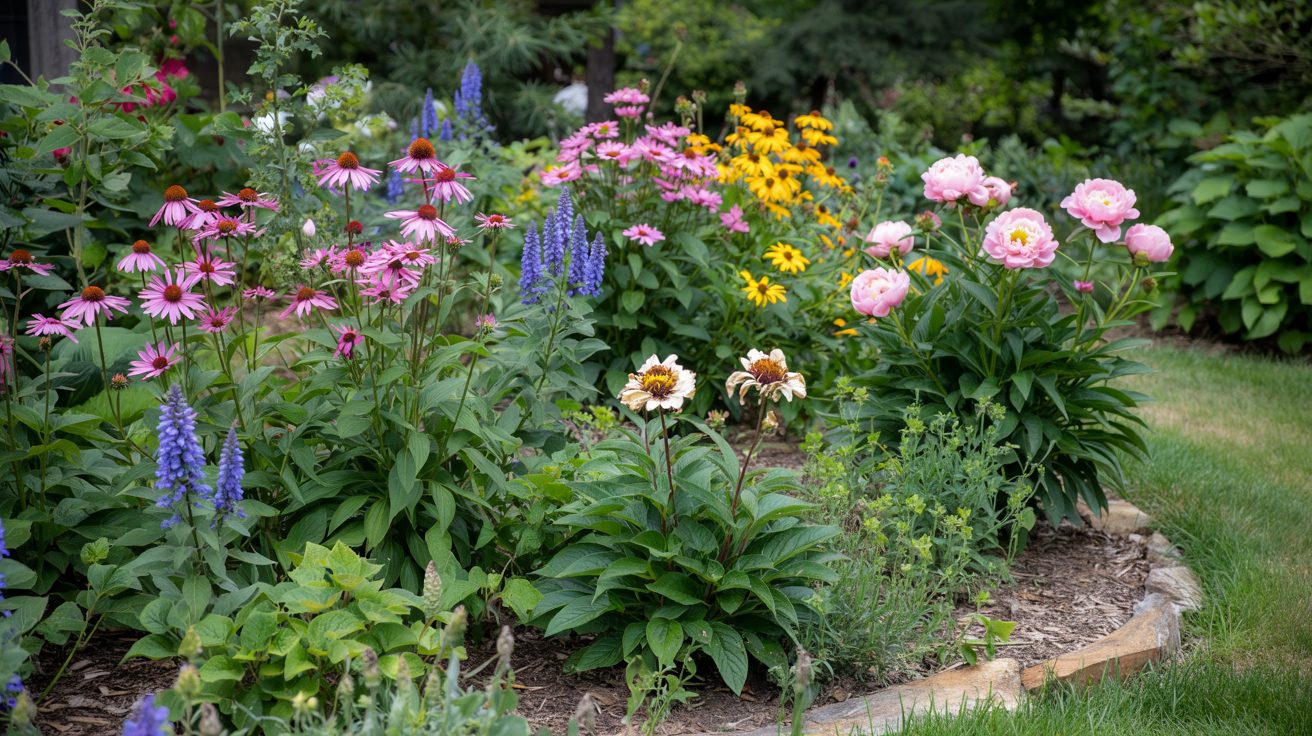
Unlike annuals, these plants build deeper root systems each year, returning reliably every spring from zone 3 through zone 9 with only basic maintenance - dividing every few years, occasional deadheading, and some winter mulch in colder climates.
These 12 perennial flowers cover sun, shade, dry soil, and moist conditions across USDA zones 3–9. All are widely sold at garden centers, return year after year, and reward minimal care with consistent bloom, structure, and seasonal interest.
Sun-Loving Perennials for Open Beds
Most gardeners have at least one sunny border to fill, and these varieties were chosen because they bloom at different points from late spring through fall - so the bed never goes flat.
Remember it later
Planning to try this recipe soon? Save it for a quick find later!
Learning to remove spent blooms correctly adds weeks to many of their seasons.
Echinacea (Purple Coneflower)
Zone 3-9 Easy
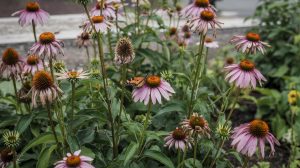
Echinacea purpurea is native to North American prairies, and that origin explains its toughness. Once established, it handles drought, clay soil, and deer browsing better than most border plants, with blooms that last 6-8 weeks in midsummer.
- Height: 24-48 inches - taller plants may need light staking in windy spots.
- Wildlife value: Leave seedheads standing through winter; goldfinches strip them bare by February.
- Division: Every 3-4 years in early spring keeps clumps vigorous and centered.
Rudbeckia fulgida 'Goldsturm' (Black-Eyed Susan)
Zone 3-9 Easy
Few perennials bloom as relentlessly as 'Goldsturm', which starts flowering in July and often carries color into October without any deadheading. Its tight 18-24 inch clumps rarely flop, making it one of the most maintenance-free options you can grow from established transplants.
- Soil tolerance: Handles clay and light drought equally well once roots settle.
- Spreading: Self-seeds modestly - remove a few seedheads if you want to keep clumps controlled.
Salvia nemorosa 'Caradonna'
Zone 4-8 Easy
The dark, almost black stems on 'Caradonna' set it apart from other salvias - the contrast against deep violet flower spikes is sharp and architectural. It reaches 18-24 inches and reblooms freely when cut back by half after the first flush fades.
- Deer and rabbit resistance: Aromatic foliage makes it unpalatable to most browsers.
- Pairing tip: Plant next to 'Goldsturm' for a violet-and-gold combination that overlaps in late summer.
Cut 'Caradonna' back by half — not to the ground — after the first bloom flush. New flowering stems appear within 3–4 weeks in most zones.
Catmint (Nepeta x faassenii 'Walker's Low')
Zone 4-8 Easy
Despite the name, 'Walker's Low' mounds to 12-18 inches with soft grey-green foliage that smells of mint when brushed. It starts blooming in May, and a light shearing after the first flush triggers rebloom that continues until frost.
- Edge use: Works as low-growing border coverage along pathways where harder edging plants fail.
- Drought: Handles dry spells well - avoid overwatering, which causes floppy growth.
Lavender (Lavandula angustifolia 'Hidcote')
Zone 5-8 Medium
Compact and fragrant, 'Hidcote' tops out at 12-18 inches with tight purple spikes that hold color well when cut for drying. The single non-negotiable requirement is sharp drainage around lavender roots - wet clay in winter kills it faster than cold does.
- Zone edge: In zones 5-6, mulch lightly with gravel (not wood chips) after hard frost to prevent heaving.
- Pruning: Trim by one-third in early spring, never cutting into old woody stems.
Lavender planted in heavy clay or low-lying spots that collect water over winter will crown-rot. Raised beds or sloped ground solve this immediately.
Peony 'Sarah Bernhardt' (Herbaceous Peony)
Zone 3-8 Medium
A well-planted 'Sarah Bernhardt' will bloom every May for 30 or more years without division. The double pink blooms are large and fragrant, but the plant needs two specific conditions: full sun and shallow planting - eyes no deeper than 1-2 inches below soil surface.
- Staking: Use wire peony rings set in place by early April, before stems exceed 8 inches.
- Cold requirement: Needs consistent winter dormancy, making it unreliable below zone 9 or in areas with erratic freeze-thaw cycles.
- Ants: Normal on buds - they feed on nectar and do no damage.
Shade and Part-Shade Perennials
A tree canopy or north-facing bed doesn't mean settling for bare soil and moss. These varieties earn their place in low-light conditions where sun-lovers fail, and they pair well with each other for a layered understory.
Gardeners looking for more options can browse plants suited to low-light beds beyond these picks.
Hosta 'Sum and Substance'
Zone 3-9 Easy
'Sum and Substance' is among the largest hostas available - mature clumps reach 24-36 inches tall with individual leaves spanning 18-24 inches across in a bold chartreuse-gold. Unlike many hostas, it tolerates several hours of morning sun without scorching.
- Slug resistance: Thick leaf texture deters slugs better than thin-leafed varieties, though not completely.
- Division: Split every 4-5 years in early spring to maintain vigor - a sharp spade through the crown works cleanly.
- Winter: Cut foliage to ground after first hard frost; crowns are hardy to zone 3.
Astilbe 'Fanal'
Zone 4-8 Medium
The deep crimson plumes on 'Fanal' rise above fine, fern-textured foliage in late spring and make one of the most saturated color statements in a shade bed.
It demands one thing consistently: moisture - allow soil to dry out during summer and the leaf edges go brown fast.
- Soil: Humus-rich, consistently moist soil - mulch 2-3 inches deep to hold moisture through July.
- Spent plumes: Leave them standing; the dried rust-colored heads add winter texture for months.
Bleeding Heart (Dicentra spectabilis)
Zone 3-9 Easy
Dicentra spectabilis blooms in April and May with distinctive arching stems carrying rows of rose-pink, heart-shaped flowers. The catch: it goes fully dormant by July in warm climates, leaving a gap you'll want to fill strategically with summer perennials.
- Gap-filling partners: Plant hostas, ferns, or astilbe within 12 inches - their foliage expands just as bleeding heart fades.
- Foliage: Let leaves yellow naturally before cutting back; removing them early weakens next year's bloom.
Bleeding heart thrives in zones 3–9 but blooms earlier and fades faster in zones 7–9. In hot climates, treat it as a spring ephemeral and plan companion planting accordingly.

Long-Season Performers That Bridge Spring and Fall
Some perennials earn their space not through one spectacular flush but through season-long reliability. These two do their best work when much of the border has peaked and faded.
Daylily (Hemerocallis 'Stella de Oro')
Zone 3-9 Easy
At 12-18 inches, 'Stella de Oro' is the smallest and most reblooming of the common daylilies - individual flowers last one day, but buds follow in continuous succession from June through September in most zones.
It handles poor soil, urban pollution, and temporary drought without complaint.
- Deadheading: Remove spent scapes at the base to keep new buds coming without visual clutter.
- Division: Every 3 years in late summer maintains bloom quality; dividing congested clumps restores the reblooming cycle quickly.
Sedum 'Autumn Joy' (Hylotelephium telephium)
Zone 3-9 Easy
While most of the border winds down in August, 'Autumn Joy' is just hitting its stride. Flat-topped flower heads open dusty pink, deepen to salmon, then turn rust-red by October - extending late-season color in the garden well past first frost.
- Structure: Thick succulent stems stand upright without staking from 18-24 inches.
- Winter value: Leave seedheads intact; birds use them through February and the dried forms add structure to bare beds.
- Drainage: Like lavender, it rots in waterlogged soil over winter - avoid low spots.
Phlox paniculata 'David'
Zone 4-8 Medium
White-flowered 'David' was selected specifically for mildew resistance - a chronic problem that ruined older phlox varieties by August. It grows 24-36 inches tall with large fragrant flower heads that draw butterflies and hummingbirds from mid-July through September.
- Air circulation: Space plants 18-24 inches apart; crowded planting invites the mildew 'David' was bred to avoid.
- Deadheading: Removing the first flush of heads encourages branching and secondary bloom on side shoots.
Perennial Flowers at a Glance
Before committing space in a border, it helps to compare these varieties side by side on the conditions that matter most. Use this table to match plants to your specific bed conditions.
| Variety | Zone | Sun | Height | Peak Bloom |
|---|---|---|---|---|
| Echinacea | 3–9 | Full sun | 24–48 in | July–Aug |
| Rudbeckia 'Goldsturm' | 3–9 | Full sun | 18–24 in | July–Oct |
| Salvia 'Caradonna' | 4–8 | Full sun | 18–24 in | May–Sept |
| Catmint 'Walker's Low' | 4–8 | Full sun | 12–18 in | May–Oct |
| Lavender 'Hidcote' | 5–8 | Full sun | 12–18 in | June–July |
| Peony 'Sarah Bernhardt' | 3–8 | Full sun | 24–36 in | May–June |
| Hosta 'Sum and Substance' | 3–9 | Shade | 24–36 in | Foliage/Aug |
| Astilbe 'Fanal' | 4–8 | Part shade | 18–24 in | June–July |
| Bleeding Heart | 3–9 | Part shade | 24–36 in | April–May |
| Daylily 'Stella de Oro' | 3–9 | Sun/part shade | 12–18 in | June–Sept |
| Sedum 'Autumn Joy' | 3–9 | Full sun | 18–24 in | Aug–Oct |
| Phlox 'David' | 4–8 | Sun/part shade | 24–36 in | July–Sept |
Pairing early bloomers like Peony and Bleeding Heart with late-season performers like Sedum and Rudbeckia ensures color across the full growing calendar - which is the core logic behind a well-designed perennial border.

Deer-Resistant Varieties Worth Noting
Deer pressure is real in suburban and rural gardens, and no plant is completely deer-proof. That said, several varieties on this list are genuinely low on deer preference - and understanding why helps you build a more resilient bed.
For a broader look at purple-flowering plants that deter browsers, aromatic foliage is the common thread.
- Echinacea: Coarse, bristly stems and foliage make it unappealing to deer when other food is available.
- Salvia 'Caradonna': Strong aromatic oils in the foliage - deer and rabbits avoid it consistently.
- Catmint 'Walker's Low': Mint scent repels deer reliably, though it may attract neighborhood cats.
- Lavender 'Hidcote': Fragrance and slightly bitter leaf oils make it one of the most skipped plants in any deer-heavy garden.
- Peony: Deer typically leave peonies alone, though young spring shoots may get nipped in areas with heavy pressure.
In zones 3–5 where winter food is scarce, deer browse more aggressively and may sample plants they normally avoid. Even "resistant" varieties benefit from barrier protection during late winter in these zones.
How to Choose the Right Perennial for Your Spot?
The fastest way to kill a perennial is planting a sun-lover in shade, or a drought-tolerant plant in a bog. Matching plant to condition matters more than any other factor across the perennial garden plants category.
- Full sun, dry soil: Echinacea, Sedum 'Autumn Joy', Lavender 'Hidcote', and Catmint handle heat and drought once roots are established.
- Full sun, average moisture: Rudbeckia 'Goldsturm', Salvia 'Caradonna', Daylily 'Stella de Oro', and Peony 'Sarah Bernhardt' cover this most common condition.
- Part shade, consistent moisture: Astilbe 'Fanal' and Bleeding Heart are your first choices here.
- Full to deep shade: Hosta 'Sum and Substance' outperforms almost everything else in low-light conditions.
- Zone 3-4 reliability: Stick with Echinacea, Rudbeckia, Sedum, Hosta, Daylily, Peony, and Bleeding Heart - all are rated to zone 3 or 4.
Phlox 'David' and Astilbe bridge the sun-to-part-shade gap, making them flexible choices when a bed gets uneven light through the day.

Frequently Asked Questions
All 12 varieties in this list return annually in their rated zones — Echinacea, Rudbeckia 'Goldsturm', and Sedum 'Autumn Joy' are especially reliable from zone 3 through zone 9 with no replanting required.
Lavender 'Hidcote', Salvia 'Caradonna', and Catmint 'Walker's Low' show the strongest deer resistance due to aromatic foliage oils. Echinacea and Peony are also rarely browsed except in zones 3–5 during food-scarce winters.
Divide hostas in early spring when eyes are just emerging, every 4–5 years. Peonies rarely need division, but if you must, do it in September — replant with eyes 1–2 inches below soil surface or they won't rebloom.
Daylily 'Stella de Oro' and Catmint 'Walker's Low' both bloom from late spring through fall with minimal deadheading, covering roughly 16–20 weeks in zones 4–8.
Most established perennials need only a balanced slow-release fertilizer (10-10-10) applied once in early spring. Echinacea and Sedum actually perform better in lean soil — over-fertilizing produces floppy stems and fewer flowers.
Pin it for your next perennial flowers: best varieties and growing tips project.