A solid privacy screen can transform a yard from exposed to genuinely usable - but only if you choose the right tree for your conditions.
The wrong pick either grows too slowly, tops out too short, or dies in a bad winter, leaving gaps you didn't expect.
These 12 trees and shrubs deliver reliable screening and privacy across a wide range of zones, sun levels, and soil types. From fast-growing conifers to shade-tolerant broadleafs, each pick earns its place in a real landscape plan.
How to Pick a Privacy Tree Before You Buy?
Most planting mistakes start at the garden center, not in the ground. Buyers grab the fastest-growing label without checking mature width, zone suitability, or whether the species stays dense at the base as it ages.
Remember it later
Planning to try this recipe soon? Save it for a quick find later!
The best fast-growing trees for privacy aren't always the right trees for your yard - a 60-foot Leyland cypress on a 40-foot lot creates as many problems as it solves.
- Zone first: A Zone 5 planting of Zone 6 holly will die in a hard winter, no matter how well you mulch it.
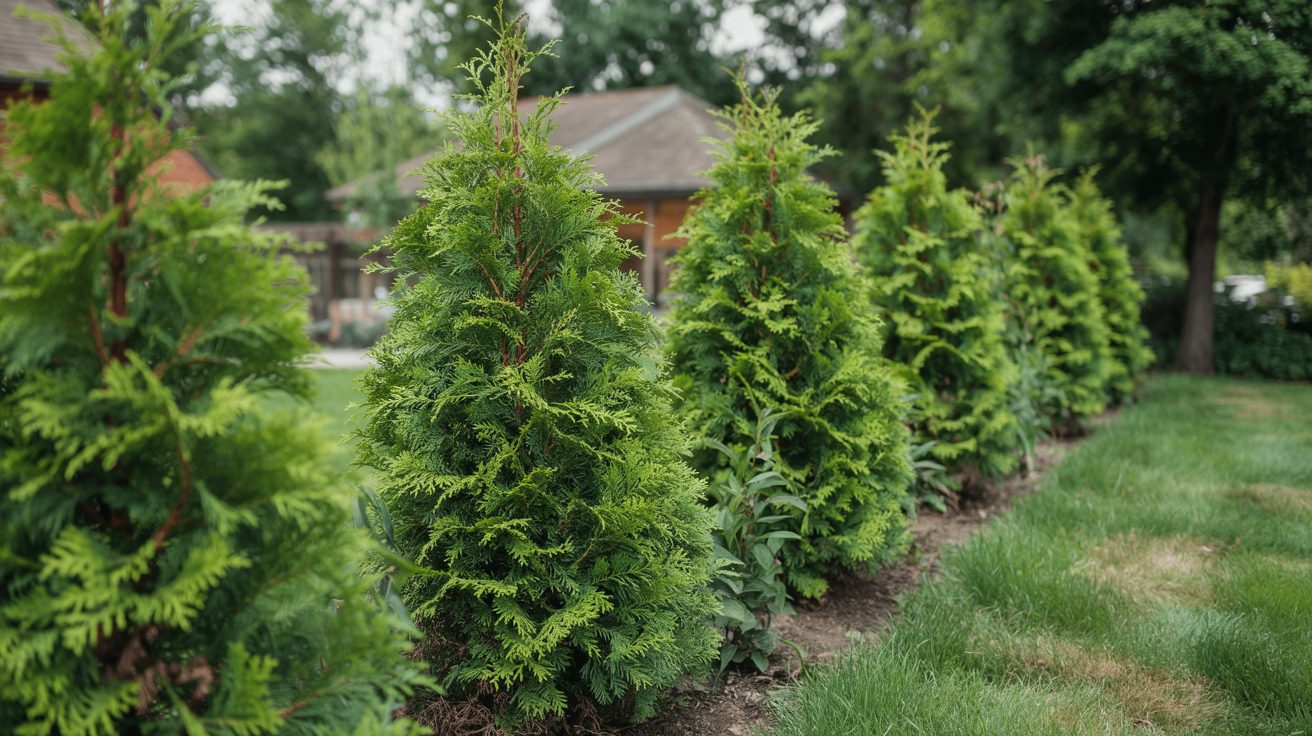
- Width matters: Columnar trees like Emerald Green arborvitae stay narrow; allow 4-5 feet per tree. Broad spreaders like Green Giant need 8-10 feet of spacing.
- Base density: Some fast growers go leggy at the bottom after 10 years. Shearing every spring keeps the lower canopy tight.
- Evergreen vs. deciduous: Evergreens screen year-round; deciduous trees lose leaves in winter, leaving only branching structure between you and neighbors.
Plant in a single staggered row rather than a straight line. Offset trees by half their spacing width to close gaps faster and create a more natural-looking screen.
Evergreen Conifers: The Fastest Dense Screens
Conifers dominate the privacy category for good reason. They grow fast, stay green through winter, and tolerate shearing better than most broadleaf alternatives.
These three carry most front yards and suburban lot lines across North America.
Thuja occidentalis 'Emerald Green' - Emerald Arborvitae
Zone 3–7 Easy
Thuja occidentalis 'Emerald Green' is the go-to narrow hedge for cold climates, holding a tight 3-4 foot width while reaching 12-15 feet tall over 10-15 years.
- Growth rate: Moderate, roughly 6-9 inches per year - slower than Green Giant but denser and far more manageable in tight spaces.
- Winter color: Stays a rich true green through Zone 3 winters with no bronzing, unlike many arborvitae cultivars.
- Spacing: Plant 3-4 feet apart for a tight hedge; 5 feet for a slightly looser screen that fills in within 3-4 seasons.
Deer browse Emerald Green arborvitae heavily in Zones 4–5, especially in winter when food is scarce. Use repellent spray from October through March in deer-pressure areas.
Thuja plicata 'Green Giant' - Green Giant Arborvitae
Zone 5–8 Easy
Nothing in the conifer world outpaces Thuja plicata 'Green Giant' for sheer coverage per year. It puts on 2-3 feet annually with irrigation in the first two seasons, and it deer-resistant, making it a smarter Zone 5-8 alternative to Leyland cypress.
- Mature size: Reaches 30-40 feet in most home landscapes, occasionally taller - plan for this before planting near structures.
- Soil tolerance: Handles clay, loam, and sandy soils as long as drainage is adequate; avoid chronically wet spots.
- Spacing: Allow 8-10 feet between plants for a natural screen; 6 feet for a formal hedge you intend to shear annually.
Cupressocyparis leylandii - Leyland Cypress
Zone 6–10 Medium
In Zones 6-10, × Cupressocyparis leylandii builds a tall screen faster than almost anything else, gaining 3-4 feet per year in good conditions. The tradeoff is long-term management - without annual shearing, it goes leggy at the base and can exceed 50 feet.
- Soil requirement: Needs well-drained soil; wet roots in winter cause Seiridium canker, a fungal disease that kills whole branches.
- Shearing schedule: Trim once in late spring and again in early fall to maintain density from ground to tip.
- Best use: Temporary screen while slower permanent plants mature, or as a long-term hedge managed aggressively at a fixed height.
| Tree | Zone | Growth/Year | Max Height | Deer Resistant |
|---|---|---|---|---|
| Emerald Green Arborvitae | 3–7 | 6–9 in | 12–15 ft | No |
| Green Giant Arborvitae | 5–8 | 2–3 ft | 30–40 ft | Yes |
| Leyland Cypress | 6–10 | 3–4 ft | 50–70 ft | Yes |
Evergreen Broadleaf Screens: Year-Round Privacy with Texture
Broadleaf evergreens don't replace conifers, but they fill a different visual role - large glossy leaves, interesting berries, and a more natural hedge look that suits certain landscapes better than a wall of flat green foliage.
Ilex × 'Nellie R. Stevens' - Nellie Stevens Holly
Zone 6–9 Easy
Nellie Stevens holly is a workhorse broadleaf for the Mid-Atlantic and Southeast, forming a dense, wind-resistant screen at 15-25 feet with glossy dark foliage year-round.
It grows 1.5-2 feet per year once established - slower than arborvitae, but the foliage is thicker and less prone to interior browning.
- Berries: Female plants produce clusters of bright red berries from fall through winter, even without a male pollinator nearby.
- Spacing: Plant 5-6 feet apart for a hedge; the pyramidal form fills gaps without aggressive shearing.
Prunus laurocerasus 'Schipkaensis' - Schipka Laurel
Zone 6–8 Easy
Schipka laurel earns its reputation in shady spots where conifers fail. Prunus laurocerasus 'Schipkaensis' tolerates heavy shade and still produces the large, leathery, dark-green leaves that make it one of the densest formal hedges available in Zones 6-8.
- Shade tolerance: One of the few privacy plants that screens effectively under a tree canopy or on a north-facing fence line.
- Fragrance: Produces small white flower spikes in late spring with a faint almond scent.
- Cold hardiness: Foliage may show wind burn in Zone 6 in open, exposed sites - plant near a structure for best results.
Magnolia grandiflora 'Little Gem' - Dwarf Southern Magnolia
Zone 7–9 Medium
'Little Gem' brings large, creamy-white fragrant blooms and glossy dark leaves to smaller properties where the standard southern magnolia would be overwhelming. At 20-25 feet tall, it suits urban lots in Zones 7-9 and maintains dense branching to the base with minimal pruning.
- Bloom season: Flowers from late spring through summer, sometimes into fall - longer than most magnolias.
- Litter: Drops large brown leaves throughout the year; avoid planting directly over patios or water features.
Pyracantha coccinea - Firethorn
Zone 6–9 Medium
Firethorn is the privacy plant that discourages human and animal intrusion simultaneously. Pyracantha coccinea carries sharp thorns along every branch, making it an effective deterrent when trained along a fence or wall.
The orange-red berry clusters persist from October through February.
- Training: Espaliered against a fence or wall, it covers 12-15 feet wide and 8-10 feet tall within 5 years.
- Wildlife value: Berries feed cedar waxwings, robins, and mockingbirds heavily in late fall.
- Maintenance: Prune in late winter; wear thick gloves - the thorns are serious.
Broadleaf evergreens like holly and laurel fill in more slowly than conifers but rarely develop the bare-base problem common in mature Leyland cypress and arborvitae hedges. They're often the better long-term choice for formal hedges under 15 feet.
Semi-Evergreen and Deciduous Options for Seasonal Screening
Not every privacy need is year-round. If you're screening a pool, patio, or vegetable garden where summer coverage matters most, deciduous and semi-evergreen plants can deliver dense summer screening with lower maintenance than most conifers.
Ligustrum japonicum - Japanese Privet
Zone 7–10 Easy
Japanese privet stays evergreen through mild winters in Zones 8-10 but drops some leaves below Zone 8 after hard freezes. Ligustrum japonicum shears exceptionally well into formal hedges and responds to heavy cutting by flushing dense new growth within weeks.
- Growth rate: Fast - 1.5-2 feet per year untrimmed; trim 2-3 times per growing season for a tight formal hedge.
- Invasive note: Birds spread seeds widely in Zones 8-10; check local invasive species lists before planting in the Southeast.
Viburnum × rhytidophylloides - Leatherleaf Viburnum
Zone 5–8 Easy
Leatherleaf viburnum fills the gap for shade-tolerant screening in Zones 5-8, where broadleaf options are limited. It holds its large, deeply textured leaves through most winters in Zone 6 and warmer, dropping them only in Zone 5 during hard stretches.
- Height: Tops out at 6-10 feet - suitable as an understory screen under taller trees.
- Berries: Red berries in summer turn black by fall; not as showy as holly but attractive to birds.
Carpinus caroliniana - American Hornbeam
Zone 3–9 Easy
American hornbeam is underused for privacy despite a natural range spanning Zone 3-9 - almost unmatched among deciduous screening trees.
Carpinus caroliniana holds brown marcescent leaves well into winter, providing partial screening even after the main leaf drop, while the dense twiggy branching blocks sightlines from about 30 feet away year-round.
- Fluted bark: The smooth, muscle-like trunk is visually distinctive up close - works as an ornamental as well as a screen.
- Site tolerance: One of the few privacy trees that performs in consistently wet, shaded locations like low spots near downspouts.
Cercis canadensis 'Forest Pansy' - Eastern Redbud 'Forest Pansy'
Zone 4–9 Easy
'Forest Pansy' redbud won't give you a solid evergreen wall, but it delivers something different: a multi-season ornamental screen with purple heart-shaped leaves in spring and dense summer canopy at 20-30 feet. It's an honest choice when aesthetics matter as much as function.
- Canopy density: Leafed out from May through October, it blocks views effectively; bare winter branching provides only partial screening.
- Best pairing: Plant in front of a fence or behind evergreen shrubs to fill the winter gap while 'Forest Pansy' provides summer canopy overhead.
Betula nigra 'Heritage' - River Birch
Zone 4–9 Easy
Multi-stem river birch forms a loose, natural screen 40-70 feet tall in Zones 4-9, with a particular talent for wet sites where most privacy trees struggle. The exfoliating cinnamon-tan bark on Betula nigra 'Heritage' adds four-season interest even when leaves are gone.
- Wet soil tolerance: One of few large trees that accepts standing water seasonally, making it valuable near drainage swales.
- Summer screening: The arching canopy creates effective dappled screening for second-floor windows; not suited for ground-level privacy near a fence.
In Zone 4, stick with Emerald Green arborvitae, American hornbeam, river birch, and Eastern redbud. Most broadleaf evergreens are Zone 6 minimum and will die or defoliate entirely below that threshold.
Spacing and Planting Guidelines
Proper spacing is where many privacy plantings fail. Trees planted too close compete for water and nutrients, leading to thin crowns and gap-prone lower branches within 8-10 years.
Too far apart, and the screen takes a decade to close.
For hedges over 50 feet long, consider alternating two species - for example, Green Giant with Nellie Stevens holly - to prevent a single pest or disease from wiping out the entire screen.
Which Privacy Tree Fits Your Situation?
These picks cover the most common real-world scenarios. Match your conditions to the right column and you'll skip most trial-and-error.
- Cold climate, narrow space (Zone 3-5): Emerald Green arborvitae at 4-foot spacing. Slow, but the most winter-reliable columnar evergreen available below Zone 5.
- Fast screen needed in 2-3 years (Zone 5-8): Green Giant arborvitae planted at 8-foot spacing with consistent irrigation the first two summers.
- Shady north-facing fence (Zone 6-8): Schipka laurel or leatherleaf viburnum - both tolerate heavy shade where most conifers thin out and die.
- Wet or low-lying site (Zone 4-9): River birch for tall canopy screening, American hornbeam for understory-level coverage near water.
- Security screen (Zone 6-9): Firethorn trained on a fence or wall - dense, thorny, and impenetrable at 8-10 feet.
- Warm climate, formal hedge (Zone 7-10): Japanese privet shears into a tight formal wall and regrows quickly after hard cuts.
- Small property, year-round interest (Zone 7-9): 'Little Gem' magnolia offers evergreen coverage under 25 feet with ornamental flowers from June through September.
For gardens in Zones 9-10 where tropical or subtropical plants are viable, privacy planting options expand significantly beyond the conifers that dominate colder zone lists.
What People Get Wrong About Privacy Plantings?
Even experienced gardeners make a handful of consistent mistakes with privacy trees that cost years of growth. These aren't rare edge cases - they show up repeatedly in established landscapes.
The most common issue is planting too close to structures. A Green Giant arborvitae planted 4 feet from a fence will eventually push the fence over as the root system and trunk base expand.
Keep conifers at least 6 feet from fences, and 10-12 feet from building foundations.
- Skipping utility checks: Always call 811 before digging. Screens along property lines frequently cross buried gas, water, or electrical lines.
- Buying the biggest available container: A 6-foot balled-and-burlapped tree often establishes slower than a 3-foot container tree of the same species - root disturbance at transplant sets large specimens back significantly.
- Ignoring the base: Fast-growing conifers naturally thin at the bottom after 15 years without shearing. Start trimming lightly from year one to keep lower branches receiving light.
- Monoculture plantings: A 200-foot Leyland cypress hedge is one fungal outbreak away from becoming a problem. Mix species wherever the budget allows.
A privacy screen is only as effective as its weakest plant. Losing one tree in a tightly spaced single-species row leaves a gap that takes 5+ years to close. Stagger your spacing and mix two species to insure against loss.
Soil drainage is frequently overlooked too. Most conifers planted in heavy clay or low-lying areas develop root rot within 3-5 years, long after the establishment phase when problems are harder to trace.
If your soil doesn't drain in 24 hours after a heavy rain, amend or raise the bed before planting. You can also browse strategies for improving dense soil that apply broadly to woody plant beds.
Finally, check your HOA documents before you plant. Many neighborhoods restrict tree height near property lines, and some prohibit specific species outright.
A call to your local cooperative extension office can confirm both zone suitability and any county-level restrictions on known invasive species like Japanese privet in the Southeast.
Once your screen is established, the maintenance drops sharply. Most mature privacy hedges need one annual shearing, spot-watering in drought years, and occasional checks for canker or scale insects.
The hard work is entirely in the first two seasons - get spacing, species selection, and establishment watering right, and the screen essentially runs itself from year three onward. Home gardeners who document what sun exposure looks like across their planting site in different seasons often avoid the most common siting mistakes.
Frequently Asked Questions
Leyland cypress and Green Giant arborvitae both gain 2–3 feet per year with adequate irrigation, making them the fastest readily available options for Zones 5–10 privacy screens.
Narrow columnar types like Emerald Green arborvitae need 3–4 feet between plants; broader growers like Green Giant and Nellie Stevens holly require 6–10 feet to prevent root competition and canopy crowding after year 8.
Schipka laurel and leatherleaf viburnum both screen effectively in full to partial shade in Zones 5–8, reaching 8–12 feet without thinning out the way most conifers do in low-light conditions.
River birch 'Heritage' and American hornbeam both tolerate seasonally wet or waterlogged soil in Zones 4–9, outperforming arborvitae and Leyland cypress which develop root rot in poorly draining ground within a few years.
Early fall is ideal in Zones 5–8 — soil is still warm enough for root growth but air temperatures reduce transplant stress; spring planting works well too, provided you water deeply every 3–4 days through the first summer.
Pin it for your next privacy trees: best varieties and growing tips project.