Silver in the garden does something no other color can - it catches light at dusk, amplifies neighboring blooms, and holds its own through the hottest weeks of summer.
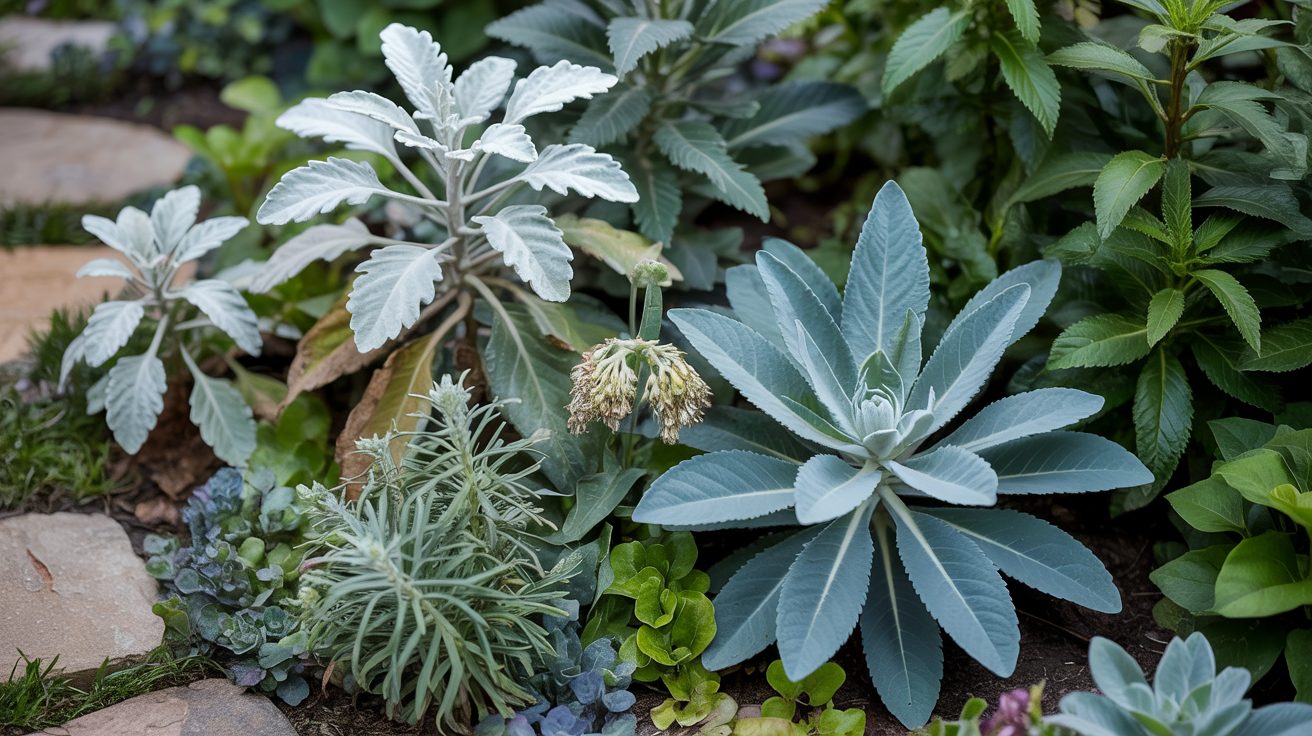
Whether you're working with silver foliage that frames colorful flowers or cultivars selected specifically for metallic, pale, or glaucous blooms, the effect is always cooler, calmer, and more deliberate than a plain green border.
These 12 varieties pair silver foliage with notable flowers across USDA zones 3–10. Most prefer full sun and lean, well-drained soil.
Several double as pollinator magnets. A few work beautifully as annuals outside their hardiness range.
Why Silver Plants Belong in Your Garden?
Most silver coloring in plants comes from fine surface hairs (trichomes) or a waxy bloom on leaf tissue that reflects UV light. That same adaptation is why so many silver plants excel in dry, full-sun conditions - their reflective surfaces reduce water loss.
Remember it later
Planning to try this recipe soon? Save it for a quick find later!
Silver foliage also acts as a visual buffer between clashing colors. Plant a silver-leaved specimen between hot orange and deep magenta, and the border suddenly looks intentional.
Pair it with soft white blooms and the result feels almost luminous at twilight.
Silver foliage loses its metallic sheen in dense shade. Even partial-shade tolerant varieties look their best with at least 4 hours of direct sun per day.
Perennial Silver Plants With Standout Blooms
These perennials return each year and offer the best long-term value for borders and pollinator gardens. Most establish quickly in their second season and require minimal intervention once settled.
Artemisia 'Powis Castle'
Zone 6–9 Easy
Artemisia 'Powis Castle' is grown almost entirely for its foliage - a dense, silver-gray mound of finely cut aromatic leaves that stays tidy all season. Flowers are sparse pale-yellow and not showy, but the plant's real job is structure.
- Habit: Mounded, 24-36 inches tall, stays compact without cutting back until spring.
- Deer resistance: Strong aromatic oils make it reliably unappealing to deer and rabbits.
- Soil: Thrives in poor, dry, well-drained soil - rich clay causes rot at the crown.
Lavandula x intermedia 'Silver Edge'
Zone 5–9 Easy
Among long-blooming lavender varieties, 'Silver Edge' stands out for its pronounced leaf silvering alongside strong purple flower spikes. The bloom runs 8-10 weeks from late spring into midsummer.
- Foliage: Narrow silver-edged leaves hold color even after flowers fade.
- Pollinators: Heavily visited by bumblebees and honeybees during peak bloom.
- Care: Cut back by one-third after flowering to prevent woodiness at the base.
Perovskia atriplicifolia (Russian Sage)
Zone 4–9 Easy
Perovskia atriplicifolia produces fine silver-white stems and gray-green leaves topped with clouds of tiny lavender-blue flowers from midsummer into fall. Few perennials match its combination of airy texture and drought endurance.
- Height: 36-48 inches - use it as a mid-border filler behind lower edging plants.
- Drought tolerance: Established plants need watering only every 10-14 days in summer heat.
- Winter care: Leave stems standing through winter and cut to 6 inches in early spring.
Nepeta x faassenii 'Walker's Low'
Zone 4–8 Easy
'Walker's Low' catmint offers gray-green aromatic foliage and long spikes of lavender-blue flowers across an 8-10 week window. Despite its name, it reaches 18-24 inches - a perfect mid-border height.
- Rebloom: Cut back by half after the first flush and expect a second bloom within 3-4 weeks.
- Pollinators: One of the top bumblebee attractors in the summer border.
- Companion planting: Pairs naturally with roses, where its silvery haze softens stiff canes.
Stachys byzantina 'Helen von Stein'
Zone 4–9 Easy
This lamb's ear cultivar was selected for its extra-large, thickly felted silver leaves and reduced tendency to flop. Short spikes of pink flowers appear in early summer.
- Spread: Expands slowly by basal offsets - divide every 3-4 years to keep it tidy.
- Texture: Leaves reach up to 8 inches long, roughly double the species size.
- Edging: Works at path edges where foot brushing releases no damage - it tolerates light contact.
Silver felted foliage like Stachys and dusty miller is prone to crown rot in humid climates with poor air circulation. Space plants at least 12 inches apart and avoid overhead watering.
Anchusa azurea 'Loddon Royalist'
Zone 4–8 Medium
Rough, slightly silvery-haired foliage supports vivid cobalt-blue flowers that few other perennials can match in intensity. 'Loddon Royalist' grows to 36-60 inches and self-seeds moderately, functioning as a biennial in colder zones.
- Blue intensity: Among the truest cobalt-blue flowering perennials, it outperforms most in that color range.
- Support: Stake at 18 inches to prevent toppling - stems are brittle once tall.
- Self-seeding: Deadhead about half the spent flowers to control volunteer seedlings.
Gaura lindheimeri 'Whirling Butterflies'
Zone 5–9 Easy
Silver-tinged foliage and wiry stems carry white to pale-pink flowers that flutter in any breeze, from midsummer well into the late-season border. Few plants sustain that extended bloom window with so little maintenance.
- Bloom season: Runs June through October without deadheading in most zones.
- Root depth: Develops a taproot by year two - transplant in year one or not at all.
- Design: Works at the front of deep borders where its airy habit won't block views.
Bold Statement Plants: Tall Silver Varieties
These two plants work as focal points rather than fillers. Both need full sun and sharp drainage, and both create genuine impact when given room to perform.
Eremurus × isabellinus 'Silver Dollar'
Zone 5–8 Medium
Few flowering plants match the vertical drama of foxtail lily - silver-blue basal leaves support towering cream to white flower spires reaching 4-6 feet in late spring. This is a plant that stops visitors mid-stride.
- Summer dormancy: Foliage dies back completely by midsummer - mark its position to avoid digging up fleshy roots.
- Drainage: Roots rot instantly in wet winter soil - raised beds or slopes are essential in clay zones.
- Spacing: Plant crowns 24 inches apart - they widen significantly by year three.
Centaurea montana 'Amethyst in Snow'
Zone 3–8 Easy
Silver-mottled bracts surround blue-mauve flowers with white centers on this perennial cornflower - a combination that looks hand-painted. It blooms heavily in spring and again in early fall if cut back after the first flush.
- Cold hardiness: One of the hardiest on this list, reliable to Zone 3 without mulching.
- Drought tolerance: Established plants manage on natural rainfall in most temperate zones.
- Height: Compact at 12-18 inches - works in the front third of mixed borders.
Centaurea montana can spread aggressively in the Pacific Northwest. In zones 7–8 west of the Cascades, divide clumps every 2 years or site it where spreading is welcome.
Annuals and Short-Season Silver Varieties
Annuals let you test silver combinations before committing bed space to perennials. These three establish fast and make an impact within the same season they're planted.
Senecio cineraria (Dusty Miller)
Zone 8–10 Easy
Senecio cineraria is the most widely available silver-foliage annual, grown for intensely white-felted leaves at 8-14 inches. Occasional yellow daisy flowers appear in heat, but most gardeners pinch them to keep foliage energy strong.
- Container use: Excellent as a "thriller-filler" component in summer pots alongside vibrant purple annuals.
- Heat tolerance: Handles reflected heat from paving and walls better than most foliage annuals.
- Watering: Water when the top inch of soil dries out - overwatering causes root rot faster than drought.
Rudbeckia hirta 'Silver Shield'
Zone 4–8 Easy
This cultivar brings something the standard black-eyed Susan doesn't - distinctly glaucous silver-green leaves beneath bold yellow flowers. For growing black-eyed Susans with extra visual punch, 'Silver Shield' is a reliable upgrade on the species.
- Heat tolerance: More compact and less prone to legginess than straight Rudbeckia hirta in humid summers.
- Bloom time: Flowers July through September when deadheaded every 10-14 days.
- Seed start: Start indoors 6 weeks before last frost for first-year flowers in cold zones.
Eschscholzia californica 'Silver Anniversary'
Zone 6–10 Easy
California poppy with silver-gray foliage and prolific orange-yellow flowers that open each morning and close at night. Direct-sow in early spring and seeding directly into beds yields faster establishment than transplanting.
- Self-seeding: Drops seed freely in zones 8-10 - treat it as a permanent colony once established.
- Bloom speed: Flowers appear just 60-70 days from direct sowing.
- Soil: Poor, sandy soil produces the most silvery foliage - fertile beds push green growth instead.

Side-by-Side Comparison
These six frequently purchased varieties are easiest to compare before making a selection. The table covers the traits that matter most when matching a plant to a specific garden spot.
| Plant | Zone | Height | Sun | Best Use |
|---|---|---|---|---|
| Artemisia 'Powis Castle' | 6–9 | 24–36 in | Full sun | Foliage anchor, deer-resistant border |
| Perovskia atriplicifolia | 4–9 | 36–48 in | Full sun | Back border, drought garden |
| Stachys byzantina 'Helen von Stein' | 4–9 | 8–12 in | Full sun/part shade | Path edging, ground cover |
| Nepeta 'Walker's Low' | 4–8 | 18–24 in | Full sun | Rose companion, pollinator bed |
| Eremurus 'Silver Dollar' | 5–8 | 48–72 in | Full sun | Focal point, cutting garden |
| Senecio cineraria | 8–10 | 8–14 in | Full sun/part shade | Container, annual edging |
How Silver Foliage Behaves in Humid Climates?
Silver plants evolved in dry, Mediterranean, or semi-arid regions. Their trichome-covered surfaces trap moisture against leaves in humid air, which invites fungal problems.
That doesn't mean they won't grow in humid zones - it means they need specific handling.
In zones 7-9 with wet summers, removing spent flower stems promptly improves airflow around the crown and reduces fungal pressure on silver-leafed plants significantly.
- Soil amendment: Incorporate coarse grit (at least 20% by volume) into planting holes in clay-heavy humid zones.
- Mulch gap: Keep mulch 3-4 inches away from the crown - contact with wet organic mulch is a leading cause of rot.
- Spacing: Add 25% more spacing than the tag recommends to improve air circulation between plants.
- Best performers in humidity: Nepeta, Gaura, and Rudbeckia 'Silver Shield' handle humidity better than woolly-leaved types like Stachys and Senecio.
In the Southeast (zones 8–9 with humid summers), Artemisia 'Powis Castle' benefits from hard cutting in late summer rather than spring — this removes fungal-damaged stems before fall regrowth begins.
Choosing by Garden Situation
Use these scenario-based shortcuts to match the right silver plant to your specific conditions. Many gardeners discover that exploring ornamental plant combinations across zones becomes much easier once a silver anchor is in place.
- Dry, full-sun bank or slope: Artemisia 'Powis Castle' and Perovskia are your most reliable choices - both endure weeks without irrigation once established after year one.
- Pollinator-focused border: Lead with Nepeta 'Walker's Low' for bees and add Lavandula 'Silver Edge' nearby - the two bloom in overlapping windows and attract different species.
- Tall focal point in a cutting garden: Eremurus 'Silver Dollar' provides unmatched height; pair it with Anchusa 'Loddon Royalist' for a blue-and-silver cutting combination.
- Container or annual edging: Senecio cineraria works in any zone as an annual and costs little to replace - ideal for testing silver combinations before buying perennials.
- Cold zones (3-4) with limited options: Centaurea montana 'Amethyst in Snow' is the hardiest on this list and one of the few silver-mottled plants rated to Zone 3 without winter protection.
- Long-season color into October: Gaura 'Whirling Butterflies' outlasts nearly everything else in the border and keeps late-season coneflowers company without competing for space.
Frequently Asked Questions
Perovskia atriplicifolia and Nepeta 'Walker's Low' are top performers in full sun, both reliably hardy to Zone 4 and capable of blooming for 8–10 weeks with minimal supplemental water once established in their second season.
Lavandula 'Silver Edge,' Nepeta 'Walker's Low,' and Perovskia atriplicifolia are consistently the strongest pollinator attractors among silver-foliaged plants, drawing bumblebees, honeybees, and hoverflies from late spring through September.
In humid zones 7–9, amend planting soil with at least 20% coarse grit, keep mulch 3–4 inches away from crowns, and increase plant spacing by 25% to reduce the fungal rot that affects woolly-leaved types like Stachys and Senecio most severely.
Senecio cineraria, Stachys byzantina 'Helen von Stein,' and Centaurea montana tolerate partial shade of 3–4 hours, but their silver coloring becomes noticeably less intense — expect greener foliage with less than 5 hours of direct sun daily.
Pin it for your next silver flowers: 15 stunning varieties project.