Roses have a reputation for being fussy, and some genuinely are - but plenty of modern varieties bloom all summer with almost no spraying, tolerate part shade, and survive zone 4 winters without a second thought. The challenge isn't growing roses.
It's picking the right one for your site before you plant.
From disease-resistant shrubs to fragrant climbers and compact miniatures, this list covers 12 proven rose varieties organized by type and use. We highlight zone range, light needs, and maintenance level for each so you can match a rose to your actual garden conditions.
Shrub Roses for Low-Maintenance Gardens
Shrub roses are the most forgiving category for newer gardeners. They respond well to hard cutbacks, rarely need spraying, and most garden centers stock at least two or three reliable cultivars year-round.
Remember it later
Planning to try this recipe soon? Save it for a quick find later!
Knock Out (Rosa 'Knock Out')
Zone 5–10 Easy
Introduced in 2000, Knock Out rewrote the expectations for disease-resistant roses. It blooms continuously from late May through hard frost, producing hot-pink semi-double flowers without any spray program.
- Disease resistance: Exceptional blackspot and powdery mildew resistance - one of the best in its class.
- Size: Stays 3-4 feet tall and wide with one hard annual cutback in early spring.
- Use: Mass planting, mixed borders, or low hedging along walkways.
Shrub 'The Fairy' (Rosa 'The Fairy')
Zone 4–9 Easy
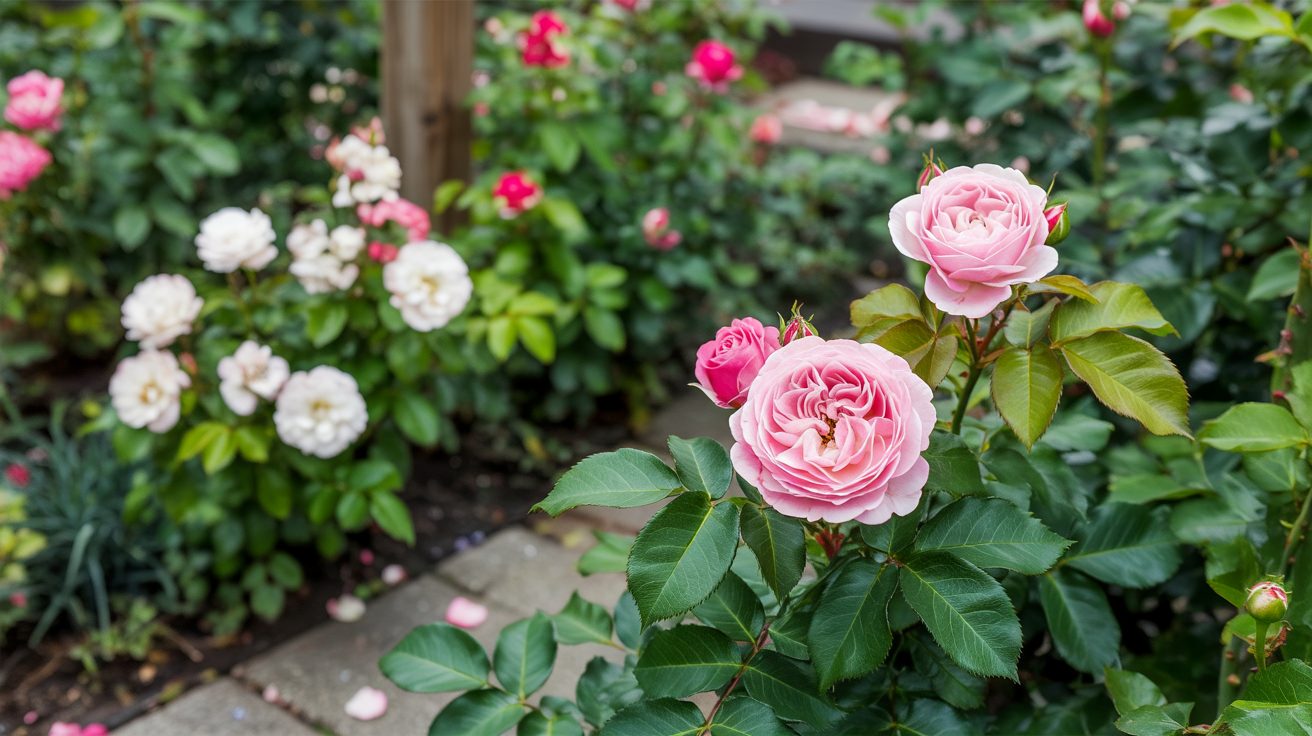
'The Fairy' is a polyantha-type that mounds to just 2-3 feet, smothering itself in small clusters of soft pink flowers from June through October. It tolerates poorer soils and light shade better than almost any other rose on this list.
- Habit: Spreading, mounding - excellent as a low edging or front-of-border plant.
- Shade tolerance: Blooms reliably with as few as 4 hours of direct sun.
- Maintenance: Deadheading extends bloom, but the plant reblooms even without it.
Cut Knock Out back to 12–18 inches in late winter or early spring before new growth starts. This keeps the plant from becoming woody at the base and extends its productive life by years.
David Austin 'Graham Thomas' (Rosa 'Graham Thomas')
Zone 5–9 Medium
'Graham Thomas' is among the most recognized English roses worldwide - its deep honey-gold cupped blooms carry a strong tea and violet fragrance.
You can train it as a 4-6 foot shrub with regular pruning, or let it reach 8-10 feet on a wall as a short climber.
- Fragrance: Rich and consistent across multiple flushes through the season.
- Flexibility: Responds well to cutting back hard in spring to maintain shrub form.
- Disease: Moderate blackspot resistance - remove fallen leaves in autumn.
Floribundas and Grandifloras for Repeat Color
Floribundas produce flowers in clusters rather than single high-centered blooms, which means more color per stem and more visual impact across a long season. Grandifloras split the difference between floribunda abundance and hybrid tea size.
Floribunda 'Iceberg' (Rosa 'Iceberg')
Zone 4–9 Easy
'Iceberg' is the white rose most widely planted in public gardens for good reason. It produces heavy flushes of lightly fragrant white blooms from early summer through fall, and it's one of few roses that performs acceptably in partial shade.
- Shade tolerance: Manages with 4-6 hours of direct sun - useful on east-facing fences.
- Disease resistance: Better than most hybrid teas, though blackspot can appear in wet summers.
- Height: Compact at 3-4 feet, easy to fit in mixed borders without overcrowding neighbors.
Grandiflora 'Queen Elizabeth' (Rosa 'Queen Elizabeth')
Zone 5–9 Medium
'Queen Elizabeth' grows tall - 5-6 feet in most gardens - with large, clear-pink blooms on long stems that work both in the garden and in a vase. It combines the cluster habit of a floribunda with bloom size closer to a hybrid tea.
- Use: Back-of-border plant, informal screen, or cut-flower garden staple.
- Repeat bloom: Consistent flushes through the season when spent blooms are removed promptly.
- Feeding: Responds visibly to monthly balanced fertilizer during the growing season.
'Iceberg' comes in both a bush form and a climbing form. The climber reaches 10–15 feet and works well on fences where you want white blooms without heavy maintenance. Both are the same cultivar, grafted differently.

Hybrid Teas for Cut Flowers
Hybrid teas are the classic florist rose - large, high-centered blooms on long single stems. They reward consistent feeding and monitoring, making them better suited to gardeners willing to put in the work.
Hybrid Tea 'Mister Lincoln' (Rosa 'Mr. Lincoln')
Zone 5–9 Medium
'Mister Lincoln' produces some of the deepest red blooms in the hybrid tea category, and its fragrance is exceptional - rich, true rose scent that carries across a garden. Stems reach 18-24 inches, ideal for cutting.
- Blackspot: Susceptible - apply a preventative fungicide every 10-14 days in humid climates.
- Feeding: Feed every 3-4 weeks with a rose-specific fertilizer from bud break through August.
- Height: Reaches 4-6 feet; benefits from deadheading after each bloom cycle.
Hybrid Tea 'Peace' (Rosa 'Peace')
Zone 5–9 Medium
Introduced in 1945 and still widely sold, 'Peace' carries large blossoms in a yellow-to-pink blend that shifts color as blooms age. It's moderately vigorous at 3-5 feet and performs best when fed consistently - skip the fertilizer and bloom quality drops noticeably.
- Bloom: Large, 5-6 inch flowers with good vase life when cut at bud stage.
- Disease: Average blackspot resistance - remove infected leaves immediately to slow spread.
- Availability: Found at almost every garden center, often bare-root in late winter.
Hybrid teas grafted onto rootstock have a bud union at the base of the stem. In zones 5–6, mound 8–10 inches of loose soil or mulch over that union before the first hard freeze, then remove it in spring as temperatures stabilize.
Climbing Roses for Fences and Arbors
Climbing roses don't actually grip surfaces - they need to be tied to supports. Once trained, they can cover a fence completely within three growing seasons and provide years of seasonal bloom with minimal attention.
Climbing 'New Dawn' (Rosa 'New Dawn')
Zone 5–9 Easy
'New Dawn' is the most widely grown repeat-blooming climber in North America, and it earns that status. Flexible canes reach 10-15 feet and handle cold winters better than most climbers in its class.
- Light: Tolerates partial shade - one of few climbers that performs on a north-facing fence in the right zone.
- Bloom: Pale pink semi-double flowers from June through frost, with the heaviest flush in early summer.
- Training: Tie horizontal canes to encourage more lateral shoots - this dramatically increases flower count.
Climbing 'Zéphirine Drouhin' (Rosa 'Zéphirine Drouhin')
Zone 5–9 Medium
Nearly thornless canes make 'Zéphirine Drouhin' the practical choice near high-traffic areas - along a fence gate, a porch railing, or a narrow arbor. Deep cerise-pink blooms carry a strong fragrance and appear on both old and new wood.
- Thorns: Nearly absent - safe to train and handle without heavy gloves.
- Shade: Performs in partial shade, making it useful on structures that get less than 6 hours of sun.
- Height: 8-12 feet; responds well to thinning old canes every 2-3 years.
Polyantha 'Cécile Brünner' (Rosa 'Cécile Brünner')
Zone 5–9 Easy
Tiny blush-pink blooms in tight clusters give 'Cécile Brünner' the look of a miniature bouquet at every branch tip. As a shrub, it stays 3-4 feet; as a climber, it can reach 12 feet on a wall with little encouragement.
- Flowers: Each bloom is barely an inch wide - perfect for cutting into small arrangements.
- Vigor: Surprisingly fast-growing as a climber, especially in zones 7-9 where it remains semi-evergreen.
- Disease: Above-average disease tolerance for an older cultivar.
Miniature Roses for Containers and Small Spaces
Miniature roses follow the same care rules as full-sized varieties but in a much smaller footprint. They're not just scaled-down decorations - many are genuinely disease-resistant and straightforward to grow in pots on a sunny patio.
Miniature 'Sunny Knock Out' (Rosa 'Sunny Knock Out')
Zone 5–10 Easy
At 12-18 inches tall, 'Sunny Knock Out' brings the same disease-resistant genetics as its full-sized relatives into a container-friendly package. Bright yellow blooms repeat continuously through the season with no spray program needed.
- Container use: Works well in pots as small as 12 inches wide; water every 2-3 days in summer heat.
- Disease resistance: Inherits the Knock Out line's blackspot resistance - rarely needs fungicide.
- Winter storage: In zones 5-6, move containers to an unheated garage once temperatures drop below 20°F.
Miniature roses in containers are effectively one zone less hardy than in-ground plants. A 'Sunny Knock Out' rated to zone 5 may need winter protection in a container in that same zone — treat container minis as zone 6 plants for overwintering purposes.
Side-by-Side: How These Varieties Compare
Use this table to quickly cross-reference zone, light needs, height, and relative maintenance before committing to a purchase. Height figures reflect typical garden performance, not maximum potential.
| Variety | Zone | Height | Sun | Maintenance |
|---|---|---|---|---|
| Knock Out | 5–10 | 3–4 ft | Full sun | Low |
| Iceberg | 4–9 | 3–4 ft | Part shade OK | Low |
| Graham Thomas | 5–9 | 4–6 ft | Full sun | Medium |
| New Dawn (Climber) | 5–9 | 10–15 ft | Part shade OK | Low |
| Zéphirine Drouhin | 5–9 | 8–12 ft | Part shade OK | Medium |
| Mr. Lincoln | 5–9 | 4–6 ft | Full sun | High |
| Sunny Knock Out (Mini) | 5–10 | 12–18 in | Full sun | Low |
| The Fairy | 4–9 | 2–3 ft | Part shade OK | Low |

Managing Blackspot and Powdery Mildew
Both diseases are fungal, but they behave differently. Blackspot spreads via water splash on leaves; powdery mildew spreads in dry conditions with high humidity.
Knowing which you're dealing with changes how you treat it.
Variety selection is your first line of defense. Knock Out, 'The Fairy,' and 'New Dawn' resist blackspot far better than hybrid teas - choosing one of these on a shady or wet site will save you considerable frustration.
When you do need to manage disease, removing spent blooms and infected leaves reduces spore load before you reach for a spray.
- Blackspot prevention: Water at the base, never overhead; mulch to reduce soil splash onto lower leaves.
- Powdery mildew: Improve air circulation by spacing plants at least 3 feet apart and pruning crowded centers.
- Spray timing: Apply fungicide preventatively in early spring rather than reactively once symptoms appear - reactive spraying rarely clears an established infection.
- Resistant varieties: Knock Out, Iceberg, 'The Fairy,' and 'New Dawn' rarely need fungicide even in wet zones 5-7.
Which Rose Fits Your Garden?
Rather than browsing by appearance, start with your site constraints. Zone, available sun, and how much time you want to spend are more useful filters than bloom color when you're choosing a first or second rose.
- You want color with almost no maintenance: Knock Out or 'The Fairy' - both tolerate neglect, skip spraying entirely, and rebloom without deadheading.
- You have a partially shaded fence: 'New Dawn' or 'Zéphirine Drouhin' - both climb to 10+ feet and perform in sites with 4-5 hours of direct sun. For similar screening on a fence line, 'New Dawn' is faster.
- You're cutting flowers for the house: 'Mister Lincoln' for fragrance and classic form, 'Queen Elizabeth' if you want cluster stems, 'Peace' if you want large single blooms with color variation.
- You garden in a small space or containers: 'Sunny Knock Out' miniature - 12-18 inches, continuously blooming, disease-resistant, and perfectly scaled to a patio pot.
- You want fragrance above everything else: 'Graham Thomas' and 'Zéphirine Drouhin' lead the list; 'Mister Lincoln' is the strongest among hybrid teas.
- Zone 4 winters are your reality: 'Iceberg,' 'The Fairy,' and 'Cécile Brünner' are your most cold-hardy options, all rated to zone 4 with normal winter dormancy.
When comparing roses to other structural garden plants, evergreen shrubs offer year-round coverage but can't match the seasonal flower impact of a well-chosen rose on the same structure. The two categories work well together - shrubs for winter backbone, roses for summer display.
If you're working with a garden that also includes food crops, roses make good neighbors.
Unlike tomato plants, which need consistent irrigation schedules, established shrub roses like Knock Out tolerate short dry spells without visible stress once their root system matures in year two or three.
For gardens in regions where native plant selection matters for pollinators, single and semi-double roses like Knock Out and 'New Dawn' offer far more accessible pollen than fully double hybrid tea blooms, which pollinators often can't navigate.

Frequently Asked Questions
Knock Out and 'The Fairy' are the most forgiving options for beginners — both are rated zones 4–9, require no spray program, and rebloom through fall without regular deadheading.
'Iceberg,' 'The Fairy,' 'New Dawn,' and 'Zéphirine Drouhin' all bloom reliably with 4–6 hours of direct sun, making them your best options for east-facing fences or spots with afternoon shade.
'New Dawn' typically reaches 10–15 feet in zones 5–9, while 'Zéphirine Drouhin' tops out at 8–12 feet; both need to be tied to supports since climbing roses don't grip surfaces on their own.
'Sunny Knock Out' miniature grows to 12–18 inches and performs well in containers as small as 12 inches wide, but needs watering every 2–3 days in summer and winter protection in zones 5–6.
'Graham Thomas' carries a rich honey-and-tea scent rated among the strongest in the David Austin lineup, and 'Mister Lincoln' produces the most intense classic rose fragrance among hybrid teas in zones 5–9.
Pin it for your next types of roses: best varieties and growing tips project.