Picking the wrong heater for a hot tub is an expensive mistake - one that shows up in your energy bill every single month.
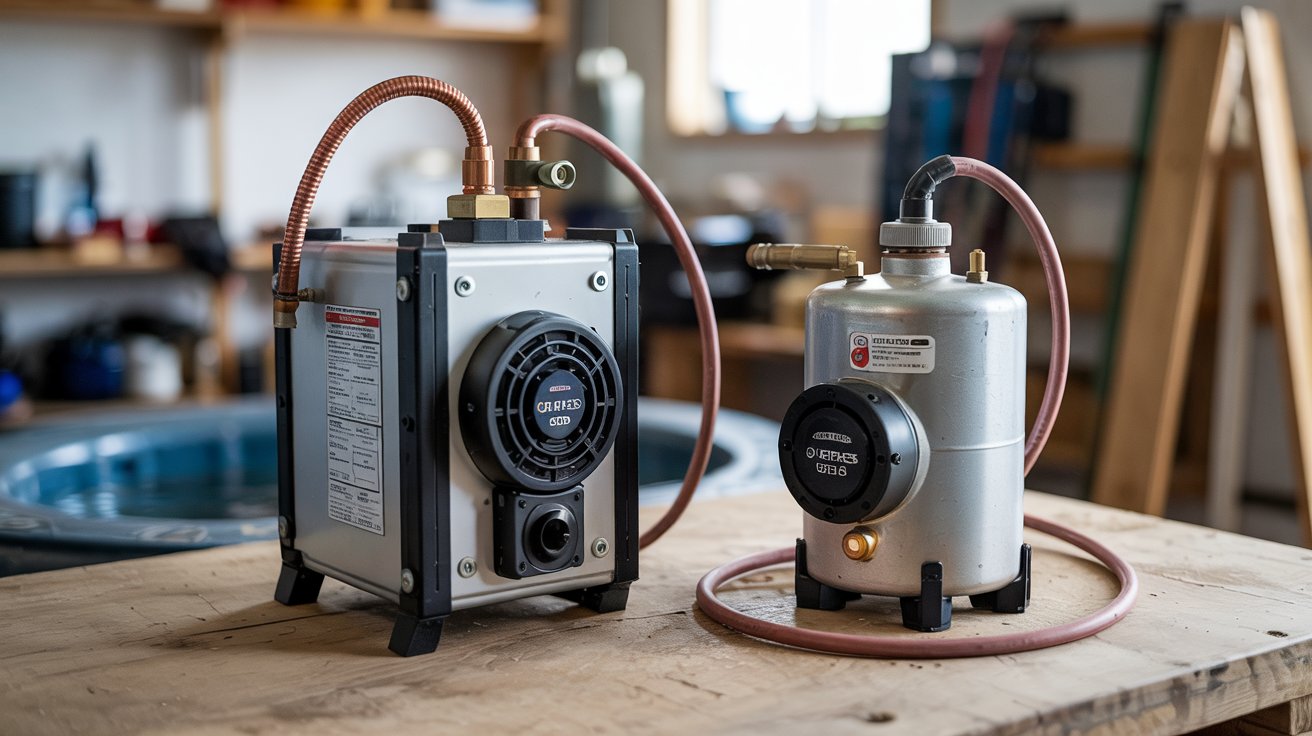
Whether you're retrofitting an outdoor spa or planning a new installation, the choice between a tankless water heater and a storage tank model shapes how fast your tub heats, what you pay upfront, and how the system holds up through cold winters.
Hot tubs aren't like a household shower. They hold 300 to 500 gallons of water, sit outdoors in variable temperatures, and often run on irregular schedules - weekend soaks, seasonal use, or daily evening dips.
Those conditions change the math significantly. A system that works well for an indoor bathroom may underperform badly when it's tasked with maintaining spa water through a January freeze.
According to DOE heater guidance, tankless models are 8-34% more efficient than storage water heaters and commonly last around 20 years - but that efficiency advantage depends heavily on how and where the unit runs.
For outdoor hot tub setups, climate, tub size, and usage frequency all influence which option delivers better value.
This comparison covers both hot tub heating costs and system performance so you can make a confident, install-ready decision - no cold surprises, no oversized equipment bill.
Choosing between tankless and storage tank heaters for a hot tub depends on climate, tub size, usage frequency, and upfront budget. Tankless units win on long-term efficiency and lifespan; storage tanks cost less upfront and install more simply.
Neither is universally better — your outdoor setup decides.
In climates with hard winters (Zone 5 and colder), outdoor tankless units require freeze-protection features or insulated enclosures. Without that, even a quality unit can crack its heat exchanger in a single hard freeze. Factor in freeze protection before finalizing your choice.
How Tankless and Storage Heaters Work for a Hot Tub?
A storage tank heater keeps a large volume of water - typically 40 to 80 gallons - continuously heated and ready to draw from. For a hot tub, that means the tub refills or recirculates from a pre-heated reserve, but standby heat loss is constant.
Remember it later
Planning to try this recipe soon? Save it for a quick find later!
A tankless unit, by contrast, fires up only when water flows through it, heating on demand without storing anything.
For outdoor spa setups, both types need dedicated gas lines or high-amperage electrical circuits. Tankless gas models also require proper venting - a real constraint on covered patios or enclosed spa areas.
As the DOE tankless overview notes, on-demand systems avoid continuous standby heat loss, which matters when a tub sits idle for days between uses.
| Feature | Tankless | Storage Tank |
|---|---|---|
| Heating method | On demand, flow-activated | Continuous, stored reserve |
| Standby heat loss | Minimal | Ongoing (adds to cost) |
| Outdoor venting | Required (gas models) | Required (gas models) |
| Electrical draw | High surge (electric models) | Lower continuous draw |
| Space needed | Wall-mount, compact | Floor-standing, larger footprint |
| Recirculation support | Needs compatible pump | Built-in loop support |
Performance and Efficiency for Outdoor Spa Use
Efficiency isn't just a spec-sheet number - it's the difference between a heater that pays for itself in three years and one that never does. For hot tubs specifically, the standby loss problem hits storage tanks hardest.
A tank sitting outside in 30°F air loses heat faster than the same tank in a heated garage, raising your gas or electric bill without heating a single bather.
Tankless units sidestep that problem entirely. The DOE's heater comparison confirms tankless systems are 8-34% more efficient, and they can last roughly 20 years - nearly double the lifespan of a typical storage tank.
Over a 15-year period, that lifespan difference can mean avoiding one full replacement cycle.
For propane vs natural gas decisions on outdoor appliances, the same logic applies here: fuel type affects both operating cost and installation complexity.
Delivery speed is a different story. A storage tank has 40-80 gallons of hot water ready immediately. A tankless unit heats water as it flows, so a large tub refill - say, 400 gallons from cold - takes longer without supplemental heating.
Most hot tub owners using tankless systems maintain a base temperature and reheat incrementally rather than draining and refilling often.
According to ENERGY STAR savings data, a qualifying gas tankless heater can save a typical household about $95 per year on gas bills versus a standard storage model. For a dedicated hot tub heater running year-round, those savings compound quickly.
Maintenance frequency differs too. Storage tanks need an anode rod replaced every 3-5 years and an annual flush to clear sediment.
Tankless units need descaling - especially in hard-water areas - roughly once a year, and filters cleaned every few months.
- No standby heat loss — only burns fuel when water is actively flowing
- Longer service life (~20 years) means fewer full replacement cycles
- Compact wall-mount design suits tight outdoor spa enclosures
- Better annual operating cost over time for frequent users
- Larger hot water reserve handles fast, high-volume tub refills
- Lower upfront purchase and installation cost
- Handles cold-climate outdoor placement without added freeze gear
- Simpler recirculation loop integration for spa systems

Costs, Installation, and Maintenance
Budget shapes most hot tub heater decisions before anything else does. Storage tank units run $300-$900 for the unit itself; tankless models typically start around $800 and can reach $2,000 or more for high-output gas versions suited to large outdoor tubs.
Installation labor adds $300-$1,500 on top, depending on whether gas lines or electrical panels need upgrading.
For outdoor kitchens, decks, and spa pads, those electrical and gas upgrade costs are often shared across projects - check your outdoor kitchen budget if you're planning both at once, since trenching a gas line once saves money versus doing it twice.
Tankless units carry higher upfront costs but lower operating costs over time, as the DOE's demand heater page confirms. The break-even point depends on how often the tub runs, local energy prices, and climate - typically 5-8 years for frequent users.
| Task | Tankless | Storage Tank |
|---|---|---|
| Descaling / flush | Annually (hard water areas) | Annually |
| Anode rod | Not required | Every 3–5 years |
| Filter cleaning | Every 3–6 months | Not required |
| Freeze protection | Required outdoors (cold zones) | Insulated jackets help |
| Expected service life | ~20 years | ~10–15 years |
If you install a gas tankless heater outdoors, budget an extra $150–$300 for a weatherproof enclosure rated for your climate zone. Exposed heat exchangers in freezing temps are the leading cause of premature tankless failure in outdoor spa setups.
Climate, Tub Size, and When Each Option Makes Sense
No single heater wins for every outdoor setup. A 300-gallon tub used every weekend in Arizona calls for a completely different solution than a 500-gallon spa used twice a week in Minnesota.
The three variables that matter most are climate zone, tub capacity, and usage frequency - and they interact in ways that shift the calculus fast.
According to the DOE's on-demand heater guide, tankless systems offer particular advantages for irregular hot-water usage and space-constrained installs - both common in outdoor spa settings. In cold climates, though, extra insulation and heating strategies become essential regardless of which type you choose.
Warm climates (Zone 7-10): Tankless units perform at their best here - no freeze risk, lower ambient heat loss, and consistent on-demand efficiency. Cold climates (Zone 3-6): Storage tanks with insulated jackets handle freezing temps more reliably. If you go tankless in a cold zone, install it in a protected enclosure and use a unit with built-in freeze protection. Outdoor temperatures below 20°F can reduce a tankless unit's flow rate by up to 30%, slowing reheat times significantly.
Small tubs (under 350 gallons): Either type works well. A mid-range tankless unit (140,000-180,000 BTU gas) can reheat a 300-gallon tub within 1-2 hours. Large tubs (400-600 gallons): Storage tanks provide a larger thermal reserve for fast temperature recovery. Tankless units at this scale need higher BTU ratings and may require two units in parallel, which raises cost considerably. A pool type comparison shows similar sizing trade-offs at larger water volumes.
Daily users: Tankless wins on operating cost - the tub stays at temperature via short recirculation cycles rather than holding stored heat all day. Occasional or seasonal users: Storage tanks make more sense. If the tub sits idle for days, a tankless unit's efficiency advantage shrinks. You're not losing standby heat you never generated. Weekend-only users in mild climates often find a well-insulated storage tank the simpler, cheaper solution with minimal trade-off.

Verdict: Which Hot Tub Heater Type Should You Choose?
If you use your hot tub four or more times per week and live in a mild climate, a tankless unit almost always comes out ahead over a 5-10 year window. The efficiency savings and longer lifespan absorb the higher upfront cost, and the compact footprint suits most outdoor spa pads.
For seasonal users, cold-climate installs, or anyone working within a tight upfront budget, a well-insulated storage tank is the more practical answer.
The DOE's full heater guide makes clear that efficiency gains are usage-driven - for smaller or less frequent hot-water draws, the tankless payback period stretches out considerably. You can see a similar cost-vs-use trade-off when comparing fuel-type appliances for other outdoor setups.
Planning the full outdoor setup? Budget early - pool installation pricing and hot tub heating both scale with climate and infrastructure.
And if you're adding an outdoor storage shed nearby, that's often an ideal weatherproof housing option for a tankless unit in colder regions.
- Frequent, year-round hot tub users who prioritize lower long-term operating costs
- Mild-climate installs where freeze protection isn't a major concern
- Compact outdoor spa pads where floor space is at a premium
- Seasonal or weekend-only users where standby loss is limited and upfront cost matters more
- Cold-climate setups (Zone 5 and below) where freeze risk complicates tankless installs
- Large-volume tubs needing fast hot-water reserve without high-BTU tankless units
For a broader look at outdoor heating and spa decisions, the same framework - climate, capacity, frequency - applies across most outdoor appliance purchases.
And if you're weighing total backyard costs, sod installation pricing and hardscaping often run alongside hot tub projects in full outdoor renovations.
Frequently Asked Questions
Tankless heaters are 8–34% more efficient than storage models and avoid standby heat loss, making them the more efficient choice for frequent hot tub users in mild climates.
Yes, but you need a unit rated at 140,000 BTU or higher for tubs over 300 gallons. Outdoor installs in cold climates also require freeze-protection features.
Tankless heaters last roughly 20 years with proper maintenance. Storage tank heaters typically last 10–15 years before requiring replacement.
ENERGY STAR-rated tankless gas heaters save about $95 per year over standard storage models. For hot tubs used daily, savings typically offset the higher upfront cost within 5–8 years.
Most jurisdictions require a permit for gas line work or electrical panel upgrades connected to an outdoor heater. Check local codes before starting installation.
Pin it for your next tankless vs tank water heater for hot tub project.