Most people buy the wrong hauling tool for their yard - not because they didn't research, but because they measured budget first and terrain second. A cheap single-wheel barrow on a sloped property leads to spilled mulch and sore shoulders.
A bulky four-wheel cart in a narrow urban plot just blocks the gate.
This guide cuts that confusion out. We cover the core cart-vs-wheelbarrow decision, map real price bands to honest feature expectations, and list specific 2026 picks for the most common yard tasks.
You'll also find a maintenance checklist and warranty notes - because a $180 cart that lasts three seasons is no bargain. Pairing the right hauler with the right grip and hand protection makes every load safer and faster.
No pick here requires a contractor's budget. Entry-level options start around $50, while heavy-duty steel carts top out near $400.
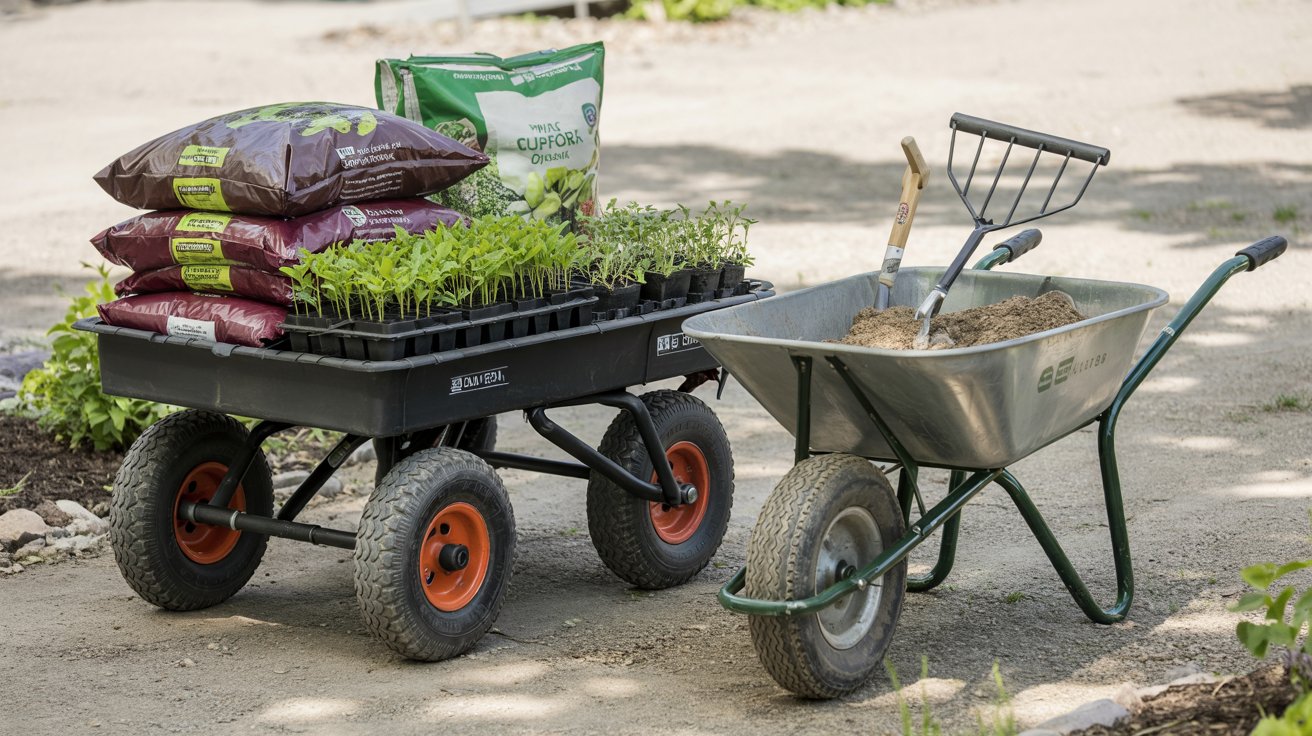
Choosing between a garden cart and a wheelbarrow comes down to terrain, load type, and gate width. Four-wheel carts handle heavy, stable loads on flat ground; wheelbarrows offer better maneuverability on slopes and tight paths.
Budget ranges from $50 entry-level to $400+ heavy-duty.
Buyer's Path and Quick Picks
The fastest way to narrow your choice is to answer two questions: How wide are your garden gates, and does your yard slope? A standard garden cart is roughly 24-28 inches wide, and many residential gates run just 36 inches - that leaves little margin on each side.
Remember it later
Planning to try this recipe soon? Save it for a quick find later!
Wheelbarrows are typically 20-22 inches wide, which makes them the default for tight spaces.
Terrain matters just as much as width. Four-wheel carts distribute weight evenly across a flat bed, which makes them stable for bagged mulch, pavers, or potted plants.
On a slope, that same stability can work against you - a loaded cart on a grade wants to roll. A single-wheel wheelbarrow lets you pivot and control descent with your body weight.
Load type is the third filter. If you're hauling loose material like compost or gravel, a dump cart saves significant time.
If you're moving balled-and-burlapped trees or stacked stone, a flat-bed cart with a low deck wins. According to This Old House's barrow guide, most homeowners need a capacity between 4 and 6 cubic feet for typical seasonal tasks.
Here are three anchor picks to frame the rest of this guide:
- Best Overall: A 6 cu. ft. poly-tray dump cart with pneumatic tires, priced $150-$200. Handles mulch, soil, and garden waste with one-handed dumping.
- Best Value: A 4 cu. ft. steel-tray wheelbarrow in the $60-$90 range. Solid for weekend tasks, fits through any standard gate.
- Best for Small Spaces: A compact folding garden wagon at $80-$130. Stores flat, fits narrow paths, and handles lighter loads up to 150 lbs.
A wheelbarrow buying overview from Do It Best's buying guide reinforces that capacity, tray size, and wheel type are the three specs to lock down before price-shopping. We'll work through each in detail in the sections below.
Cart vs Wheelbarrow: Core Differences by Task
The names get used interchangeably at hardware stores, but they behave very differently under load. A wheelbarrow uses one or two front wheels and two rear legs - you tilt and push, balancing the load between your arms and the wheel.
A garden cart uses four wheels and sits level on its own, so you pull or push without holding anything up.
That difference shapes everything from fatigue to spill risk. According to USDA load-handling guidance, centering weight low and close to the wheels reduces strain on arms and lower back - a principle four-wheel carts handle automatically, while wheelbarrow users must manage manually.
For mulch runs on flat ground, a dump cart with a poly bed and pneumatic tires is hard to beat. You load it at the pile, pull it across the lawn, and tip without bending.
For moving pavers or flagstone, a low-deck flatbed cart keeps heavy material centered and reduces tipping risk.
Tight paths change the math fast. A narrow urban plot with 30-inch raised beds and gravel walkways is wheelbarrow territory.
The single-wheel design lets you thread between beds without clipping edges.
- Mulch delivery (flat): Use a dump cart, 6 cu. ft., with pneumatic tires. One trip handles a full half-cubic-yard bag.
- Pavers or stone: Use a flat-bed steel cart with a 600-lb+ rating. Keep load centered over the axle.
- Tight garden paths: Use a single-wheel barrow, 4-5 cu. ft. It fits gaps that would stop any cart.
- Sloped yard: A two-wheel barrow adds front stability on grades while keeping the narrow footprint.
The cart stability comparison at Do It Best notes that four-wheel carts significantly outperform wheelbarrows when loads exceed 200 pounds on level ground. Below that threshold on flat terrain, either tool works fine.
Knowing your typical load weight before you buy saves a return trip to the store.
Before buying, load a laundry basket with a 50-lb bag of sand and carry it through your garden gate. If it's awkward, measure that gate opening — many carts won't clear 36 inches with room to steer.
Pairing your cart with smart summer garden maintenance habits keeps hauling tasks shorter and more predictable across the season.

Budget Tiers: What to Expect in Each Price Range
Price in this category tracks material quality and wheel spec more than brand name. A $55 poly-tray wheelbarrow and a $55 metal-tray version perform similarly for one season - the differences show up in year two and three.
Knowing what each tier actually delivers helps avoid over-buying for a weekend warrior's workload or under-buying for a working farm.
The 2026 wheelbarrow price benchmarks from This Old House show most homeowner-grade carts fall between $80 and $220, with heavy-duty contractor models jumping sharply above $300. That gap reflects frame gauge, axle design, and tire quality - not just cosmetics.
Entry-level ($50-$90) buys a steel-tray or poly-tray wheelbarrow with a solid tire and a painted steel frame. Solid (foam-filled) tires never go flat but transmit more vibration.
These are fine for occasional seasonal use - light mulching, leaf hauling, or moving potted plants.
Mid-range ($90-$180) is where pneumatic (air-filled) tires appear reliably. Pneumatic tires absorb bumps and roll more easily over uneven ground.
Bed sizes grow to 5-6 cubic feet, and some dump-cart designs enter this tier with a basic latch mechanism.
- Frame material: Powder-coated steel resists rust far better than plain painted steel. Look for it at mid-range and above.
- Wheel type: Pneumatic tires (10-inch diameter minimum) make a real difference on gravel paths and lawn.
- Bed material: High-density poly beds resist denting and rust; steel beds handle heavier point loads like stone.
- Dump mechanism: A pinned dump latch should release with one hand - test it in-store before buying.
Premium ($180-$300) delivers heavier-gauge steel frames, 13-inch pneumatic tires, and rated load capacities of 600 lbs or more. Brands in this range typically include a 2-3 year warranty on frame welds.
The USDA's safe load-handling principles note that stable axle placement and low center of gravity are key durability factors - both improve noticeably at this price point.
Heavy-duty ($300-$420) covers contractor and farm-grade carts with welded steel beds, 1,200-lb capacities, and commercial-grade axles. Most homeowners don't need this tier unless they're regularly moving bulk stone, firewood, or equipment.
Flat-free foam tires feel like an upgrade, but on rough gravel or uneven ground they make the cart harder to push and transfer more vibration to your wrists. If your yard isn't paved or smooth lawn, stick with pneumatic.
Investing in a solid mid-range cart complements other tool upgrades - like picking a hose that won't kink under pressure or adding a drip kit for consistent watering - making your full tool kit more reliable season over season.
Top Picks for 2026: Best Overall, Best Value, Best for Hills
These picks aren't brand sponsorships - they represent the feature combinations that show up repeatedly as best-in-class across independent reviews and user feedback. Specs are drawn from current retail listings and confirmed against This Old House's 2026 barrow ratings for accuracy.
Each model below covers a distinct use case. No single pick is best for every yard, which is why task alignment matters more than any single star rating.
| Pick | Type | Capacity | Tire | Price Range | Best For |
|---|---|---|---|---|---|
| Best Overall | Dump cart, poly bed | 6 cu. ft. / 600 lbs | 13-in pneumatic | $150–$195 | Flat yards, mulch, compost |
| Best Value | Steel-tray wheelbarrow | 4 cu. ft. / 300 lbs | 16-in pneumatic | $65–$85 | General hauling, tight gates |
| Best for Hills | Two-wheel barrow, steel | 5 cu. ft. / 350 lbs | Dual 15-in pneumatic | $110–$145 | Slopes, uneven terrain |
| Best Heavy-Duty | Flatbed steel cart | Flatbed / 1,200 lbs | 13-in pneumatic (x4) | $320–$395 | Stone, firewood, equipment |
| Best Small Space | Folding garden wagon | 2.5 cu. ft. / 150 lbs | 8-in solid | $80–$125 | Narrow paths, light loads |
The best overall dump cart earns its spot for versatility. A poly bed won't rust, the 13-inch pneumatic tires handle lawn and gravel equally, and the dump latch lets one person unload without crouching.
It covers 90% of homeowner hauling tasks.
The two-wheel barrow for hills is an underrated pick. A second front wheel adds lateral stability on a 10-15% slope without adding significant width.
Per the wheel-type comparison guide, dual-front designs reduce tipping force by roughly 40% compared to single-wheel models on grades.
- Add-on: Liner tray - A removable poly liner for steel-bed carts speeds cleanup and prevents rust from wet compost or manure.
- Add-on: Cover/tarp - A fitted cargo bungee net keeps loose material from blowing off on windy days.
- Add-on: Replacement tire kit - Buy one when you buy the cart. Pneumatic tires do go flat, and mid-season replacement kits sell out at hardware stores.
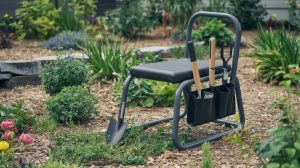
Keeping your tools organized between hauls is easier when you also invest in a kneeler that doubles as a seat and stay on top of keeping your cutting edges sharp.

Care, Maintenance, and Warranty Essentials
The most common reason garden carts fail early isn't overloading - it's neglect between seasons. A flat tire left unmounted over winter develops a flat spot.
A steel bed left with wet compost sitting in it for two weeks starts pitting. Neither failure is covered under warranty because both are user-caused.
Research from OSU AgrAbility's ergonomic guidance highlights that proper loading and unloading habits reduce both user strain and mechanical stress on cart frames - meaning how you use the cart directly affects how long it lasts.
On warranty: most mid-range carts carry a 1-year warranty on parts and welds. Premium models step up to 3 years on structural components.
Read the fine print - many warranties exclude tire wear, rust on untreated steel, and damage from overloading.
Common failure modes by tier include bent axles on overloaded entry carts, cracked poly beds on models left in prolonged UV exposure, and seized axle nuts on carts that never get lubricated. All three are preventable.
A cart that's cleaned, lubricated, and stored properly regularly outlives its warranty by years.
Poly beds won't rust, but extended UV exposure causes brittleness after 5–7 years. Store poly-bed carts in shade or under a cover during hot summers to slow UV degradation.
For a complete seasonal toolkit, pairing your cart with a rain barrel for water storage and a reliable drip system setup covers most mid-season hauling and watering needs together. Rounding out your outdoor tool decisions with compatible gear makes each task faster and less physically demanding.
Don't overlook whether a drip or sprinkler system fits your layout when planning cart access around irrigation lines.
Frequently Asked Questions
A garden cart has four wheels and sits level on its own, supporting loads up to 1,200 lbs. A wheelbarrow uses one or two wheels and requires the user to balance the load manually, with typical capacities of 300–400 lbs.
Most standard homeowner wheelbarrows are rated for 300–400 lbs. Exceeding that limit stresses the axle and frame welds, which are the two most common failure points on entry and mid-range models.
No — four-wheel carts can roll uncontrolled on slopes above 10%. A two-wheel barrow or single-wheel barrow gives better directional control on grades and is the safer choice for sloped yards.
A folding garden wagon in the $80–$125 range handles narrow paths best. Most fold flat to under 6 inches for storage and carry 150 lbs, which covers typical container and planting tasks in tight urban gardens.
A dump cart saves significant effort for mulch. A 6 cu. ft. dump cart lets one person unload a full half-yard of mulch in seconds without shoveling, versus manually emptying a standard flat-bed cart scoop by scoop.
Pin it for your next best garden cart and wheelbarrow project.